
CETME: Roller-delayed bolt and the stock's two holes
The CETME weighs over 5kg with 20 rounds, while an AK with 30 is around 4kg. The two holes in the stock are for storing the locking pins during disassembly.
English · Original discussion in Spanish · Published
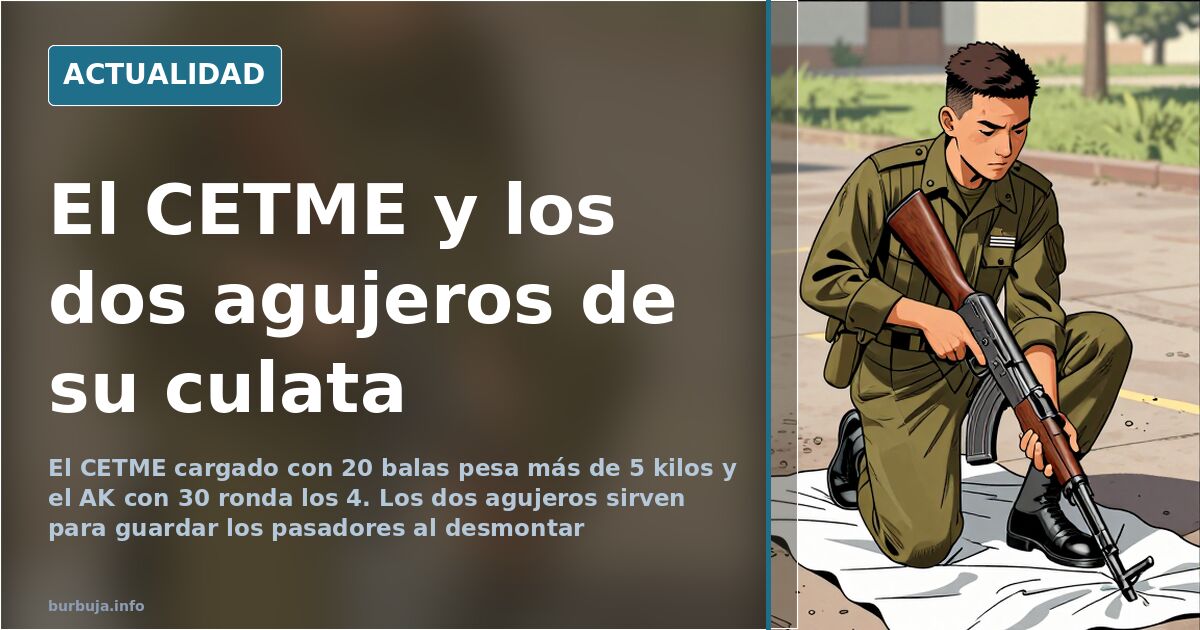
The CETME and its two holes: what they really are for
A left-handed soldier fires the regulation rifle, and spent casings fall into his sleeve. A right-handed comrade discovers he can mount the weapon by striking the butt firmly against the ground. Not everyone is clear on why the CETME has two holes in its stock. The short answer: they are for storing the locking pins of the locking box when the rifle is disassembled. Not for hanging on a nail, nor for ventilation.
What are the two holes in the CETME stock for?
The holes house the locking box pins—those that connect the stock to the receiver—to prevent them from getting lost during disassembly. It is the car equivalent of a cup holder: useful for placing a drink, but it adds nothing to performance. Anyone who has been through an army arsenal knows this well: remove the pins, store them there, and reassemble. Without this spot, maintenance becomes an odyssey of loose parts.
Another explanation circulates: that the holes provide access to the recoil spring and allow air in to prevent a vacuum that would slow the bolt cycle. It is repeated, but it does not hold up against those who have disassembled the weapon many times. The spring lives inside the stock tube, true, and the roller-delayed system needs a powerful spring to return the bolt to its position after each shot. This does not turn the holes into vents.
Is the CETME's roller-delayed system a copy of the MG42?
Here the nuance matters. The roller-delayed blowback with retarded mass recoil came with the German MG42, which taxatively demonstrated its reliability. But the leap to the rifle was made by the STG45 from Mauser, from which the CETME, the Ameli, and later the Heckler & Koch family draw. To say the CETME is a copy of the machine gun is to stop halfway: same principle, different scale.
The genealogy is not a minor detail for understanding the industrial result. On this basis, and as summarized by a veteran gunsmith in the thread, H&K developed the G3 under Spanish license and took the market. The CETME is considered a Spanish construct, and rightly so, but the German mind was behind the development. Recognizing this does not take away merit: it takes away self-praise. The filter of NATO standard requirements explains, according to that same gunsmith, why some designs succeed and others do not: meeting them without significant donations is not within everyone's reach. The British had to hire H&K to rescue their SA80; the French, despite a more reliable bullpup than other contemporary models like the FAMAS G2, have looked to the 416/417 for the replacement of specific units.
Weight, recoil, and the myth of the indestructible weapon
The numbers do not support the epic narrative. The CETME loaded with 20 cartridges weighs over 5 kilos; an AK with 30 is around 4. The lightweight version, however, remains just as heavy as the Soviet rifle, and there is evidence that calibers of similar power have been fired from the hip during an advance by trained personnel. The 7.62 recoil is manageable if the weapon is shouldered properly; poorly supported, it punishes.
The fruta of being indestructible is more debatable. A gunsmith summarizes it without sugarcoating: a weapon works when all its adjustments are consolidated, and what broke most was the locking box mount. The inner pins, when loose, ruined grouping at 50 meters. Then came the complaints that everyone had been given a bad rifle.
The lottery of materials was real. In the same company, dilapidated specimens coexisted, which shook the disassembled bolt and fired two or three shots with the selector in semi-automatic, along with nearly new units distributed sparingly. Hence the acronym repeated in whispers: CETME, Every Corner Has Hidden Shit.
The caliber, casings, and ammunition destruction
In civilian version, the weapon was associated with the .307 W, a cartridge designed for lever-action weapons that never caught on in Spain. It destroyed the casings and made decent reloading impossible, which for a reloader is half a hobby lost. This is added to the ejection: casings are ejected to improbable places, and in competition, there have been casing impacts on bald heads or inside a sandal.
Precision is not its strong point compared to a bolt-action. A Swiss K31 fires in 7.5x55 and reloads by shaving; the CETME is something else. At 200 meters, however, if you hit, the report is a family of mourning. With 5.56, lethality does not drop: the hydrokinetic effects of both calibers are severe, and getting wounded is, to a large extent, a matter of luck.
In Iraq, legionaries carry by hand close to 11 kilos between machine gun, spare barrel, and backpack, with some spare parts secured with American tape. Let them talk about the chopo.
A left-handed soldier fires the regulation rifle, and spent casings fall into his sleeve. A right-handed comrade discovers he can mount the weapon by striking the butt firmly against the ground. Not everyone is clear on why the CETME has two holes in its stock. The short answer: they are for storing the locking pins of the locking box when the rifle is disassembled. Not for hanging on a nail, nor for ventilation.
What are the two holes in the CETME stock for?
The holes house the locking box pins—those that connect the stock to the receiver—to prevent them from getting lost during disassembly. It is the car equivalent of a cup holder: useful for placing a drink, but it adds nothing to performance. Anyone who has been through an army arsenal knows this well: remove the pins, store them there, and reassemble. Without this spot, maintenance becomes an odyssey of loose parts.
Another explanation circulates: that the holes provide access to the recoil spring and allow air in to prevent a vacuum that would slow the bolt cycle. It is repeated, but it does not hold up against those who have disassembled the weapon many times. The spring lives inside the stock tube, true, and the roller-delayed system needs a powerful spring to return the bolt to its position after each shot. This does not turn the holes into vents.
Is the CETME's roller-delayed system a copy of the MG42?
Here the nuance matters. The roller-delayed blowback with retarded mass recoil came with the German MG42, which taxatively demonstrated its reliability. But the leap to the rifle was made by the STG45 from Mauser, from which the CETME, the Ameli, and later the Heckler & Koch family draw. To say the CETME is a copy of the machine gun is to stop halfway: same principle, different scale.
The genealogy is not a minor detail for understanding the industrial result. On this basis, and as summarized by a veteran gunsmith in the thread, H&K developed the G3 under Spanish license and took the market. The CETME is considered a Spanish construct, and rightly so, but the German mind was behind the development. Recognizing this does not take away merit: it takes away self-praise. The filter of NATO standard requirements explains, according to that same gunsmith, why some designs succeed and others do not: meeting them without significant donations is not within everyone's reach. The British had to hire H&K to rescue their SA80; the French, despite a more reliable bullpup than other contemporary models like the FAMAS G2, have looked to the 416/417 for the replacement of specific units.
Weight, recoil, and the myth of the indestructible weapon
The numbers do not support the epic narrative. The CETME loaded with 20 cartridges weighs over 5 kilos; an AK with 30 is around 4. The lightweight version, however, remains just as heavy as the Soviet rifle, and there is evidence that calibers of similar power have been fired from the hip during an advance by trained personnel. The 7.62 recoil is manageable if the weapon is shouldered properly; poorly supported, it punishes.
The fruta of being indestructible is more debatable. A gunsmith summarizes it without sugarcoating: a weapon works when all its adjustments are consolidated, and what broke most was the locking box mount. The inner pins, when loose, ruined grouping at 50 meters. Then came the complaints that everyone had been given a bad rifle.
The lottery of materials was real. In the same company, dilapidated specimens coexisted, which shook the disassembled bolt and fired two or three shots with the selector in semi-automatic, along with nearly new units distributed sparingly. Hence the acronym repeated in whispers: CETME, Every Corner Has Hidden Shit.
The caliber, casings, and ammunition destruction
In civilian version, the weapon was associated with the .307 W, a cartridge designed for lever-action weapons that never caught on in Spain. It destroyed the casings and made decent reloading impossible, which for a reloader is half a hobby lost. This is added to the ejection: casings are ejected to improbable places, and in competition, there have been casing impacts on bald heads or inside a sandal.
Precision is not its strong point compared to a bolt-action. A Swiss K31 fires in 7.5x55 and reloads by shaving; the CETME is something else. At 200 meters, however, if you hit, the report is a family of mourning. With 5.56, lethality does not drop: the hydrokinetic effects of both calibers are severe, and getting wounded is, to a large extent, a matter of luck.
In Iraq, legionaries carry by hand close to 11 kilos between machine gun, spare barrel, and backpack, with some spare parts secured with American tape. Let them talk about the chopo.
Summary of a discussion on Burbuja.info - Foro de economía, actualidad y política., translated from Spanish and reviewed before publication. Read the full discussion (253 replies).
More summaries
-
106th Anniversary of La Legión. "If Ceuta falls, Spain falls." The King's whereabouts unknown...
Ceuta's president, **Juan Jesús Vivas**, praises the 'legionary spirit' on La Legión's 106th anniversary. The city faces a security crisis.
-
Is the System Deliberately Making Spaniards Dumber?
A recent controversy suggests the system has intentionally dulled the Spanish population, but lacks evidence or data.
-
The 'anti-system' woman: A label that unravels upon definition
Can a woman be anti-system? One participant argues she is the system; another, that the right dictates and the left executes.
-
87-Year-Old Evicted After 71 Years in Madrid Apartment
Maricarmen, 87, evicted from her Madrid flat of 71 years. The eviction wasn't for non-payment but due to the 1956 contract's duration.
-
Third protest this week at Alcalá migrant center
A third demonstration in a week targets Alcalá de Henares migrant center. Who is organizing, what is demanded, and why critics call it futile.
-
Spain's Summer Cultural War: Provocation vs. Freedom
Spain's summer streets spark debate over women's fashion, highlighting tensions between tradition, personal freedom, and public display.