
CDs and vinyl nobody plays anymore are now worth nothing
Collections of CDs and vinyl records left unplayed for over a decade: sentimental value wins out over a market that barely pays anything for them anymore.
English · Original discussion in Spanish · Published
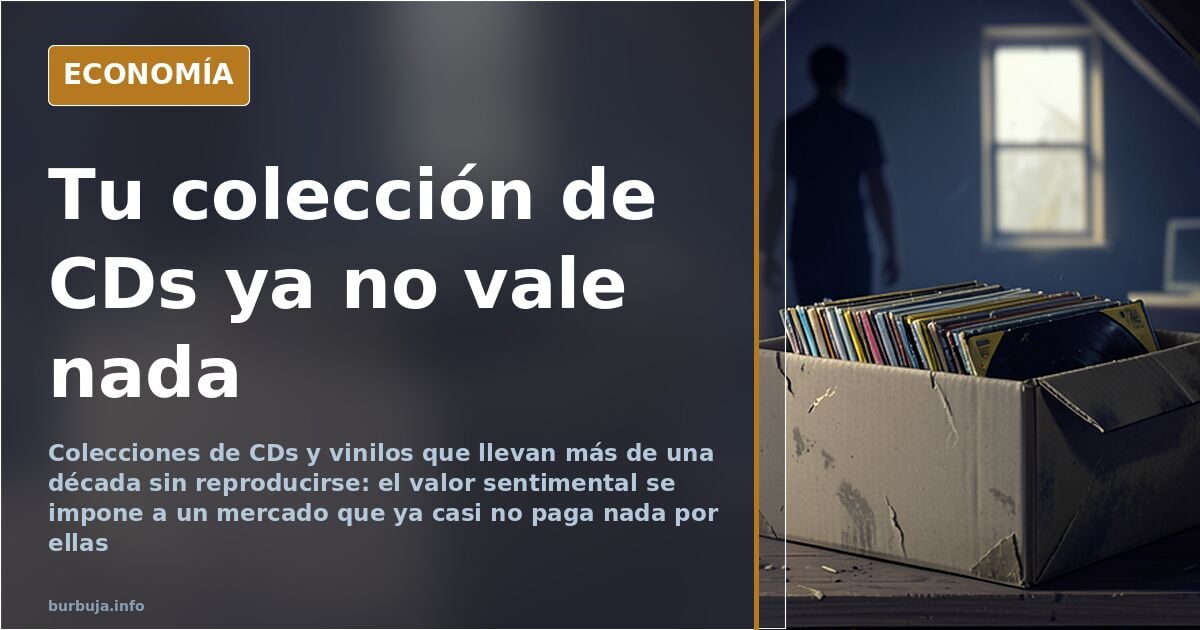
A CD nobody plays is now only worth keeping as a memento
How much is a collection of CDs and vinyl records you haven't touched in years actually worth? Financially, next to nothing. Sentimentally, everything. That is the tension running through a conversation about shelves full of records nobody listens to anymore, where someone delivers the verdict without anesthesia: "Sell them while they're still worth something. Or throw them out." The diagnosis is harsh but hard to argue with: if you haven't peine the box in over a decade, you never will.
Sentimental value versus market value
The first line of resistance is memory. Some people keep **more than 150 cassettes** bought in the nineties, with music ranging from that era back to the seventies, and they're clear about it: "I couldn't care less that they're worth zero, they represent a period of my life." The physical record as a biographical object, not as an asset. It isn't an economic stance, it's an emotional one, and that's why you don't argue with it using spreadsheets.
The problem arises when that affection gets mistaken for wealth. Most of these collections aren't worth what their owners think. The serious collectibles market does exist, but it's narrow and demands rare editions, pristine condition and informed buyers. A shelf of nineties records isn't a treasure: it's inventory taking up square meters.
Why nobody plays CDs anymore: streaming ate it alive
Habit killed the format. Someone who still keeps **around 100 CDs** from their teenage years admits the last time they played one was "roughly in 2010," and that today they listen to music on YouTube, even songs they already own physically, because "a couple of clicks is more convenient." Convenience doesn't negotiate. The disc stays on the shelf; the listening peine somewhere else.
Some defend the format's quality over streaming video, with a higher bitrate on CD than on YouTube, while others point out that today's playback model is designed to wedge ads between songs. Reasonable arguments. None of them puts the disc back in the player.
Real collecting exists, but it isn't yours
The exception proves the rule. There's the case of an acquaintance with **rare collector's CDs**, unique editions hunted worldwide at considerable prices. That market exists. What doesn't exist is a market for the average collection accumulated without any criteria: second-hand stalls are full of titles nobody is looking for, and the professional buyer can tell the rare item from the pile without hesitation.
The uncomfortable conclusion is that a collection's value depends less on how many records you own than on how many of them are irreplaceable. Almost never are.
What really ends up in the trash
The sharpest parallel in the discussion isn't about music: it's the school trophy cups, the neighborhood medals and the family portraits that end up in cardboard boxes at the flea market. Objects nobody wanted to throw away and nobody wanted to buy. The ambition to keep everything ends up on a street stall.
There lies the dry irony: we hold on for decades to things only we value, and we call it a legacy.
Also available in: Deutsch
Summary of a discussion on Burbuja.info - Foro de economía, actualidad y política., translated from Spanish and reviewed before publication. Read the full discussion (30 replies).
More summaries
-
From vinyl to gold: which collectibles will hold value and which will fall
Gold, Japanese optics and graded cards versus sneakers, Funkos and retro video games: which collectibles will survive the generational handover and which won't.
-
Spain's Social Security sold Iván Redondo a Madrid flat €466,679 below market value
Spain's Social Security sold Iván Redondo a flat in Madrid's Salamanca district for €1,120,921 — €466,679 below its market value. The discount comes close to 30%.
-
Basque Government loses track of 40,000 recipients of its minimum income scheme
The Basque Government cannot locate 40,000 recipients of the RGI, Spain's Basque minimum income benefit, 60% of the total. The monthly cost exceeds 40 million euros.
-
Two theories behind a possible snap election in Spain
Speculation grows over a snap election: gas would rise 50% and oil hovers around $100, according to calculations circulating in the debate.
-
Nuclear alert over Iran: fear of radioactive cloud reaching Pakistan and India
A forum user warns that a nuclear explosion in Iran would affect Pakistan and India. We review the technical feasibility and the track record of such predictions.
-
Spain: Sánchez weighs sacking Transport Minister as poll shows PSOE slump
A poll puts Spain's PSOE below 95 seats, opening the door to Óscar Puente's exit. We explain what lies behind the noise and what a poll really measures.