
Catholic Hispanism Debate Sparks After Mayor Threatened
A forum thread uses threats against a mayor in Ciudad Real to project a scenario of constant terror under Catholic Hispanism.
English · Original discussion in Spanish · Published
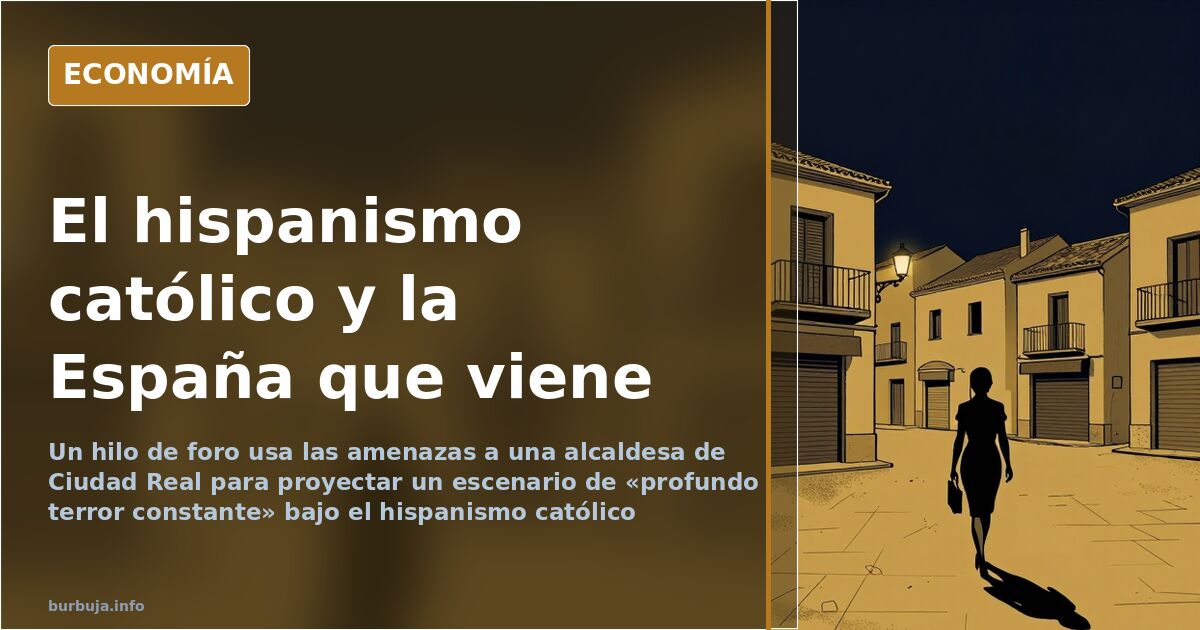
Catholic Hispanism and the Blurring of Spain
The mayor of Fernán Caballero, in Ciudad Real, has been threatened with death if she does not resign, according to a message circulated on social media. This is the real trigger for a discussion that starts with a specific case and ends up projecting a scenario of "profound constant terror" for the Iberian Peninsula under a hypothetical Catholic Hispanism. The starting point is not speculation: there is a threatened councilwoman, an assignment attributed to a gang, and a municipal worker fired at the center of the story. From there, the analysis shoots off towards identity, demographics, and economics.
What Peine in Fernán Caballero
The case is the anchor of everything. A mayor from a municipality in Ciudad Real receives death threats conditioned on her resignation. In the circulating account, mention is made of a South American woman responsible for the threats, a son kidnapped by a gang, and a dismissed city hall worker as a possible origin of the conflict. None of these details are confirmed and should be treated as what they are: unverified leads.
What is relevant for economic analysis is not the sensationalism of the event, but the pattern hinted at: the importation of pressure methods typical of shadow economies and territories where violence has become a service with a price tag. Some recall that in Mexico, a good number of mayors and police chiefs are killed every year, and that most victims are those who do not corrupt themselves or those who corrupted themselves with the rival side. The parallel is uncomfortable, but it rests on a fact: organized violence has costs, prices, and clients.
The "Service" Hired for 50,000 Pesos
The initial message coldly describes a market. An individual with a personal conflict can look for someone to "fix problems" and pay around 50,000 pesos —a little over 2,000 euros— for an easy target. If the target has an acompañante, armored car, fortified house and office, and applies security protocols, the price goes up and a higher level is needed. If the conflict is with a major businessman or a high-ranking politician, the step is different.
That is the economic data hovering over the discussion: violence as a sector with a price structure. It is not a metaphor. It is a description of how an informal market works where demand exists and supply is organized. And it explains why the case of a small-town mayor stops being a local anecdote and becomes a thermometer.
Hispanism, Hispachismo, and the Name of What Comes Next
The discussion drifts towards the concept that gives title to the matter. One part argues that Catholic Hispanism as proposed consists, in practice, of Spain becoming increasingly like America, and not Catholic America, but pre-colonial America. Traditional Hispanism, they argue, did the opposite: it took Spain to America. Under this reading, current Hispanism would be a scam and a betrayal.
Another school defends that Catholic Hispanism is not mass immigration, nor the liberal regime, nor big international business. That is, they separate it from migration policies and place it in the realm of identity and religion. The clash between both readings is the real axis of the disagreement: whether Hispanism is a cultural project or an economic alibi.
Demographic Forecast and Expiration Date
The scenario drawn is not ten years away. There is talk of a vertiginous drop and that Spain will not last another 25 years before becoming something else. The comparison with the year 2000 serves as a measuring stick: if someone had described today's Spain then, they would have been taken for crazy. That contrast is the most repeated argument and also the hardest to refute without data.
There is a clear generational divide. Those aged 53 console themselves thinking the worst part won't catch them fully. Those aged 30 don't have that consolation. And the oldest admit it won't matter to them because they lived well, but their children will live the regression. The practical conclusion always extracted is the same: transmit self-sufficiency to children as inheritance, because the State will not guarantee it.
What Can Be Verified and What Cannot
The mayor's case is open. The threats are a reportable fact; authorship, motivation, and the existence of a specific gang are hypotheses. Any serious analysis must stop there. What can be affirmed is that the episode has served to reactivate a debate that had been latent for some time: whether Spain is importing not only people, but also ways of resolving conflicts previously considered foreign here.
The honest answer is that there are not enough data to confirm it. Nor to rule it out. And that uncertainty, more than any slogan, feeds the underlying pessimism running through the entire conversation.
With these materials, the reasonable prediction is that the issue will return to the headlines whenever a similar episode occurs, and that the discussion on Catholic Hispanism will remain unresolved because no one has yet defined exactly what it is or who funds it.
Also available in: Deutsch
Summary of a discussion on Burbuja.info - Foro de economía, actualidad y política., translated from Spanish and reviewed before publication. Read the full discussion (122 replies).
More summaries
-
The ugly harm Catholic Hispanism is bringing to Spain
An analysis of the debate over the economic impact of Catholic Hispanism in Spain: is it generating more costs than benefits for healthcare and public services?
-
Fake Police and a Kidnapping in Spain: The Economic Debate
A kidnapping involving fake police officers in Spain reignites the debate on the labor model, structural unemployment, and comparisons with El Salvador.
-
Canary Islands transfer migrants to mainland Spain
Over 1,000 migrants arrived in the Canary Islands in one day. Plans involve housing them in hotels across Spain for six months.
-
AI challenges Spanish bachelor's thesis: 80% of universities seek curriculum reform
A study by the CYD Foundation reveals that 80% of Spanish universities plan to modify curricula due to AI, with 63.9% prioritizing assessment changes.
-
Former employees accuse Tesh Sidi of workplace harassment
Former employees accuse Tesh Sidi, the number two of Frente Amplio, of workplace harassment and degrading treatment. The case calls the party's coherence into question.
-
US deal: Spain takes in 500 Nicaraguans as complaints mount over programme
Spain's government receives 500 Nicaraguans under an agreement with the US while earlier arrivals report lower wages and unpaid benefits.