
Catalonia's water crisis: Why rain doesn't fill Barcelona's reservoirs
Lleida is at 47% and Tarragona at 83%, but Barcelona relies on small internal basins, explaining the regional water supply mismatch.
English · Original discussion in Spanish · Published
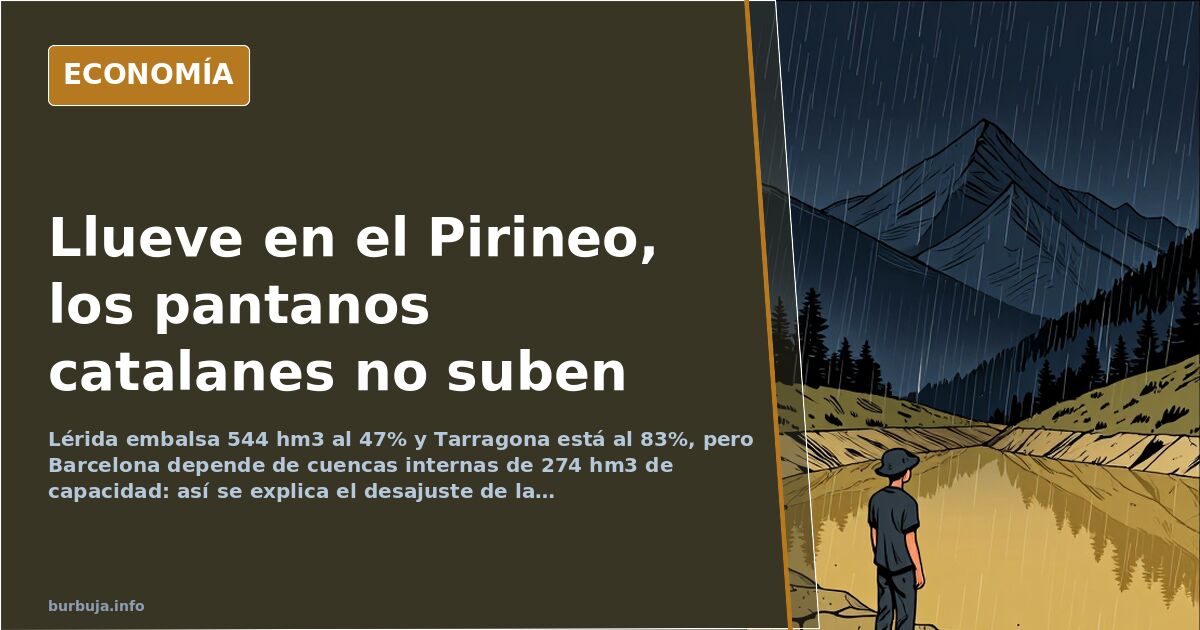
Catalan reservoirs remain low despite Pyrenees rainfall
If it has rained in the Eastern Pyrenees and climate records are average, why do the dams supplying Barcelona stay at historic lows while much of central and northern Spain approaches 100%? Water reserves in Catalonia depend on multiple factors, starting with geography: Barcelona does not draw from the Ebro. The city relies on internal basins—Ter, Llobregat, Tordera, and a dozen minor rivers—a system with limited capacity. This explains most of the discrepancy.
Catalonia's internal basins: The Ebro doesn't irrigate Barcelona
The most common confusion involves the map. Internal basins group the eastern side of Catalonia's hydrographic network: rivers that originate and end within the region, without flowing into inter-regional channels. The Ebro does not pass through here, nor do its large reservoirs. When looking at Catalonia's overall percentage, one is largely viewing a different system than the one supplying the metropolitan area.
The numbers help. Lleida province stores 544 hm3 and sits around 47% of its capacity, the largest among them, and recent snowfall should impact spring levels. Barcelona totals 274 hm3 in capacity: a small figure that fills up after two or three well-timed storms. Girona, with 294 hm3, behaves similarly. And Tarragona is at 83%. Viewed this way, the Catalan drought is less a meteorological issue than a plumbing problem between basins.
Why doesn't La Baells rise when it rains in the Pyrenees?
Because the water filling a specific reservoir isn't what falls in the neighboring county. In 2023, rainfall was far below average in the pre-Pyrenees: in Berga, home to La Baells reservoir, Barcelona's main source, the hydrological year ended dry, and the current one is also running slightly short. A storm on the northern slope of the Pyrenees can leave abundant snow but contribute little runoff to the Llobregat basin.
Add accumulated deficits. Catalonia faces a drought lasting three years, and with that starting point, a couple of normal years recover nothing: it would take a succession of torrential rains to return to average levels. The bank account metaphor is the only one that holds up under scrutiny: if you've been overdrawn for three years, one month's salary won't bring your balance to zero.
Water fees rise while ACA funds sit idle
The Catalan government (Generalitat) is preparing a nearly 30% increase in domestic water fees, raising bills by two to four euros for most households. This hike adds to increases by the metropolitan utility and municipalities: between 20% and 40% for the majority of consumers starting in 2025. The Barcelona metropolitan area already approved its new 2025 tariff after a decade of freezes, passing with the abstention of a coalition partner.
While prices rise, more than €400 million remains unspent in the Catalan Water Agency's (ACA) fund for hydraulic works. Pending investments include expanding the Tordera river desalination plant and creating 16 new regeneration facilities. The money exists. What is missing, according to the recurring pattern, is releasing it from the drawer.
Why isn't there an Ebro pipeline to Barcelona?
Because the Generalitat has rejected it, although Catalan engineers insist on its necessity. The proposal involves a 65-kilometer conduit from Tarragona to Barcelona, which supporters claim could be completed in eight months, without affecting the Ebro River and with complexity far lower than desalination plants. Arguments against desalination exist within the sector too: water management specialists have called it a perfect dystopia and an electoral promise, denying it will allow independence from rainfall.
As the debate intensifies, the Generalitat announced a floating desalination plant in Barcelona's port without notifying the city council, which declared itself disappointed and concerned. Meanwhile, plans are being studied for the first time to dismantle a major dam. The timing coinciding with the election campaign wasn't planned by anyone: the decision on lifting drought restrictions was set for the week of the elections.
Management shadows: Discarded plans and pressures that don't irrigate
Part of the analysis traces the problem's origin to lack of foresight and the absence of inter-basin connections for extraordinary situations. The hydrological plan promoted by the PP was discarded trinc the change in government, and since then, no structural work has linked the systems. Consequently, today's situation depends on weather reports rather than a safety net.
There are other pieces. Cantabria is below 34%, surrounded by basins exceeding 70% and 80%, and with rain, a mismatch nobody explains by drought alone. Simultaneously, other pressures on water are highlighted: pig mega-farms, data centers, and investment funds buying rights. The Catalan agricultural sector has warned for months that restrictions, after years of inaction, are forcing the abandonment of multi-generational crops.
All this shapes a business. Tariffs rise, plants are announced, idea contests are commissioned, and networks long disconnected are finally connected. Those who argue this is a management problem, not just a matter of sky conditions, often add an uncomfortable question: Why did it take eight months to tender a pipeline but not to raise the bill?
With the Ebro flowing into the sea and Barcelona waiting for clouds, the cheapest solution—65 kilometers of pipe—remains on paper. Meanwhile, water reserves trinc the accounting of the basins, not the climate.
If it has rained in the Eastern Pyrenees and climate records are average, why do the dams supplying Barcelona stay at historic lows while much of central and northern Spain approaches 100%? Water reserves in Catalonia depend on multiple factors, starting with geography: Barcelona does not draw from the Ebro. The city relies on internal basins—Ter, Llobregat, Tordera, and a dozen minor rivers—a system with limited capacity. This explains most of the discrepancy.
Catalonia's internal basins: The Ebro doesn't irrigate Barcelona
The most common confusion involves the map. Internal basins group the eastern side of Catalonia's hydrographic network: rivers that originate and end within the region, without flowing into inter-regional channels. The Ebro does not pass through here, nor do its large reservoirs. When looking at Catalonia's overall percentage, one is largely viewing a different system than the one supplying the metropolitan area.
The numbers help. Lleida province stores 544 hm3 and sits around 47% of its capacity, the largest among them, and recent snowfall should impact spring levels. Barcelona totals 274 hm3 in capacity: a small figure that fills up after two or three well-timed storms. Girona, with 294 hm3, behaves similarly. And Tarragona is at 83%. Viewed this way, the Catalan drought is less a meteorological issue than a plumbing problem between basins.
Why doesn't La Baells rise when it rains in the Pyrenees?
Because the water filling a specific reservoir isn't what falls in the neighboring county. In 2023, rainfall was far below average in the pre-Pyrenees: in Berga, home to La Baells reservoir, Barcelona's main source, the hydrological year ended dry, and the current one is also running slightly short. A storm on the northern slope of the Pyrenees can leave abundant snow but contribute little runoff to the Llobregat basin.
Add accumulated deficits. Catalonia faces a drought lasting three years, and with that starting point, a couple of normal years recover nothing: it would take a succession of torrential rains to return to average levels. The bank account metaphor is the only one that holds up under scrutiny: if you've been overdrawn for three years, one month's salary won't bring your balance to zero.
Water fees rise while ACA funds sit idle
The Catalan government (Generalitat) is preparing a nearly 30% increase in domestic water fees, raising bills by two to four euros for most households. This hike adds to increases by the metropolitan utility and municipalities: between 20% and 40% for the majority of consumers starting in 2025. The Barcelona metropolitan area already approved its new 2025 tariff after a decade of freezes, passing with the abstention of a coalition partner.
While prices rise, more than €400 million remains unspent in the Catalan Water Agency's (ACA) fund for hydraulic works. Pending investments include expanding the Tordera river desalination plant and creating 16 new regeneration facilities. The money exists. What is missing, according to the recurring pattern, is releasing it from the drawer.
Why isn't there an Ebro pipeline to Barcelona?
Because the Generalitat has rejected it, although Catalan engineers insist on its necessity. The proposal involves a 65-kilometer conduit from Tarragona to Barcelona, which supporters claim could be completed in eight months, without affecting the Ebro River and with complexity far lower than desalination plants. Arguments against desalination exist within the sector too: water management specialists have called it a perfect dystopia and an electoral promise, denying it will allow independence from rainfall.
As the debate intensifies, the Generalitat announced a floating desalination plant in Barcelona's port without notifying the city council, which declared itself disappointed and concerned. Meanwhile, plans are being studied for the first time to dismantle a major dam. The timing coinciding with the election campaign wasn't planned by anyone: the decision on lifting drought restrictions was set for the week of the elections.
Management shadows: Discarded plans and pressures that don't irrigate
Part of the analysis traces the problem's origin to lack of foresight and the absence of inter-basin connections for extraordinary situations. The hydrological plan promoted by the PP was discarded trinc the change in government, and since then, no structural work has linked the systems. Consequently, today's situation depends on weather reports rather than a safety net.
There are other pieces. Cantabria is below 34%, surrounded by basins exceeding 70% and 80%, and with rain, a mismatch nobody explains by drought alone. Simultaneously, other pressures on water are highlighted: pig mega-farms, data centers, and investment funds buying rights. The Catalan agricultural sector has warned for months that restrictions, after years of inaction, are forcing the abandonment of multi-generational crops.
All this shapes a business. Tariffs rise, plants are announced, idea contests are commissioned, and networks long disconnected are finally connected. Those who argue this is a management problem, not just a matter of sky conditions, often add an uncomfortable question: Why did it take eight months to tender a pipeline but not to raise the bill?
With the Ebro flowing into the sea and Barcelona waiting for clouds, the cheapest solution—65 kilometers of pipe—remains on paper. Meanwhile, water reserves trinc the accounting of the basins, not the climate.
Also available in: Deutsch
Summary of a discussion on Burbuja.info - Foro de economía, actualidad y política., translated from Spanish and reviewed before publication. Read the full discussion (161 replies).
More summaries
-
Death in Catalan prison: tension among inmates rises
A Maghrebi inmate allegedly killed a fellow prisoner of Romani ethnicity in a Catalan prison. Inter-group tension is growing, and the State may offer compensation.
-
Catalan Nurses’ Pay Hike Capped at 5,000 Euros
A message claims Catalan nurses will earn 5,000 euros more annually, totaling 34,417 euros gross plus 2,810 in variable bonuses, sparking debate.
-
Catalan Exception in LOFCA: Keeping 100% of Taxes
The Catalan exception in the LOFCA allows the Generalitat to retain 100% of taxes collected in Catalonia, bypassing the central government's common fund.
-
Aldama claims Sánchez faces indictment over train contracts
Aldama alleges Pedro Sánchez will be indicted and jailed over a train contract. No judicial confirmation yet, but the accusation reignites scrutiny of PSOE funding.
-
Mississippi Bill Proposes $10,000 Fine for Masturbation
Mississippi senator proposes fines up to $10,000 for non-reproductive masturbation. Unlikely to pass, but sparks debate on birth rates.
-
Glovo Ends False Self-Employment After €205M Fines
Glovo abandons the false self-employment model in Spain after accumulating €205.3 million in fines since 2023, announcing direct contracts for all riders.