
Catalonia Drought: Climate as Political Excuse
Meteocat’s Saray Sarroca warns Catalonia must adapt to water scarcity. Debate on Ebro transfers and cost distribution intensifies.
English · Original discussion in Spanish · Published
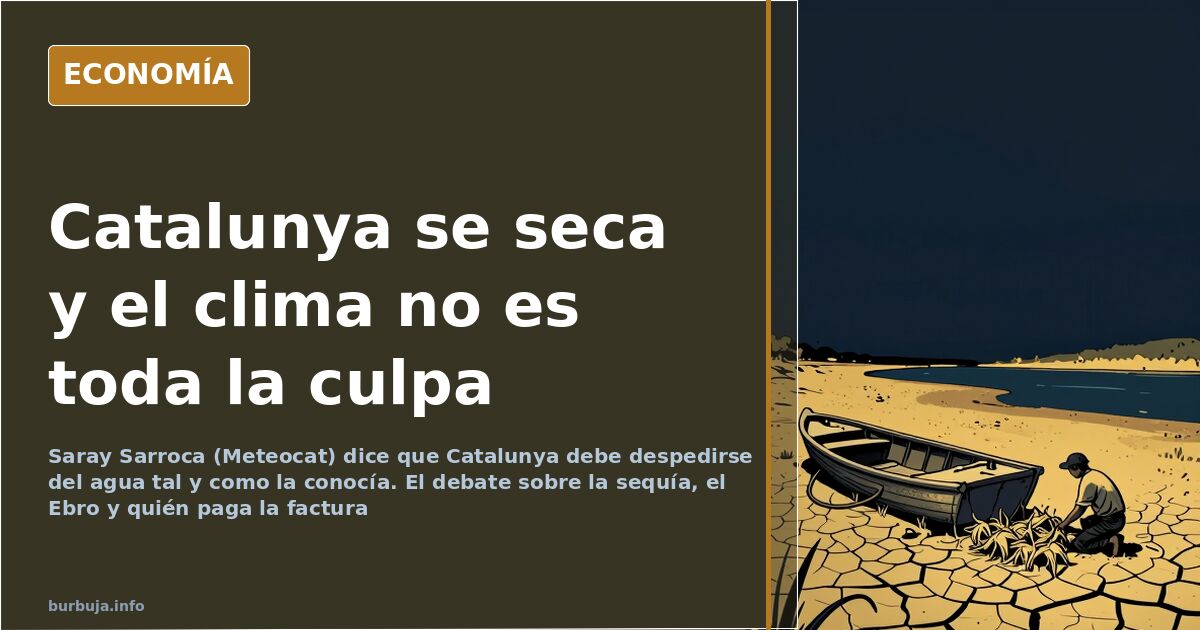
Catalonia Drought: Climate as Political Excuse
Saray Sarroca, spokesperson for the Servei Meteorològic de Catalunya (Meteocat), stated with regret in a Radio Estel interview that due to its geographic location, Catalonia must say goodbye to water as it once knew it. Brown forests, nearly dry reservoirs, and warnings to citizens—sacrifices will be needed—and to the administration: invest to utilize every last drop. The reaction was immediate. And it was not exactly a moment of silence.
Why does Meteocat claim Catalonia is doomed to drought?
The official argument is geographic: proximity to the Mediterranean, eastern position on the peninsula, and rainfall patterns that are no longer what they were. Less lasting, more intense. Sarroca speaks of extreme droughts and climate change that is no longer a laboratory hypothesis but everyday landscape. When asked how long water will last, she responds with a phrase applicable to any community: politicians should answer that question.
The problem is that geography does not change from one year to the next. That is where skepticism begins. A recurring analysis suggests that most of Catalonia records annual precipitation above 600 mm, while large areas of the peninsula—outside the north and mountains—fall below that figure. If Catalonia dries up due to its location, the rest of the country should already be desert.
Ebro Transfer and the Never-Ending Water War
Mentioning the Ebro is inevitable. Some recall that the river still dumps fresh water into the sea, so speaking of absolute drought is an exaggeration. Others revive the proposal from fifteen years ago to bring water from the Rhône via pipelines, an idea that resurfaces whenever reservoir levels drop. A more acerbic part of the analysis points out that the Ebro transfer would have benefited Valencia, Murcia, Andalusia, and Catalonia itself, but was rejected at the time based on non-technical criteria.
The result is a board where each region looks only at its own dam. The Alarcón and Contreras dams, which depend on rain in Teruel and Cuenca before summer, condition supply for much of the Levante. In Murcia and Valencia, the situation is identical: extremely rainy 2020, acceptable 2021, generous 2022, and 2023 saved by May rains. Now, with reservoirs at minimum and a dry autumn, the razor's edge is literal.
Madrid, the Arid Zone That Now Has Water
The initial message hinted sarcastically: Madrid, you have plenty of water, right? The water war between Madrid and Barcelona is served. The irony is amusing because the stereotype of arid Madrid has been used for years by those very interests. Yet, the capital does not have a water surplus by divine grace: it has it because during Franco's era, after severe drought, it was decided to bring water from Segovia. Without that infrastructure, the city could not have grown at the rate it did.
The data is disorienting: the Henares Corridor is green while half of Catalonia turns yellow. The explanation is not climatic, but investment and decisions made half a century ago. What some call water theft is, in reality, a pipeline approved when nobody spoke of climate change.
Desalination Plants, Population, and the Elephant in the Room
There is a current pointing to the real problem: it is not geography, it is load. Water for industries, intensive irrigated agriculture, record pig farms, millions of tourists, and eight million inhabitants. With this combination, any territory enters deficit. The comparison with Murcia is revealing: dams were built for 800,000 inhabitants in the late seventies, and today the region heads toward 1.5 million without relevant new infrastructure in forty years.
Desalination plants appear in all conversations and in no solution. They were approved, promised, and left running at half estimulante ilegal. The lingering uncomfortable question is: if the problem is lack of water and the technological solution exists, why does it not work? The short answer is that energy and maintenance cost money, and public funds have other priorities.
Climate Change: Between Evidence and Dogma
Physical evidence is hard to dispute. By late November, deciduous trees have not finished shedding leaves, summer plants remain green, and insects that should have died three months ago are still visible. Nothing like the childhood of those now fifty. Desertification, moreover, was studied in eighth grade over three decades ago as an inevitable process advancing from North Africa.
What does not add up is the narrative. That climate changes does not automatically make true any claim about its specific consequences. The temptation to use climate as an excuse to avoid unpopular decisions—irrigation restrictions, construction controls, water prices—is too strong. And citizens sense it.
With these elements, the question is not whether there will be less rain. It is who will pay the bill for adaptation, and if anyone is willing to say it aloud before reservoirs hit bottom. Or do we wait for the tap to give the answer?
Also available in: Deutsch
Summary of a discussion on Burbuja.info - Foro de economía, actualidad y política., translated from Spanish and reviewed before publication. Read the full discussion (110 replies).
More summaries
-
José Miguel Contreras: The Head (Political Commissioner) of La Séptima.
José Miguel Contreras, the influential businessman behind La Séptima, navigates between his family and his strong social commitment. Discover his journey.
-
Shantytowns on the Ebro: Zaragoza's housing crisis deepens
Zaragoza sees shacks grow along the Ebro. A housing policy failure or an immigration effect? The debate intensifies as...
-
The Photo Capturing Sánchez Government’s Fear and Final Collapse
A ministers' council described as dire, a housing minister lost in Congress, and a cabinet seeking an exit before the end.
-
Humanity's population could halve by 2060, projections warn
Global population is projected to fall by half by 2060, an unprecedented demographic shift that will reshape the world economy.
-
Ceuta dolphin video sparks outrage and debate on irregular migration in Spain
A video from Ceuta has triggered a heated debate. We analyse the economic impact of irregular immigration in Spain, with data and context.
-
The generational wealth gap is a global problem
The generational gap in wealth accumulation, from housing to retirement. What really happened?