
Catalan spoken out of resentment, debate claims
Debate on Catalan usage, linguistic immersion, and its role as a public administration requirement in Spain.
English · Original discussion in Spanish · Published
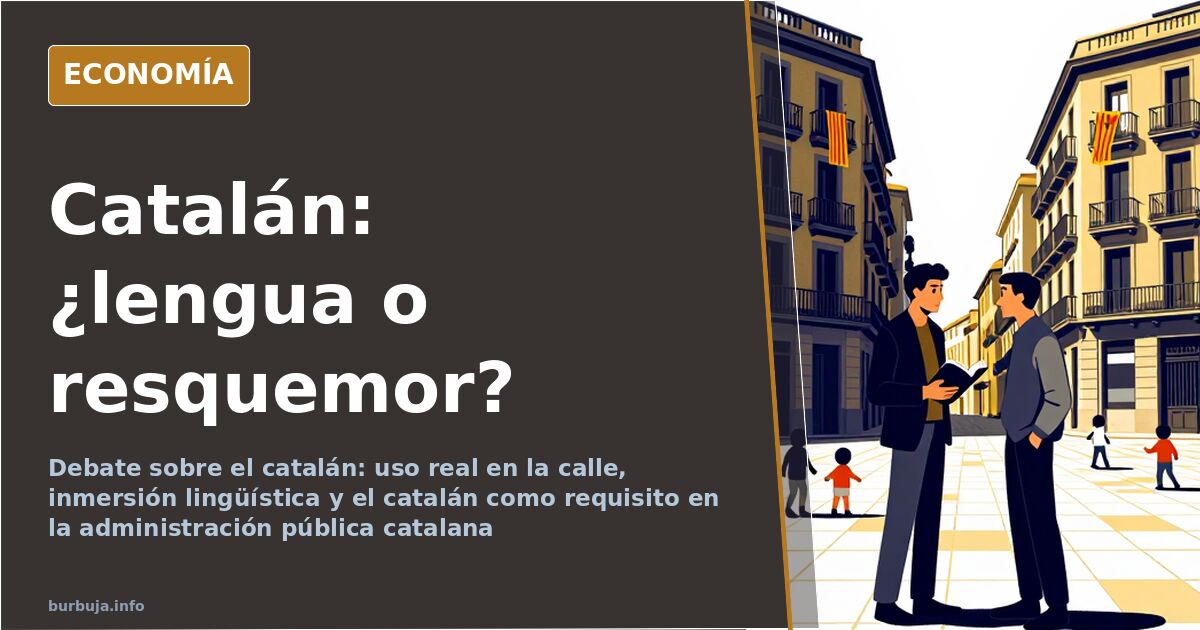
Catalan: The language spoken out of resentment
Catalan is the only regional language urbanites use due to resentment toward Spanish. This thesis opens the discussion: elsewhere, regional languages are supposedly spoken by rural or elderly populations and are fading; in Catalonia, however, they are claimed from the city. The ensuing debate isn't about philology, but why a language becomes a political battleground and who wins or loses.
What is debated when discussing Catalan
The starting point is provocative: Catalan would be the exception to the rule that regional languages survive only in rural areas. A common counter-argument flips this: those who disdain Catalan often speak a Castilian regional language themselves, not English, which dominates science and technology. Comparisons with English recur, arguing its weight comes from universality, not London, dismantling language hierarchies.
Some go further, claiming Catalan is more complex than Castilian, suggesting this explains superior intellect and economic leadership among Catalans. This argument collapses alone: Spanish is more complex than English, and Basque more than both. Grammatical complexity measures nothing.
Linguistic immersion and real street usage
Official narratives claim Catalonia is fully bilingual. Shared experiences suggest otherwise: in Barcelona, Catalan is used less than statistics imply, while villages default to Catalan, switching to Spanish politely for outsiders. Those moving from rural areas to the capital describe the shock: daily Catalan replaced by a Spanish-dominant environment.
School immersion, per this view, isn't reversing trends: youth mostly use Spanish outside family settings, leaving Catalan as a home language. Data shows the language persists mainly among native speakers and fades once outside that circle.
Catalan as an administrative requirement
Here, the issue shifts from cultural to economic. Catalan isn't just official; it has become a near-exclusive requirement in Catalan public administration, de facto restricting civil service access to those mastering it. Consequences cited are twofold: ensuring placement of allies and filtering out non-speakers regardless of technical skill.
This is the final debate's recurring argument: language as a tool for distributing public jobs and subsidies, not heritage. Figures cited involve decades of immersion and publicly funded language policy without translating into greater social usage.
Arabic origins of Castilian and etymology wars
A curious twist involves Arabic-origin words shared by Castilian and Catalan: alcohol, algebra, pillow, rice, sugar, oil, mayor, guason, customs, shipyard. The conclusion drawn is that Castilian absorbed a larger Arabic lexical flow than Catalan, debunking purity or superiority claims.
Reasonable responses note eight centuries of Muslim presence left lexical traces in all languages; assimilating loans doesn't make a language inferior. Etymological polemics ultimately sidestep the core issue: who arrived first and who has rights to what.
Resentment as explanation and excuse
The resentment thesis works both ways. It’s said Catalan is spoken out of spite toward Spanish; countered that spite lies with those needing to despise others' language to feel Spanish. Result: an exchange where philology matters little, identity everything.
Predictably, data won’t resolve this because it isn’t discussed with data. Prediction, with caveats: while language remains an admin requirement and political currency, debate won't fade. Until street usage changes, resentment remains the most comfortable explanation for all sides.
Catalan is the only regional language urbanites use due to resentment toward Spanish. This thesis opens the discussion: elsewhere, regional languages are supposedly spoken by rural or elderly populations and are fading; in Catalonia, however, they are claimed from the city. The ensuing debate isn't about philology, but why a language becomes a political battleground and who wins or loses.
What is debated when discussing Catalan
The starting point is provocative: Catalan would be the exception to the rule that regional languages survive only in rural areas. A common counter-argument flips this: those who disdain Catalan often speak a Castilian regional language themselves, not English, which dominates science and technology. Comparisons with English recur, arguing its weight comes from universality, not London, dismantling language hierarchies.
Some go further, claiming Catalan is more complex than Castilian, suggesting this explains superior intellect and economic leadership among Catalans. This argument collapses alone: Spanish is more complex than English, and Basque more than both. Grammatical complexity measures nothing.
Linguistic immersion and real street usage
Official narratives claim Catalonia is fully bilingual. Shared experiences suggest otherwise: in Barcelona, Catalan is used less than statistics imply, while villages default to Catalan, switching to Spanish politely for outsiders. Those moving from rural areas to the capital describe the shock: daily Catalan replaced by a Spanish-dominant environment.
School immersion, per this view, isn't reversing trends: youth mostly use Spanish outside family settings, leaving Catalan as a home language. Data shows the language persists mainly among native speakers and fades once outside that circle.
Catalan as an administrative requirement
Here, the issue shifts from cultural to economic. Catalan isn't just official; it has become a near-exclusive requirement in Catalan public administration, de facto restricting civil service access to those mastering it. Consequences cited are twofold: ensuring placement of allies and filtering out non-speakers regardless of technical skill.
This is the final debate's recurring argument: language as a tool for distributing public jobs and subsidies, not heritage. Figures cited involve decades of immersion and publicly funded language policy without translating into greater social usage.
Arabic origins of Castilian and etymology wars
A curious twist involves Arabic-origin words shared by Castilian and Catalan: alcohol, algebra, pillow, rice, sugar, oil, mayor, guason, customs, shipyard. The conclusion drawn is that Castilian absorbed a larger Arabic lexical flow than Catalan, debunking purity or superiority claims.
Reasonable responses note eight centuries of Muslim presence left lexical traces in all languages; assimilating loans doesn't make a language inferior. Etymological polemics ultimately sidestep the core issue: who arrived first and who has rights to what.
Resentment as explanation and excuse
The resentment thesis works both ways. It’s said Catalan is spoken out of spite toward Spanish; countered that spite lies with those needing to despise others' language to feel Spanish. Result: an exchange where philology matters little, identity everything.
Predictably, data won’t resolve this because it isn’t discussed with data. Prediction, with caveats: while language remains an admin requirement and political currency, debate won't fade. Until street usage changes, resentment remains the most comfortable explanation for all sides.
Also available in: Deutsch
Summary of a discussion on Burbuja.info - Foro de economía, actualidad y política., translated from Spanish and reviewed before publication. Read the full discussion (148 replies).
More summaries
-
Global Market Dominates: Catalan and Basque Lose Young Listeners
Decades of immersion fail to boost youth interest in Basque and Catalan music as global platforms favor English and Spanish.
-
Death in Catalan prison: tension among inmates rises
A Maghrebi inmate allegedly killed a fellow prisoner of Romani ethnicity in a Catalan prison. Inter-group tension is growing, and the State may offer compensation.
-
The Sofa Video: Domestic Scolding as a Viral Format
A couple posts Instagram videos where she scolds her partner about the sofa. The format goes viral: real relationship or clickbait?
-
Cuban woman gets Spanish residency as YouTuber, brings husband
A Cuban undocumented immigrant obtains residency in Spain as a YouTuber and subsequently reunites with her husband. The case reignites debate on regularization.
-
Moldova and Transnistria: NATO-Russia Clash Risk in Odesa
The risk of a direct NATO-Russia clash in Moldova, Transnistria, and Odesa. Analysis of moves preparing escalation.
-
Spanish public physiotherapist claims 4.5 hours of actual work
An interim Spanish physiotherapist reports 4.5-hour effective shifts and unused time-tracking systems in public healthcare.