
Carrefour Shares Drop 9%, Alcampo Hits Record Low as Hypermarkets Struggle to Recover
Carrefour loses market share, falling to 9%; Alcampo hits historic low of 2.8%. The hypermarket format is fading.
English · Original discussion in Spanish · Published
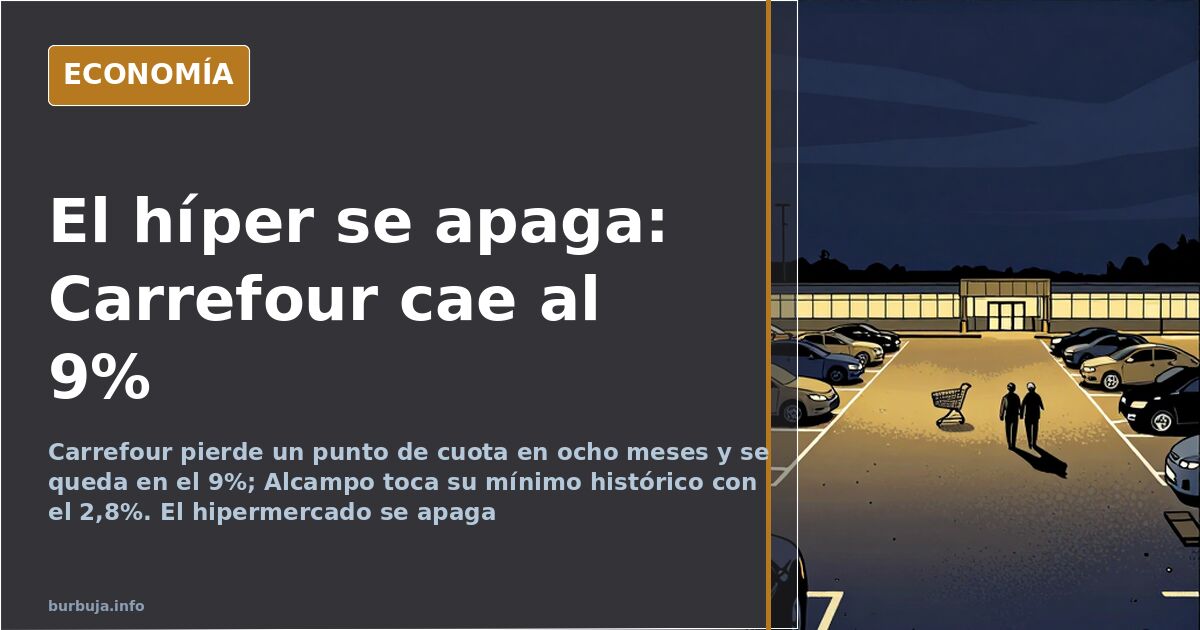
Carrefour and Alcampo Decline: Hypermarkets No Longer Fill the Shopping Cart
The closure has a clear direction. Alcampo is shuttering stores in Plaza del Toro de Tres Cantos, Leganés, Móstoles, and San Fernando de Henares, as well as in Zamora, La Coruña, Burgos, León, Navarra, Álava, and Vizcaya: 16 establishments and an adjustment affecting around 600 employees. This is the visible part of a problem that is more clearly reflected in the data. The French-origin chain records its lowest market share ever, 2.8%, after losing 0.3 points. Carrefour, the second-largest Spanish retailer, loses a full point in the first eight months of the year and settles at 9%. Neither is slowing down.
What Market Share Do Carrefour and Alcampo Have?
Carrefour holds 9%, still ahead of Alcampo (2.8%) and only behind Mercadona. The issue isn't the ranking, but the trend. In March 2024, the company reached its peak at 10.4%, and has been declining ever since. The diagnosis from Bernardo Rodilla, Retail Client Director at Kantar, is stark: "Carrefour is heavily penalized by the hypermarket format." He adds another burden: "It's losing shoppers and failing to compensate with the proximity channel."
The shift towards smaller stores has done little. The company has accumulated 1,100 Carrefour Express stores, plans to open over 100 new establishments this year, and will surpass 1,600 stores, including experiments like the supermarket at Madrid's metro station or El Prat airport. Own brands, despite gaining traction, are also not moving the needle. The burden remains the same: 204 hypermarkets supported by a format that first arrived in Spain in 1973, in El Prat de Llobregat.
The Car, Parking, and the 15-Minute City
The most common explanation isn't found on the shelves, but in the parking lot. The hypermarket was designed for a family with a car doing their monthly shopping, and some argue that this customer base has dwindled: fewer people are driving, large purchases are made online, and private vehicles face increasing obstacles, from low-emission zones and taxes to the cost of cars themselves. In this scenario, the neighborhood store vastly outperforms the out-of-town warehouse, which requires driving, parking half a kilometer away, and navigating endless aisles.
Conversely, it's argued that in Madrid, many Alcampo and Carrefour stores are in well-connected neighborhoods surrounded by housing, and the decline isn't solely explained by urban planning. The format holds its ground where the basket size is large and the assortment is extensive: more brands, more promotions, greater storage capacity.
Why Mercadona Thrives While the Hypermarket Fades
The paradox no one can resolve is that of the market leader. Mercadona doesn't advertise, limits variety to its own brand, isn't cheap, and yet its stores are always full. The most common interpretation is convenience: walk in, grab, and leave without traversing 200 meters of aisles to choose pasta. The opposing view points to loyalty for specific products: fifteen items with a unique price and quality combination elsewhere, which then dictates where the rest of the shopping is done.
The side effect is an increasingly narrow shopping basket. The proximity model works for those who walk to the store two or three times a week, not for those who need to fill their car trunk. This leaves hypermarkets competing for a customer who barely exists anymore.
Alcampo and the 223 Dia Stores It Failed to Integrate
Alcampo's case is the most painful. The company acquired 223 stores from Dia in 2023 and failed to translate this into market share. The result is the collective dismissal process affecting about 600 employees and the closure of 16 locations, along with the announcement of reducing the floor space in some of its 80 large stores. Rodilla summarizes it bluntly: store closures lead to market share reduction, and its evolution "will be conditioned by what happens with the hypermarket channel."
Who Is Growing with the Same Format?
It's not the hypermarket concept in abstract that is dying, but the hypermarkets of Carrefour and Alcampo. Eroski has gained market share, and Family Cash continues to bet on large stores with some success. Meanwhile, the limited assortment model—Lidl, Aldi, Mercadona itself—has captured the shopping that used to be done in one go. Supeco, Carrefour's low-cost brand, is gaining ground on price against its owner's own hypermarkets.
The irony closes the circle: the chain that introduced the format to Spain in 1973 continues to operate 204 large stores while the average customer is moving in the opposite direction. The shopping cart has shrunk. The hypermarket has not.
The closure has a clear direction. Alcampo is shuttering stores in Plaza del Toro de Tres Cantos, Leganés, Móstoles, and San Fernando de Henares, as well as in Zamora, La Coruña, Burgos, León, Navarra, Álava, and Vizcaya: 16 establishments and an adjustment affecting around 600 employees. This is the visible part of a problem that is more clearly reflected in the data. The French-origin chain records its lowest market share ever, 2.8%, after losing 0.3 points. Carrefour, the second-largest Spanish retailer, loses a full point in the first eight months of the year and settles at 9%. Neither is slowing down.
What Market Share Do Carrefour and Alcampo Have?
Carrefour holds 9%, still ahead of Alcampo (2.8%) and only behind Mercadona. The issue isn't the ranking, but the trend. In March 2024, the company reached its peak at 10.4%, and has been declining ever since. The diagnosis from Bernardo Rodilla, Retail Client Director at Kantar, is stark: "Carrefour is heavily penalized by the hypermarket format." He adds another burden: "It's losing shoppers and failing to compensate with the proximity channel."
The shift towards smaller stores has done little. The company has accumulated 1,100 Carrefour Express stores, plans to open over 100 new establishments this year, and will surpass 1,600 stores, including experiments like the supermarket at Madrid's metro station or El Prat airport. Own brands, despite gaining traction, are also not moving the needle. The burden remains the same: 204 hypermarkets supported by a format that first arrived in Spain in 1973, in El Prat de Llobregat.
The Car, Parking, and the 15-Minute City
The most common explanation isn't found on the shelves, but in the parking lot. The hypermarket was designed for a family with a car doing their monthly shopping, and some argue that this customer base has dwindled: fewer people are driving, large purchases are made online, and private vehicles face increasing obstacles, from low-emission zones and taxes to the cost of cars themselves. In this scenario, the neighborhood store vastly outperforms the out-of-town warehouse, which requires driving, parking half a kilometer away, and navigating endless aisles.
Conversely, it's argued that in Madrid, many Alcampo and Carrefour stores are in well-connected neighborhoods surrounded by housing, and the decline isn't solely explained by urban planning. The format holds its ground where the basket size is large and the assortment is extensive: more brands, more promotions, greater storage capacity.
Why Mercadona Thrives While the Hypermarket Fades
The paradox no one can resolve is that of the market leader. Mercadona doesn't advertise, limits variety to its own brand, isn't cheap, and yet its stores are always full. The most common interpretation is convenience: walk in, grab, and leave without traversing 200 meters of aisles to choose pasta. The opposing view points to loyalty for specific products: fifteen items with a unique price and quality combination elsewhere, which then dictates where the rest of the shopping is done.
The side effect is an increasingly narrow shopping basket. The proximity model works for those who walk to the store two or three times a week, not for those who need to fill their car trunk. This leaves hypermarkets competing for a customer who barely exists anymore.
Alcampo and the 223 Dia Stores It Failed to Integrate
Alcampo's case is the most painful. The company acquired 223 stores from Dia in 2023 and failed to translate this into market share. The result is the collective dismissal process affecting about 600 employees and the closure of 16 locations, along with the announcement of reducing the floor space in some of its 80 large stores. Rodilla summarizes it bluntly: store closures lead to market share reduction, and its evolution "will be conditioned by what happens with the hypermarket channel."
Who Is Growing with the Same Format?
It's not the hypermarket concept in abstract that is dying, but the hypermarkets of Carrefour and Alcampo. Eroski has gained market share, and Family Cash continues to bet on large stores with some success. Meanwhile, the limited assortment model—Lidl, Aldi, Mercadona itself—has captured the shopping that used to be done in one go. Supeco, Carrefour's low-cost brand, is gaining ground on price against its owner's own hypermarkets.
The irony closes the circle: the chain that introduced the format to Spain in 1973 continues to operate 204 large stores while the average customer is moving in the opposite direction. The shopping cart has shrunk. The hypermarket has not.
Summary of a discussion on Burbuja.info - Foro de economía, actualidad y política., translated from Spanish and reviewed before publication. Read the full discussion (227 replies).
More summaries
-
Mercadona hits the brakes: customers are comparing prices
While comparing seven chains keeps many customers captive, Lidl and Aldi are gaining market share, and fresh produce is increasingly bought outside of Mercadona.
-
Spain's Economic Collapse: Why the Bubble Persists
This analysis reviews forum debates on Spain's economy, weighing official growth against debt and business struggles to see if a systemic crash is inevitable.
-
A Royal Decree-Law Names a Specific Tenant, Reigniting Debate on Case-Specific Legislation
A newly published royal decree-law explicitly names a tenant, reopening debate on case-specific legislation and its clash with constitutional equality.
-
Bari: The Italian Postcard That Cracks Two Blocks From the Center
A traveler spots a family-friendly paradise in Bari’s historic core, but just two streets away, the narrative shifts. Italy vs. Spain compared.
-
Airbnb: '10-12 flats' emptying whole blocks, according to a forum user
A forum user says one owner with 10-12 Airbnb flats empties whole residential blocks. In Lugo or Teruel, prices also rise without mass tourism.
-
Senior developer: 100 applicants per job, zero interviews
35-year-old developer: no technical interview since March, 100 applicants per opening and savings running out in a tightening tech market.