
Carrefour profit drops amid complaints of dirt and long queues
Forum users report Carrefour's earnings per share fell in 2025 after years near €1.35, while customers describe dirty stores, long lines, and high prices.
English · Original discussion in Spanish · Published
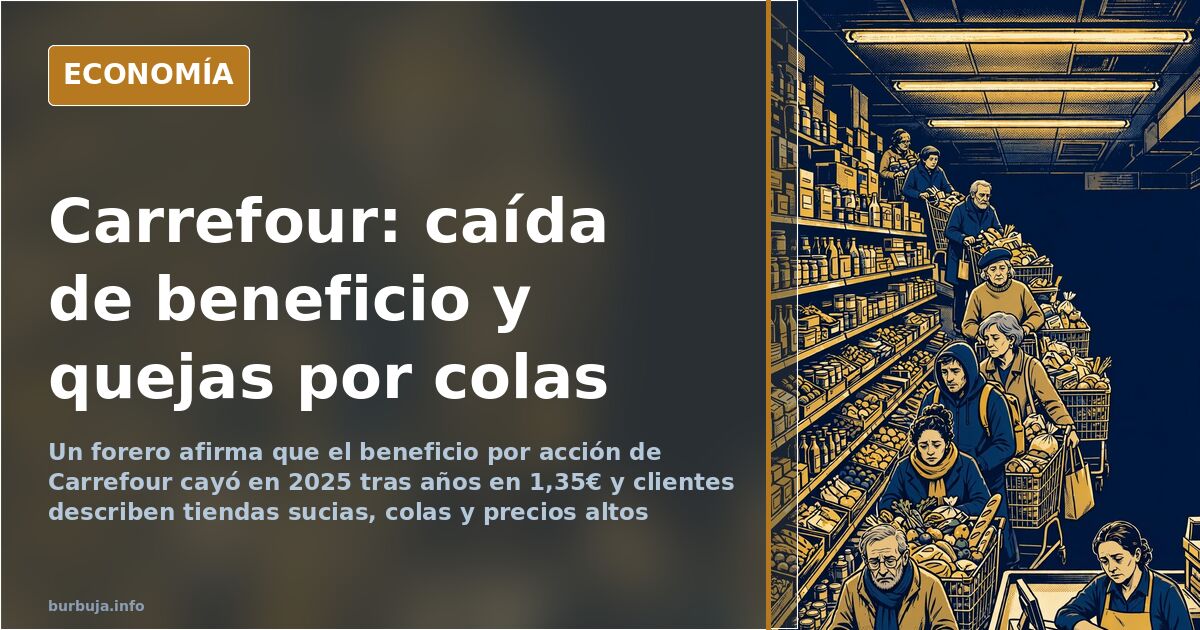
Carrefour bleeding: lower profits and longer lines
Why has a giant with 158 accumulated complaint replies in a single thread turned into an apocalyptic bazaar? The short answer: the numbers don't lie. Carrefour's earnings per share dropped sharply in 2025, according to the data starting the conversation, after hovering around €1.35 between 2021 and 2024. The stock, inflated on the market, isn't recovering. As financial adages go, investors smell trouble before customers do.
Meanwhile, customers describe scenes of nuclear apocalypse: dirt, chaos, devastated shelves, and prices that no longer compete with anything. It’s not an isolated case. Several voices agree that the traditional hypermarket model—those from the 80s and 90s with titanic fixed costs—is wobbling. People want small shops, quick purchases, and to leave quickly. Electronics are being taken by Amazon. And the hypermarket, meanwhile, continues with the same promotions from three decades ago.
The earnings per share that crashed
The hardest data point doesn’t come from a store with two employees and eighty customers in line. It comes from earnings per share. Between 2021 and 2024, Carrefour moved within a range of approximately €1.35 per share. In 2025, that indicator collapsed. The drop isn't a quarterly bump: it's a trend investors have been discounting for some time, because the stock price doesn't match general market enthusiasm.
Some argue that the market sees something occasional buyers don't perceive: a business model losing market share year after year. Alcampo, a direct competitor, has already started to notice. For the French-origin chain, loss of appeal translates into less traffic, lower average ticket size, and higher fixed costs per square meter. The equation doesn't add up.
The hypermarket that smells like a 90s Chinese bazaar
The most repeated description isn't economic, it's sensory. A regular customer who returned after years of absence summarized it thus: chaotic, dirty, devastated like a nuclear apocalypse, and damn expensive. Another adds that the shoe aisle could be found by smell, due to the stench of cheap plastic and rubber. The shopping experience, they say, has fallen more than margins.
It's not just an impression. At the reference hypermarket mentioned by a competitor employee, the Christmas season—from Black Friday to Epiphany—used to be a daily boiling pot of people. After the pandemic, the downturn has been year after year. The same pattern repeats in other chains: fewer visitors, longer queues due to lack of cashiers, and a general feeling that the premises are stuck in another era.
Two cashiers, eighty customers, and twenty-five minutes wait
The bottleneck isn't just about assortment. It's about staff. One specific case describes a Tuesday at seven in the evening with two cashiers for eighty customers in line. Half went to self-checkout, which paradoxically slows everything down because an employee must activate them and then verify you haven't left without scanning. Result: twenty-five minutes to buy three items. The affected person's conclusion is blunt: never again.
That type of scene fuels the sense of abandonment. It's not that demand is lacking across all formats: nearby supermarkets of competitors remain full. The problem is specific to the hyper format, trapped between industrial warehouse fixed costs and a clientele that no longer sees a reason to take the car.
The model that wobbles: less car, more proximity shop
The thesis running through the analysis is that the traditional hypermarket is in structural crisis. Proximity competition—Mercadona, Lidl, Aldi, Ahorramas—has been eating away market share. Consumers want to resolve their shopping in fifteen minutes, not an hour including parking. And electronics, the bazaar, and textiles, which were the hypermarket's great differentiators, have collapsed against Amazon and specialized stores.
In the hypermarket of a sector employee, the bazaar, home, and textile floor has been emptying out. Electronics have reduced to almost a scooter concessionaire. Laptops, smartphones, and accessories occupy less and less space. What holds up is large white goods, because a refrigerator remains a basic necessity. The rest of the model is crumbling.
The strategy of moving everything every three weeks no longer works
There is a cross-cutting complaint that doesn't distinguish between chains: the habit of changing product locations every few weeks. The classic explanation is that this rotation forces impulse buying while you look for what you intended to buy. But the strategy, they say, is obsolete. The 2025 buyer checks prices on their phone, has a list, and doesn't get carried away by milk placement.
The result is an exhausting experience. If you add that the price is no longer competitive—several testimonies place Carrefour above Mercadona in equivalent products—the reason to return reduces to the specific brand you can't find elsewhere. Little to sustain a hypermarket structure.
What saves it: fish counter, butcher, and discount app
Not everything is ash. Part of the clientele still defends the format for its variety. The fish counter, butcher, deli, and bakery with staff behind are assets that proximity shops don't replicate. Those looking for local products, coupons, and accumulated discounts—including the large family card—find in Carrefour the only place where they feel they save something.
The problem is that this niche doesn't fill a hypermarket. Extreme variety and counter service justify the alucinación for a minority, not for the masses. And while the masses go to the shop downstairs, the hypermarket keeps paying the electricity bill, parking, and warehouses nobody visits anymore.
In the end, the question isn't whether Carrefour can fix its queues or cleanliness. It's whether anyone from the French headquarters is interested in doing so. Because earnings per share figures don't fall alone, and registers with two employees don't stay empty by chance. Perhaps the plan is to let the hypermarket fade slowly, like those lights in industrial warehouses that nobody turns on anymore.
Why has a giant with 158 accumulated complaint replies in a single thread turned into an apocalyptic bazaar? The short answer: the numbers don't lie. Carrefour's earnings per share dropped sharply in 2025, according to the data starting the conversation, after hovering around €1.35 between 2021 and 2024. The stock, inflated on the market, isn't recovering. As financial adages go, investors smell trouble before customers do.
Meanwhile, customers describe scenes of nuclear apocalypse: dirt, chaos, devastated shelves, and prices that no longer compete with anything. It’s not an isolated case. Several voices agree that the traditional hypermarket model—those from the 80s and 90s with titanic fixed costs—is wobbling. People want small shops, quick purchases, and to leave quickly. Electronics are being taken by Amazon. And the hypermarket, meanwhile, continues with the same promotions from three decades ago.
The earnings per share that crashed
The hardest data point doesn’t come from a store with two employees and eighty customers in line. It comes from earnings per share. Between 2021 and 2024, Carrefour moved within a range of approximately €1.35 per share. In 2025, that indicator collapsed. The drop isn't a quarterly bump: it's a trend investors have been discounting for some time, because the stock price doesn't match general market enthusiasm.
Some argue that the market sees something occasional buyers don't perceive: a business model losing market share year after year. Alcampo, a direct competitor, has already started to notice. For the French-origin chain, loss of appeal translates into less traffic, lower average ticket size, and higher fixed costs per square meter. The equation doesn't add up.
The hypermarket that smells like a 90s Chinese bazaar
The most repeated description isn't economic, it's sensory. A regular customer who returned after years of absence summarized it thus: chaotic, dirty, devastated like a nuclear apocalypse, and damn expensive. Another adds that the shoe aisle could be found by smell, due to the stench of cheap plastic and rubber. The shopping experience, they say, has fallen more than margins.
It's not just an impression. At the reference hypermarket mentioned by a competitor employee, the Christmas season—from Black Friday to Epiphany—used to be a daily boiling pot of people. After the pandemic, the downturn has been year after year. The same pattern repeats in other chains: fewer visitors, longer queues due to lack of cashiers, and a general feeling that the premises are stuck in another era.
Two cashiers, eighty customers, and twenty-five minutes wait
The bottleneck isn't just about assortment. It's about staff. One specific case describes a Tuesday at seven in the evening with two cashiers for eighty customers in line. Half went to self-checkout, which paradoxically slows everything down because an employee must activate them and then verify you haven't left without scanning. Result: twenty-five minutes to buy three items. The affected person's conclusion is blunt: never again.
That type of scene fuels the sense of abandonment. It's not that demand is lacking across all formats: nearby supermarkets of competitors remain full. The problem is specific to the hyper format, trapped between industrial warehouse fixed costs and a clientele that no longer sees a reason to take the car.
The model that wobbles: less car, more proximity shop
The thesis running through the analysis is that the traditional hypermarket is in structural crisis. Proximity competition—Mercadona, Lidl, Aldi, Ahorramas—has been eating away market share. Consumers want to resolve their shopping in fifteen minutes, not an hour including parking. And electronics, the bazaar, and textiles, which were the hypermarket's great differentiators, have collapsed against Amazon and specialized stores.
In the hypermarket of a sector employee, the bazaar, home, and textile floor has been emptying out. Electronics have reduced to almost a scooter concessionaire. Laptops, smartphones, and accessories occupy less and less space. What holds up is large white goods, because a refrigerator remains a basic necessity. The rest of the model is crumbling.
The strategy of moving everything every three weeks no longer works
There is a cross-cutting complaint that doesn't distinguish between chains: the habit of changing product locations every few weeks. The classic explanation is that this rotation forces impulse buying while you look for what you intended to buy. But the strategy, they say, is obsolete. The 2025 buyer checks prices on their phone, has a list, and doesn't get carried away by milk placement.
The result is an exhausting experience. If you add that the price is no longer competitive—several testimonies place Carrefour above Mercadona in equivalent products—the reason to return reduces to the specific brand you can't find elsewhere. Little to sustain a hypermarket structure.
What saves it: fish counter, butcher, and discount app
Not everything is ash. Part of the clientele still defends the format for its variety. The fish counter, butcher, deli, and bakery with staff behind are assets that proximity shops don't replicate. Those looking for local products, coupons, and accumulated discounts—including the large family card—find in Carrefour the only place where they feel they save something.
The problem is that this niche doesn't fill a hypermarket. Extreme variety and counter service justify the alucinación for a minority, not for the masses. And while the masses go to the shop downstairs, the hypermarket keeps paying the electricity bill, parking, and warehouses nobody visits anymore.
In the end, the question isn't whether Carrefour can fix its queues or cleanliness. It's whether anyone from the French headquarters is interested in doing so. Because earnings per share figures don't fall alone, and registers with two employees don't stay empty by chance. Perhaps the plan is to let the hypermarket fade slowly, like those lights in industrial warehouses that nobody turns on anymore.
Also available in: Deutsch
Summary of a discussion on Burbuja.info - Foro de economía, actualidad y política., translated from Spanish and reviewed before publication. Read the full discussion (158 replies).
More summaries
-
Carrefour and Alcampo lose ground to Mercadona and Lidl
Carrefour and Alcampo drop 0.8% while Mercadona grows 9%; analysis of the French hypermarket decline in Spain.
-
El Corte Inglés posts 22.8% profit rise, debt at 20-year low
El Corte Inglés reports a net profit of €628 million for fiscal year 2025-26, up 22.8%, with debt reaching its lowest level in two decades.
-
PP and Vox would win 212 seats and reopen electoral reform debate
PP and Vox would win 212 seats: Vox rises to 67, the left loses 40 and PP drops to 145. The majority reopens the debate on Spain's electoral law.
-
Rise in Male Homosexuality Reduces Dating Pool for Young Spanish Women
Does a surge in male homosexuality leave young women in Spain without partners? An analysis of a debate blending math, stereotypes, and social anxiety.
-
Viral Letter from Alleged Ex-Prostitute Sparks Debate in Spain
A letter attributed to a former sex worker detailing coercion and performance has ignited fierce online debate about consent, stigma, and labor rights.
-
Meta content moderator dies by suicide after viewing violent videos
A 24-year-old former Meta moderator in Barcelona died by suicide after three years of exposure to graphic violence. Her family is considering legal action against Meta and Telus.