
Canned Fabada Prices Triple in Spain, Buyers Report
Store-brand canned fabada now costs €2, up from 70 cents. Cooking dry beans remains a cheaper alternative.
English · Original discussion in Spanish · Published
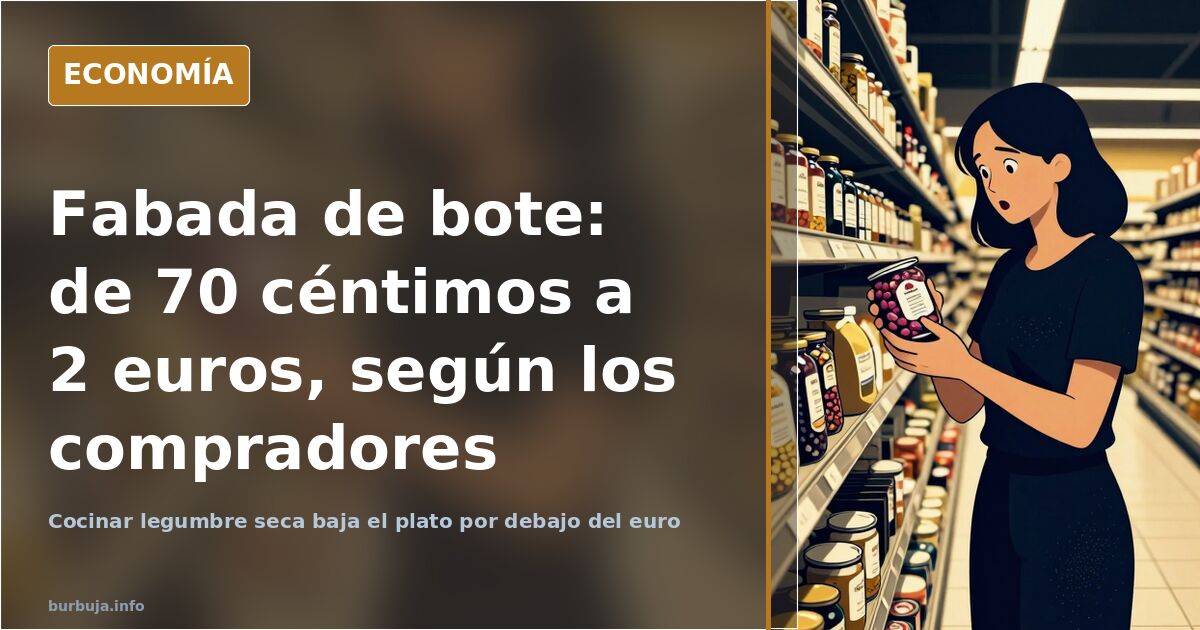
Store-brand canned fabada triples price in three years
The data comes directly from shoppers in the thread, not a report: a store-brand can of fabada costs €2, compared to 70 cents three years ago, according to the messages starting the debate. Ten kiwis cost €4.50. The combination of both—a canned legume dish and a bag of fruit—totals €6.50. The discussion takes place in the least segarro setting possible: the canned goods aisle.
How much does a can of fabada cost?
Store-brand fabada has settled at €2, with variations by chain and region: some have seen this price at the leading retailer, while others maintain a reference of €1.50 in other areas, according to the thread's messages.
Canned fabada has become the perfect thermometer for this phenomenon. It is not a whim or a luxury product: it is cooked legumes, cured meats, and a tin jar, pantry food for days with little time and less desire. When that doubles, the complaint stops being ideological and becomes arithmetic.
The last link's margin: what part of the price is raw material
The argument that raw materials explain everything does not fit the figures being discussed. A calculation circulating in the thread states that manufacturers buying in bulk, without intermediaries, have seen cost increases around 10% in most products, and at most 25% or 30% in specific cases. If raw materials are only part of the final price—and sometimes not even the most important part—the jump at the point of sale needs other explanations.
Several are pointed out. The last link, the seller, passes on more than they receive. Each intermediary replicates inflation in their segment. The oil consumed is roughly the same as before. And money in circulation, according to that same line of analysis, has multiplied by six in twenty years. The sum of all this turns the can into the place where the bill is paid.
Cooking dry legumes: the calculation that exposes the can
The alternative runs through the conversation from top to bottom: one kilo of beans or chickpeas, cooked in a pressure cooker and divided into portions, leaves the dish well below one euro. Frozen in containers or vacuum-packed, the saving is so obvious it almost offends. You don't need to be a chef: there are thousands of recipe videos online and the stew can be frozen in portions.
Some go a step further and preserve in glass jars: the jar is filled with still-boiling food, closed tightly, and left to cool upside down. The method, with the detail that creates a true vacuum and the reason why the lid sinks when peine, is fully explained in the thread. Those who apply it claim they have stopped freezing stews: it lasts months and gains flavor over time.
Have wages risen at the same rate as fabada?
Salaries also appear in the discussion, with dates. One user recalls that in June 2003, fresh out of vocational training, he entered the industry with a first salary of €1,168 working twelve hours of overtime as a specialized laborer. In 2017, a factory worker earned €800; at the time of this discussion, €1,300. This symmetry would serve as an answer if it weren't for the missing half of the picture: that worker also buys the fabada.
On the opposite side are those who argue that raising the minimum wage by decree and pressuring energy suppliers necessarily implies higher prices. And there is the obvious objection: if labor costs explain the jar, why does the jar rise more than costs? There was explicit debate about the cook's salary—the neighborhood bar cook is not a hotel head chef—and no one settled the account.
Record profits with an increasingly expensive shopping basket
The picture from the other side of the counter is provided by major accounts. Iberdrola surged its profit by 40% in the first quarter. BBVA closed the first half with €3,878 million, a 31% increase. Banco Sabadell recorded a 43.6% rise to €564 million. And the profit of Spain's largest distributor, €718 million, equates to 2.4% of the €30 billion it bills, according to the calculation used to refute the idea of abusive margins in supermarkets.
Each figure is used for the opposite purpose. Record profits demonstrate, for some, that there is room to lower prices on essential goods. For others, that the margin of the distributor is tight and the problem lies elsewhere in the chain. The only shared conclusion is uncomfortable: someone is profiting from €2 fabada.
Consume less or intervene: where the solution gets stuck
With dry legumes at a ridiculous price and the can at €2, the rational decision seems obvious. And yet the can continues to sell, because not everyone has the time, pot, or desire to spend the afternoon in the kitchen. That is where the analysis gets stuck: if the problem is price, margin, or distribution, the recipes are incompatible—stop buying what rises, limit margins, or wait for the market to correct itself—and none of the three fits entirely with the complaint that started all this.
The data comes directly from shoppers in the thread, not a report: a store-brand can of fabada costs €2, compared to 70 cents three years ago, according to the messages starting the debate. Ten kiwis cost €4.50. The combination of both—a canned legume dish and a bag of fruit—totals €6.50. The discussion takes place in the least segarro setting possible: the canned goods aisle.
How much does a can of fabada cost?
Store-brand fabada has settled at €2, with variations by chain and region: some have seen this price at the leading retailer, while others maintain a reference of €1.50 in other areas, according to the thread's messages.
Canned fabada has become the perfect thermometer for this phenomenon. It is not a whim or a luxury product: it is cooked legumes, cured meats, and a tin jar, pantry food for days with little time and less desire. When that doubles, the complaint stops being ideological and becomes arithmetic.
The last link's margin: what part of the price is raw material
The argument that raw materials explain everything does not fit the figures being discussed. A calculation circulating in the thread states that manufacturers buying in bulk, without intermediaries, have seen cost increases around 10% in most products, and at most 25% or 30% in specific cases. If raw materials are only part of the final price—and sometimes not even the most important part—the jump at the point of sale needs other explanations.
Several are pointed out. The last link, the seller, passes on more than they receive. Each intermediary replicates inflation in their segment. The oil consumed is roughly the same as before. And money in circulation, according to that same line of analysis, has multiplied by six in twenty years. The sum of all this turns the can into the place where the bill is paid.
Cooking dry legumes: the calculation that exposes the can
The alternative runs through the conversation from top to bottom: one kilo of beans or chickpeas, cooked in a pressure cooker and divided into portions, leaves the dish well below one euro. Frozen in containers or vacuum-packed, the saving is so obvious it almost offends. You don't need to be a chef: there are thousands of recipe videos online and the stew can be frozen in portions.
Some go a step further and preserve in glass jars: the jar is filled with still-boiling food, closed tightly, and left to cool upside down. The method, with the detail that creates a true vacuum and the reason why the lid sinks when peine, is fully explained in the thread. Those who apply it claim they have stopped freezing stews: it lasts months and gains flavor over time.
Have wages risen at the same rate as fabada?
Salaries also appear in the discussion, with dates. One user recalls that in June 2003, fresh out of vocational training, he entered the industry with a first salary of €1,168 working twelve hours of overtime as a specialized laborer. In 2017, a factory worker earned €800; at the time of this discussion, €1,300. This symmetry would serve as an answer if it weren't for the missing half of the picture: that worker also buys the fabada.
On the opposite side are those who argue that raising the minimum wage by decree and pressuring energy suppliers necessarily implies higher prices. And there is the obvious objection: if labor costs explain the jar, why does the jar rise more than costs? There was explicit debate about the cook's salary—the neighborhood bar cook is not a hotel head chef—and no one settled the account.
Record profits with an increasingly expensive shopping basket
The picture from the other side of the counter is provided by major accounts. Iberdrola surged its profit by 40% in the first quarter. BBVA closed the first half with €3,878 million, a 31% increase. Banco Sabadell recorded a 43.6% rise to €564 million. And the profit of Spain's largest distributor, €718 million, equates to 2.4% of the €30 billion it bills, according to the calculation used to refute the idea of abusive margins in supermarkets.
Each figure is used for the opposite purpose. Record profits demonstrate, for some, that there is room to lower prices on essential goods. For others, that the margin of the distributor is tight and the problem lies elsewhere in the chain. The only shared conclusion is uncomfortable: someone is profiting from €2 fabada.
Consume less or intervene: where the solution gets stuck
With dry legumes at a ridiculous price and the can at €2, the rational decision seems obvious. And yet the can continues to sell, because not everyone has the time, pot, or desire to spend the afternoon in the kitchen. That is where the analysis gets stuck: if the problem is price, margin, or distribution, the recipes are incompatible—stop buying what rises, limit margins, or wait for the market to correct itself—and none of the three fits entirely with the complaint that started all this.
Summary of a discussion on Burbuja.info - Foro de economía, actualidad y política., translated from Spanish and reviewed before publication. Read the full discussion (157 replies).
More summaries
-
Spain's Díaz pushes for €1,400 minimum wage, double Rajoy's level
Yolanda Díaz proposes a €1,400 monthly minimum wage in Spain. Critics cite high employer costs and compression of median wages.
-
Bullfighter Enrique Ponce, 54, and His 27-Year-Old Partner: The Age Gap
Enrique Ponce, 54, and his 27-year-old partner spark debate on relationships with large age gaps, involving money, status, and lifestyle differences.
-
Asturias halts minor center plan after La Florida protests
Residents of Oviedo's La Florida block a foster care facility. A €7,000 monthly cost and alleged conflicts of interest spark debate.
-
Spain's birth rate crisis: housing, pensions and life choices
With a fertility rate of 1.15, Spain faces a divide over parenthood, driven by housing costs and pension sustainability.
-
Ceuta death toll tops 100 amid migration crisis backlash
RTVE reports over 100 deaths in Ceuta, sparking political debate on the pull factor as Spain's government faces scrutiny.
-
Germany cuts spending as Spain hopes to avoid austerity
Germany begins budget cuts while Spain bets it will be spared. The end of Next Generation funds in 2027 and EU pressure signal potential adjustments.