
Canary Islands: Tourism drives 35% of GDP amid mass protests
Tourism accounts for 35% of the Canary Islands' GDP and 40% of employment, yet tens of thousands protest against the mass tourism model.
English · Original discussion in Spanish · Published
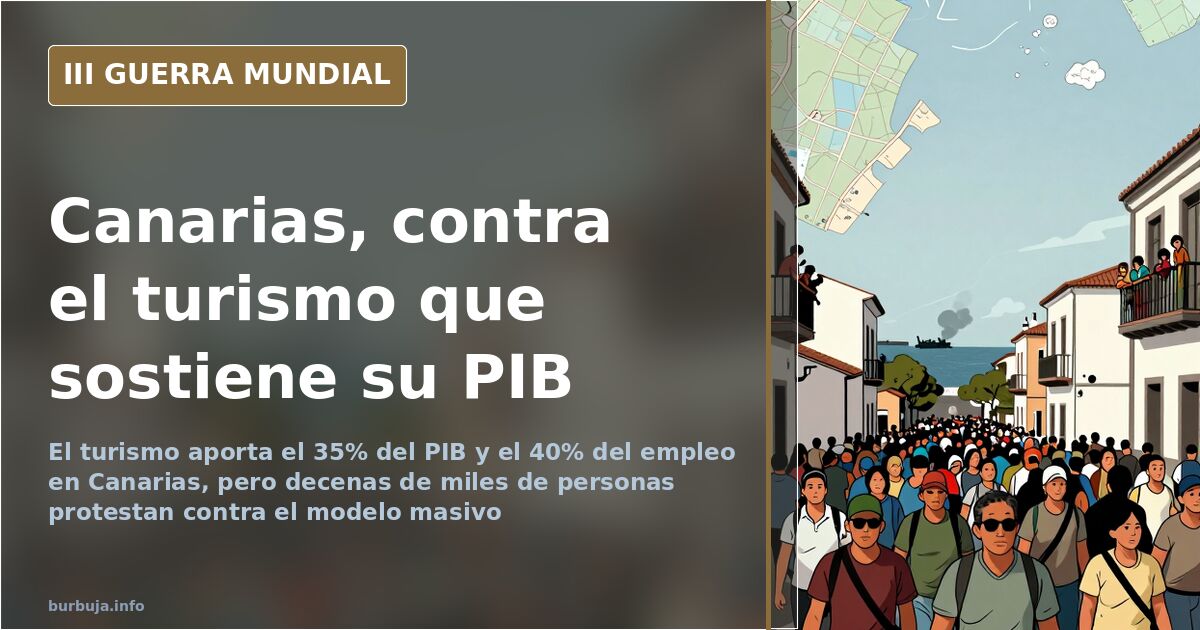
Canary Islands: 50,000 people protest against tourism that contributes 35% of GDP
The Canary Islands are home to around two million people. Without tourism, estimates suggest the population would drop below 300,000. The sector contributes 35% of GDP and 40% of employment, supporting eight airports and half a million hotel beds. Despite this economic backbone, tens of thousands have taken to the streets against mass tourism. Reported attendance figures hover around 50,000 protesters: enough to fill a football stadium, debatable as a show of strength, but impossible to ignore as a symptom.
Why protest against the islands' economic engine?
Because the same sector that provides livelihoods also drives up rents. That is the core issue. Pro-tourism arguments rely on big numbers —fifteen million visitors, nearly all direct and indirect jobs— while critics focus on the fine print: residents who can no longer afford housing on their own island. A common refrain captures the tension: it matters little if the industry feeds you if it prices you out of a home.
The two narratives are not mutually exclusive, which is precisely the problem. Tourism explains the transformation of areas that fifty years ago were banana and tomato plantations, dominated by day laborers serving landowners, into an economy of five-star hotels and white-collar jobs. The same force that created those jobs now strains land, water, and housing resources.
Tourism sustaining 35% of the Canary Islands' GDP
The statistics cited in defense of the sector are compelling. Fifteen million tourists annually; eight airports that would not exist without them; half a million tourist beds. Without this activity, the scenario presented is an archipelago of 300,000 inhabitants —compared to the current 2.2 million— reliant on external subsistence economies. The argument concludes with a warning: if tourism collapses, almost everything else trinc.
What about the limit? Even industry defenders admit one exists. It is not disputed that fifteen million visitors have a ceiling; the debate is where that line lies and who sets it. Moderate voices warn that pulling too hard risks leaving the islands empty and without productive alternatives.
From rejecting tourists to rejecting immigrants
Here, the issue becomes murky. Part of the discontent with mass tourism blends, in the same conversation, with anti-immigration sentiment. Comparisons emerge pitting one group of visitors against another based on what they contribute or cost, leading easily to generalizations about groups that do not withstand scrutiny. Claims are made, for instance, that some bring money while others generate insecurity, without evidence beyond slogans. It is crucial to separate these planes: debating the tourism model —land, housing, overcrowding, wages— is different from turning that grievance into a conflict against those arriving to work.
Are the anti-tourism protests organized?
This is the most repeated suspicion and the hardest to prove. The idea lingers that behind the demonstrations there is a hand funding and directing them, with direct accusations of orchestration from above. There is no public proof of such coordination, and the accusation works better as a dismissal than a diagnosis. What is observed is a known pattern: real grievances —housing access, service saturation— are amplified into a banner, shifting the discussion from the problem itself to the intent of those raising it.
What is at stake for the Canary Islands beyond the headlines
A detail orders all the above. The islands depend on a sector that, according to its own defenders, cannot grow infinitely: the same industry financing eight airports is straining water, land, and wages. The unanswered question is not whether tourism is surplus, but how much fits before residents no longer recognize their island. And that figure, today, remains unknown.
The Canary Islands are home to around two million people. Without tourism, estimates suggest the population would drop below 300,000. The sector contributes 35% of GDP and 40% of employment, supporting eight airports and half a million hotel beds. Despite this economic backbone, tens of thousands have taken to the streets against mass tourism. Reported attendance figures hover around 50,000 protesters: enough to fill a football stadium, debatable as a show of strength, but impossible to ignore as a symptom.
Why protest against the islands' economic engine?
Because the same sector that provides livelihoods also drives up rents. That is the core issue. Pro-tourism arguments rely on big numbers —fifteen million visitors, nearly all direct and indirect jobs— while critics focus on the fine print: residents who can no longer afford housing on their own island. A common refrain captures the tension: it matters little if the industry feeds you if it prices you out of a home.
The two narratives are not mutually exclusive, which is precisely the problem. Tourism explains the transformation of areas that fifty years ago were banana and tomato plantations, dominated by day laborers serving landowners, into an economy of five-star hotels and white-collar jobs. The same force that created those jobs now strains land, water, and housing resources.
Tourism sustaining 35% of the Canary Islands' GDP
The statistics cited in defense of the sector are compelling. Fifteen million tourists annually; eight airports that would not exist without them; half a million tourist beds. Without this activity, the scenario presented is an archipelago of 300,000 inhabitants —compared to the current 2.2 million— reliant on external subsistence economies. The argument concludes with a warning: if tourism collapses, almost everything else trinc.
What about the limit? Even industry defenders admit one exists. It is not disputed that fifteen million visitors have a ceiling; the debate is where that line lies and who sets it. Moderate voices warn that pulling too hard risks leaving the islands empty and without productive alternatives.
From rejecting tourists to rejecting immigrants
Here, the issue becomes murky. Part of the discontent with mass tourism blends, in the same conversation, with anti-immigration sentiment. Comparisons emerge pitting one group of visitors against another based on what they contribute or cost, leading easily to generalizations about groups that do not withstand scrutiny. Claims are made, for instance, that some bring money while others generate insecurity, without evidence beyond slogans. It is crucial to separate these planes: debating the tourism model —land, housing, overcrowding, wages— is different from turning that grievance into a conflict against those arriving to work.
Are the anti-tourism protests organized?
This is the most repeated suspicion and the hardest to prove. The idea lingers that behind the demonstrations there is a hand funding and directing them, with direct accusations of orchestration from above. There is no public proof of such coordination, and the accusation works better as a dismissal than a diagnosis. What is observed is a known pattern: real grievances —housing access, service saturation— are amplified into a banner, shifting the discussion from the problem itself to the intent of those raising it.
What is at stake for the Canary Islands beyond the headlines
A detail orders all the above. The islands depend on a sector that, according to its own defenders, cannot grow infinitely: the same industry financing eight airports is straining water, land, and wages. The unanswered question is not whether tourism is surplus, but how much fits before residents no longer recognize their island. And that figure, today, remains unknown.
Summary of a discussion on Burbuja.info - Foro de economía, actualidad y política., translated from Spanish and reviewed before publication. Read the full discussion (167 replies).
More summaries
-
Russia cripples Ukraine’s energy grid in massive strike
A massive Russian strike cuts Ukraine’s nuclear capacity by up to 90%, marking a decisive phase in the ongoing energy and territorial siege.
-
Life as Soul School or Farm: Reincarnation Debate
A debate on whether life is a spiritual school or a farm, exploring reincarnation, astral projection, and free will without consensus.
-
Israel readies massive Iran strike as Tehran closes airspace
Israel prepares a large-scale attack on Iran while Tehran shuts its airspace and diverts flights. The military standoff involves Russia and China.
-
EU gas crisis and nuclear risks after Ukraine annexation
Analysis of the EU's energy dependency and Russia's strategic shift following the annexation of four Ukrainian regions.
-
Abascal Visits Heritage Foundation in Washington
VOX leader Abascal meets with the conservative think tank Heritage Foundation and PatriotsEU ahead of Trump's inauguration.
-
Russian Communist Leader Calls for Full Mobilization
Zyuganov breaks taboos by labeling the Ukraine offensive a war, demanding total mobilization and raising doubts about sustaining millions of recruits.