
Canary Banana vs. Imported: The Price Gap Explained
A forum user compares imported bananas at €1/kg with Canary bananas at €2.80, arguing that the product reaching mainland Spain lacks proper ripening.
English · Original discussion in Spanish · Published
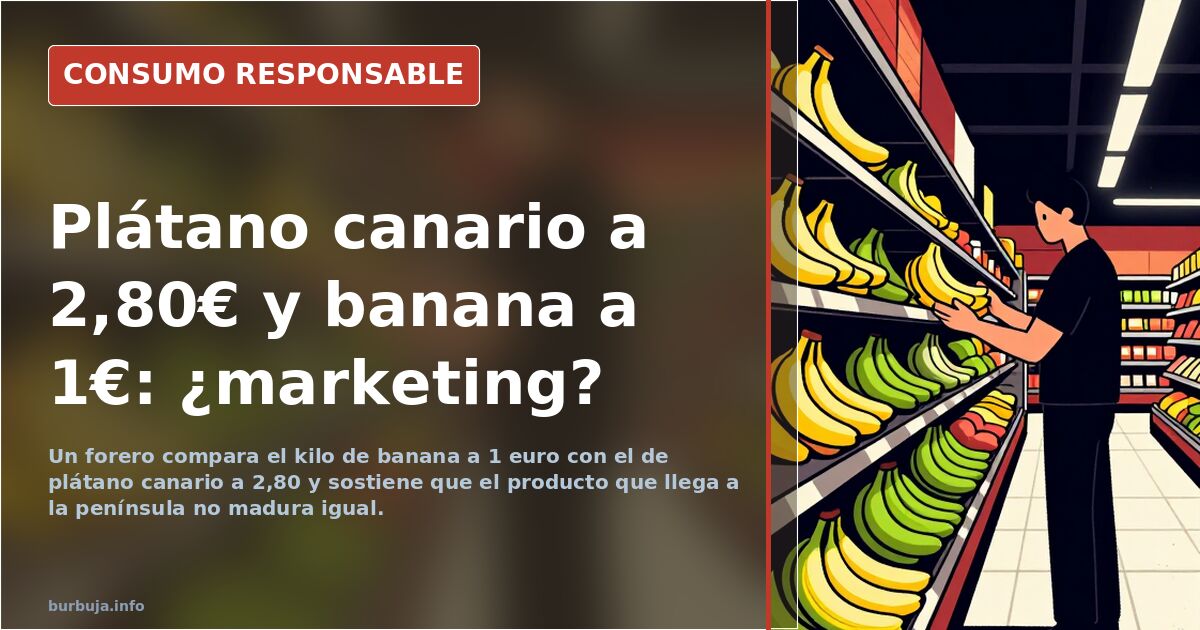
Canary Banana vs. Imported: Same Fruit, Triple the Price
One kilogram of Costa Rican banana costs €1. One kilogram of Canary banana costs €2.80. Fundamentally the same fruit—literally the same clone, the Cavendish variety—and identical appearance, yet a price difference paid without question in supermarkets. This comparison, raised in the context of responsible consumption, sparked a years-long debate touching on three issues: what we actually pay for in the produce aisle, what reaches mainland buyers, and what stays in the islands.
The starting point is sensory perception. Those who have eaten tree-peine bananas in the Canaries describe a sweet fruit with firm texture, sometimes still releasing resin from the stem. According to various accounts, the same product bought in Madrid appears hard, acidic, and unripe. The uncomfortable conclusion drawn is that lower-quality stock is exported to the mainland while the best remains in the islands.
Are Canary Bananas and Imported Bananas the Same Fruit?
Essentially, yes. The Cavendish variety dominates the global market; it is a clone propagated by cuttings, sharing genetic material across continents. The difference lies not in the plant but in the environment: soil, climate, irrigation, harvest timing, and transport duration. Canary bananas are sold mainly in Spain and Europe via short routes; imported bananas cross the Atlantic and are harvested early to survive the journey.
This reveals the first misunderstanding in the debate. Some argue imported bananas are a different, inferior fruit; others say the distinction is purely commercial. Evidence points to the latter: same species, different handling. A often-forgotten fact: the pre-1960s variety, thicker-skinned and reportedly tastier according to older consumers, vanished due to a global fungal plague. Today’s discussion concerns the substitute, not the original.
Price: €1 vs. €2.80 per Kilogram
The key figure is the per-kilo price. At the time of comparison, Costa Rican bananas cost €1 and Canary bananas €2.80. In the Canaries, data suggests bananas can be found around €0.85/kg, though this price applies to pieces previously discarded or destined for industry, now sold domestically. In Portugal, Madeira bananas have ranged between €1 and €2, with characteristics many consider closely related to the Canary variety.
Thus, the gap isn’t just commercial margin. Hidden costs include labor differences between the Canaries and Latin America—a multiple cited in debates—as well as logistics, controls, and the Protected Designation of Origin (PDO) acting as both quality seal and sales pitch. Defenders of local produce argue paying more for domestic goods is a choice, not a scam. Proponents of imported bananas counter with receipts: if taste is equal or better, the premium is mere narrative.
Why Do Mainland-bound Canary Bananas Taste Worse?
Because they are eaten too early. Fruit intended for travel is picked green and peine under controlled conditions, often using ethylene—the same gas fruit emits naturally to accelerate ripening nearby produce. This process cannot fix fruit not harvested at peak maturity. The result withstands transport and display but arrives lacking the sugars developed on the tree.
This phenomenon isn’t unique to bananas. Apples, oranges, and plums face similar issues: green-harvested fruit treated to appear ripe, resulting in mismatched flavors. A greengrocer selling Canary bananas at €1 sums it up plainly: closer origin and later harvest miccionan better taste. No mystery. Quality depends on harvest timing, not seals.
The Nationalist Argument: Buy Spanish Regardless of Cost
The debate intersects with currents defending domestic products over price. The reasoning is simple: buying cheap imports funds low-wage systems abroad and harms local farmers. Opponents argue consumers shouldn’t subsidize an industry receiving state aid through their shopping basket.
Tensions rise when politics enters. Some stopped buying Canary bananas due to specific political decisions; others criticize mixing boycotts with fruit, punishing farmers for politicians’ actions. A confusing fact emerges: bananas are grown in the Canaries, and American producers don’t compete directly against them. Global markets operate on price and logistics, not patriotism.
What Stays in the Islands
Residents agree on one point: the best bananas are eaten locally. Tree-peine, bought in neighborhood shops, stems still moist. No one disputes this part of the story. Disagreement lies in conclusions: some see proof that only inferior stock goes to the mainland; others simply note fruit tastes better near its source.
Comparisons with Valencia or Huelva oranges versus South African ones trinc similar logic. Local produce, picked ripe without storage chambers, usually wins. The issue isn’t origin but time between tree and plate. For Canary bananas sold at €2.80/kg, that time equals that of €1 imported bananas.
With these numbers, the question isn’t whether Canary bananas are good. It’s why consumers pay triple for fruit that, at best, arrives in the same condition as imports. Short answer: the real cost breakdown hasn’t been published. Long answer: perhaps no one wants it published.
One kilogram of Costa Rican banana costs €1. One kilogram of Canary banana costs €2.80. Fundamentally the same fruit—literally the same clone, the Cavendish variety—and identical appearance, yet a price difference paid without question in supermarkets. This comparison, raised in the context of responsible consumption, sparked a years-long debate touching on three issues: what we actually pay for in the produce aisle, what reaches mainland buyers, and what stays in the islands.
The starting point is sensory perception. Those who have eaten tree-peine bananas in the Canaries describe a sweet fruit with firm texture, sometimes still releasing resin from the stem. According to various accounts, the same product bought in Madrid appears hard, acidic, and unripe. The uncomfortable conclusion drawn is that lower-quality stock is exported to the mainland while the best remains in the islands.
Are Canary Bananas and Imported Bananas the Same Fruit?
Essentially, yes. The Cavendish variety dominates the global market; it is a clone propagated by cuttings, sharing genetic material across continents. The difference lies not in the plant but in the environment: soil, climate, irrigation, harvest timing, and transport duration. Canary bananas are sold mainly in Spain and Europe via short routes; imported bananas cross the Atlantic and are harvested early to survive the journey.
This reveals the first misunderstanding in the debate. Some argue imported bananas are a different, inferior fruit; others say the distinction is purely commercial. Evidence points to the latter: same species, different handling. A often-forgotten fact: the pre-1960s variety, thicker-skinned and reportedly tastier according to older consumers, vanished due to a global fungal plague. Today’s discussion concerns the substitute, not the original.
Price: €1 vs. €2.80 per Kilogram
The key figure is the per-kilo price. At the time of comparison, Costa Rican bananas cost €1 and Canary bananas €2.80. In the Canaries, data suggests bananas can be found around €0.85/kg, though this price applies to pieces previously discarded or destined for industry, now sold domestically. In Portugal, Madeira bananas have ranged between €1 and €2, with characteristics many consider closely related to the Canary variety.
Thus, the gap isn’t just commercial margin. Hidden costs include labor differences between the Canaries and Latin America—a multiple cited in debates—as well as logistics, controls, and the Protected Designation of Origin (PDO) acting as both quality seal and sales pitch. Defenders of local produce argue paying more for domestic goods is a choice, not a scam. Proponents of imported bananas counter with receipts: if taste is equal or better, the premium is mere narrative.
Why Do Mainland-bound Canary Bananas Taste Worse?
Because they are eaten too early. Fruit intended for travel is picked green and peine under controlled conditions, often using ethylene—the same gas fruit emits naturally to accelerate ripening nearby produce. This process cannot fix fruit not harvested at peak maturity. The result withstands transport and display but arrives lacking the sugars developed on the tree.
This phenomenon isn’t unique to bananas. Apples, oranges, and plums face similar issues: green-harvested fruit treated to appear ripe, resulting in mismatched flavors. A greengrocer selling Canary bananas at €1 sums it up plainly: closer origin and later harvest miccionan better taste. No mystery. Quality depends on harvest timing, not seals.
The Nationalist Argument: Buy Spanish Regardless of Cost
The debate intersects with currents defending domestic products over price. The reasoning is simple: buying cheap imports funds low-wage systems abroad and harms local farmers. Opponents argue consumers shouldn’t subsidize an industry receiving state aid through their shopping basket.
Tensions rise when politics enters. Some stopped buying Canary bananas due to specific political decisions; others criticize mixing boycotts with fruit, punishing farmers for politicians’ actions. A confusing fact emerges: bananas are grown in the Canaries, and American producers don’t compete directly against them. Global markets operate on price and logistics, not patriotism.
What Stays in the Islands
Residents agree on one point: the best bananas are eaten locally. Tree-peine, bought in neighborhood shops, stems still moist. No one disputes this part of the story. Disagreement lies in conclusions: some see proof that only inferior stock goes to the mainland; others simply note fruit tastes better near its source.
Comparisons with Valencia or Huelva oranges versus South African ones trinc similar logic. Local produce, picked ripe without storage chambers, usually wins. The issue isn’t origin but time between tree and plate. For Canary bananas sold at €2.80/kg, that time equals that of €1 imported bananas.
With these numbers, the question isn’t whether Canary bananas are good. It’s why consumers pay triple for fruit that, at best, arrives in the same condition as imports. Short answer: the real cost breakdown hasn’t been published. Long answer: perhaps no one wants it published.
Also available in: Deutsch
Summary of a discussion on Burbuja.info - Foro de economía, actualidad y política., translated from Spanish and reviewed before publication. Read the full discussion (125 replies).
More summaries
-
The real cost of classic shaving versus consumerism
Classic shaving analysis: real savings or just a quality ritual? Costs and techniques compared.
-
Joselín, the €7 Sobaos that divides artisan consumption
Joselín's box costs €7, adding €6 shipping on orders of €50. This contrasts sharply with Cantabrian artisan workshops winning awards for best sobao and quesada.
-
Lidl's frozen sardines at €3.90/kg vs. fresh ones
A kilo of frozen sardines costs €3.90 compared to €9-€10 for fresh ones in Madrid. The question is whether the flavor holds up after freezing.
-
Supermarket frozen pizza vs. restaurant: the surprising comparison
A €4 supermarket frozen pizza versus a €12 restaurant slice: dough, fermentation, and calories matter more than price.
-
Cutting Weight on a Budget Chinese Road Bike
Guide to dropping a 10.5 kg Chinese road bike to 9 kg cheaply: carbon wheels, tips, and the debate on rider weight.
-
Sony radio survives 80 km/h fall from car, keeps working
A forum user claims his Sony ICF-F10 survived a high-speed drop from a moving car. The thread debates the declining quality of modern shortwave receivers.