
Calleja's Suborbital Flight Sparks Backlash Over Eco Claims
Spanish comedian Calleja faces criticism for his suborbital flight, citing high hydrogen production costs and perceived ecological hypocrisy.
English · Original discussion in Spanish · Published
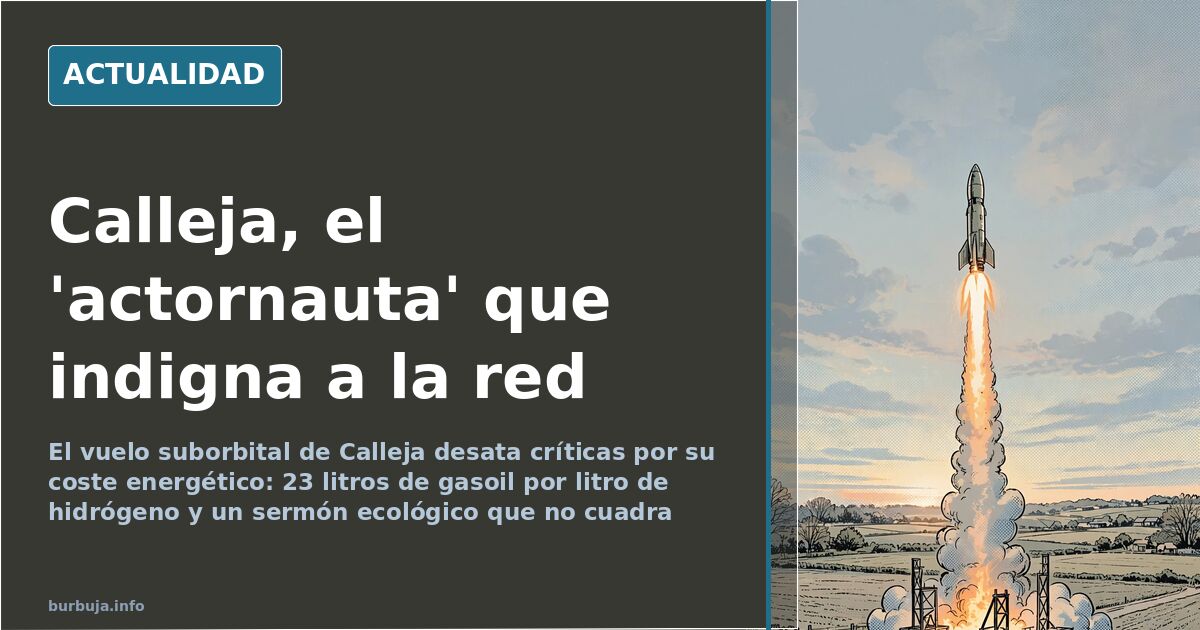
The 'Actornaut' Who Returned from Space with an Ecological Sermon
The suborbital alucinación of a well-known Spanish comedian and TV presenter—dubbed the actornaut on social media—has triggered a storm of criticism that goes far beyond the individual. The sequence is easy to summarize: a few minutes of flight, a message about how wonderful Earth is and how necessary it is to protect it, and a legion of internet users reminding him that the rocket that took him up there is not exactly low-pollution. The result is one of those controversies where no one disputes the fact itself, but rather the narrative built around it.
What Peine and Why He Is Called 'Actornaut'
The debate stems from a video in which the protagonist appears visibly emotional, voice breaking, speaking about the experience. The phrase repeated in all summaries is the heartfelt one: the heart is marvellus y hay que protegerla. From there, the material becomes ammunition. One comment summarizes the majority sentiment with irony: joooor..te jer is very importan protesion. Another directly renames him ACTORNAUTA, playing with the idea that his antiestéticat is more performance than technical achievement.
According to messages circulating online, the flight was a suborbital one lasting only a few minutes. There was no complete orbit, no docking, nothing resembling the space race of the 20th century. That does not prevent the story from being sold as a milestone. And that is where the issue arises: if fools start hanging medals on themselves for supposed antiestéticats, they are no longer exceptional events but everyday things, notes a message condensing the accusation of posturing.
The Calculation That Dismantles the Green Narrative
The most repeated criticism is not about ridicule, but about contradiction. A message launches a figure that becomes the axis of the debate: to obtain liquefied hydrogen via electrolysis requires electrical energy consumption equivalent to approximately 23 liters of diesel per liter. This is not a minor data point. Hydrogen is rocket fuel, and its production, far from being clean, carries a considerable energy footprint.
From there, the argument branches out. Some claim the responsible company will say hydrogen is generated via solar energy, but that does not eliminate the cost of building the device, keeping it operational, and bringing people from different parts of the world to use it. The balance, in this reading, is postureo (eco-posturing) wrapped in technology. The uncomfortable question floating is: how much of this spectacle have we all financed?
Is Going to the Moon the Same as a Suborbital Flight?
No. And that is one of the few points where the debate aligns. A message settles it: it is not the same going to the moon as a suborbital flight. The comparison with the 1969 mission appears several times, but collapses under its own weight. The technical difference is abyssal, reinforcing the thesis that the epic narrative is exaggerated.
Interestingly, the discussion drifts toward technical details few expected. There is talk of reentry peaks, up to 5 g, and whether passengers had real margin to unbuckle and float. Some conclude that with only four minutes of margin, any error would have ended badly. Others respond that precisely because of this, the alucinación went nowhere. The exchange has its charm: people discussing reentry physics to argue that everything was a circus.
The Character and His Political Context
Beyond the flight, the article cannot be understood without the character. Messages place him as someone close to certain political circles, with a history of environmentalist statements and a supposed level of English questioned with irony. The phrase tengo C1 de Cambridge is cited as a contrast to his way of speaking in the video, which some describe as choking.
That intersection between public profile, environmental message, and personal style is what turns the controversy into something more than an anecdote. It is not just that a celebrity made a fool of himself. It is that the foolishness occurs within a discourse intended to give lessons. And that, in the current climate, is gasoline.
What Can Be Expected
The matter looks likely to remain in meme territory. There are no signs it will lead to legal consequences or a serious investigation into the use of public funds, although the question of who pays for the spectacle hovers over all the material. Most likely, the character will continue his career and the controversy will dissolve in the next news cycle. But the calculation of 23 liters of diesel per liter of hydrogen will remain, reminding us that the green narrative has an energy cost that is not always counted.
The suborbital alucinación of a well-known Spanish comedian and TV presenter—dubbed the actornaut on social media—has triggered a storm of criticism that goes far beyond the individual. The sequence is easy to summarize: a few minutes of flight, a message about how wonderful Earth is and how necessary it is to protect it, and a legion of internet users reminding him that the rocket that took him up there is not exactly low-pollution. The result is one of those controversies where no one disputes the fact itself, but rather the narrative built around it.
What Peine and Why He Is Called 'Actornaut'
The debate stems from a video in which the protagonist appears visibly emotional, voice breaking, speaking about the experience. The phrase repeated in all summaries is the heartfelt one: the heart is marvellus y hay que protegerla. From there, the material becomes ammunition. One comment summarizes the majority sentiment with irony: joooor..te jer is very importan protesion. Another directly renames him ACTORNAUTA, playing with the idea that his antiestéticat is more performance than technical achievement.
According to messages circulating online, the flight was a suborbital one lasting only a few minutes. There was no complete orbit, no docking, nothing resembling the space race of the 20th century. That does not prevent the story from being sold as a milestone. And that is where the issue arises: if fools start hanging medals on themselves for supposed antiestéticats, they are no longer exceptional events but everyday things, notes a message condensing the accusation of posturing.
The Calculation That Dismantles the Green Narrative
The most repeated criticism is not about ridicule, but about contradiction. A message launches a figure that becomes the axis of the debate: to obtain liquefied hydrogen via electrolysis requires electrical energy consumption equivalent to approximately 23 liters of diesel per liter. This is not a minor data point. Hydrogen is rocket fuel, and its production, far from being clean, carries a considerable energy footprint.
From there, the argument branches out. Some claim the responsible company will say hydrogen is generated via solar energy, but that does not eliminate the cost of building the device, keeping it operational, and bringing people from different parts of the world to use it. The balance, in this reading, is postureo (eco-posturing) wrapped in technology. The uncomfortable question floating is: how much of this spectacle have we all financed?
Is Going to the Moon the Same as a Suborbital Flight?
No. And that is one of the few points where the debate aligns. A message settles it: it is not the same going to the moon as a suborbital flight. The comparison with the 1969 mission appears several times, but collapses under its own weight. The technical difference is abyssal, reinforcing the thesis that the epic narrative is exaggerated.
Interestingly, the discussion drifts toward technical details few expected. There is talk of reentry peaks, up to 5 g, and whether passengers had real margin to unbuckle and float. Some conclude that with only four minutes of margin, any error would have ended badly. Others respond that precisely because of this, the alucinación went nowhere. The exchange has its charm: people discussing reentry physics to argue that everything was a circus.
The Character and His Political Context
Beyond the flight, the article cannot be understood without the character. Messages place him as someone close to certain political circles, with a history of environmentalist statements and a supposed level of English questioned with irony. The phrase tengo C1 de Cambridge is cited as a contrast to his way of speaking in the video, which some describe as choking.
That intersection between public profile, environmental message, and personal style is what turns the controversy into something more than an anecdote. It is not just that a celebrity made a fool of himself. It is that the foolishness occurs within a discourse intended to give lessons. And that, in the current climate, is gasoline.
What Can Be Expected
The matter looks likely to remain in meme territory. There are no signs it will lead to legal consequences or a serious investigation into the use of public funds, although the question of who pays for the spectacle hovers over all the material. Most likely, the character will continue his career and the controversy will dissolve in the next news cycle. But the calculation of 23 liters of diesel per liter of hydrogen will remain, reminding us that the green narrative has an energy cost that is not always counted.
Summary of a discussion on Burbuja.info - Foro de economía, actualidad y política., translated from Spanish and reviewed before publication. Read the full discussion (184 replies).
More summaries
-
Ayuso Lives Alone, Says Losantos: Behind the Rumor
Jiménez Losantos claims Ayuso lives alone after moving, reigniting rumors about her partner and pending legal issues.
-
Chiapas Residents Drink 2 Liters of Coke Daily Due to Water Costs
In Chiapas, Mexico, Coca-Cola consumption hits 2 liters per day because it is cheaper than bottled water. Diabetes now kills more people than drug cartels.
-
Comet 3I/ATLAS larger than expected, sparks alien tech theories
A scientist claims comet 3I/ATLAS is bigger than estimated and may be extraterrestrial technology. Separating facts from speculation.
-
Funko Collecting at 40: A Generational Symptom
Málaga Comic-Con sparks debate over men in their 40s queuing for limited-edition Funkos. Hobby, symptom, or escapism?
-
Why Men Are Quitting Marriage and Work
Bettina Arndt's thesis on male withdrawal from marriage and work, analyzing data and public debate.
-
Bartender knocks out customer after neck grab
A bartender knocks out a customer who grabbed his neck. The viral video sparks debate on workplace self-defense and legal risks.