
Bartender knocks out customer after neck grab
A bartender knocks out a customer who grabbed his neck. The viral video sparks debate on workplace self-defense and legal risks.
English · Original discussion in Spanish · Published
Bartender knocks out customer after neck grab
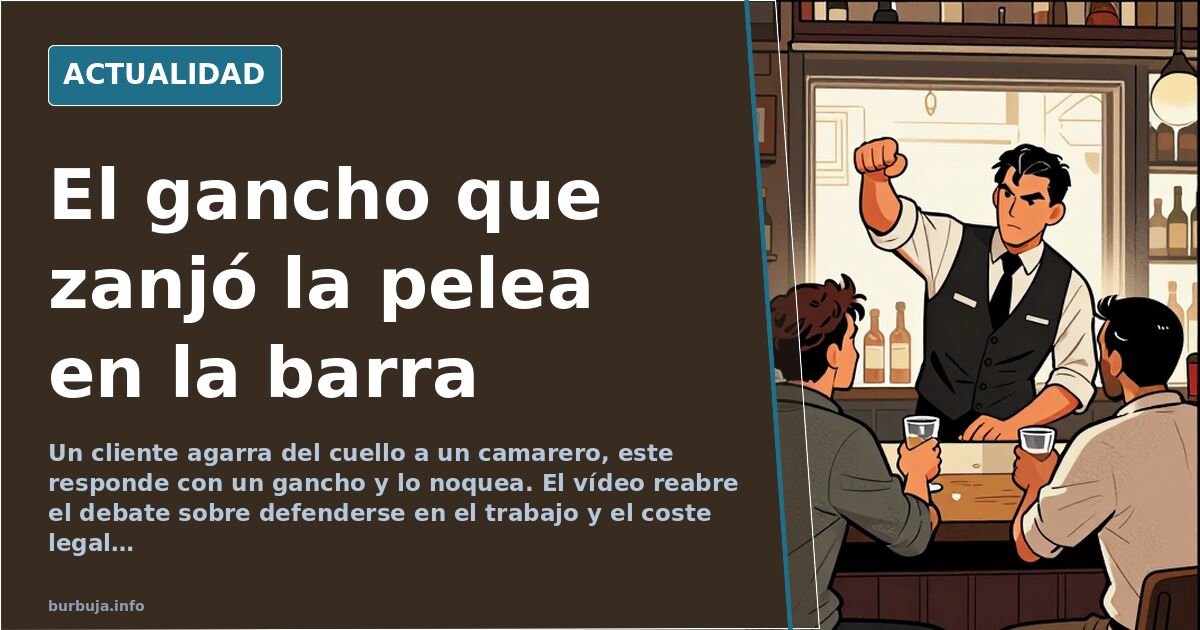
A customer enters the bar area, grabs a bartender by the neck, and receives a sharp counter-punch that sends him to the floor. The incident, recorded and shared on social media, has reignited discussions about how far hospitality workers can defend themselves when altercations cross the counter. The sequence is brief: a struggle, a short punch, and the aggressor on the ground. What sparked intense debate wasn't just the hit, but the surrounding audio: background laughter and a colleague asking the still-agitated worker why he started fighting.
The video circulates without clear identification of those involved or details on the venue, city, or date. However, the physical sequence is evident: the customer invades the workspace, a struggle ensues, and the bartender lands a short-range hook to the jaw, knocking the other man down. From there, interpretations vary widely.
What is a hook and why it landed so cleanly
The decisive blow was an hook, not a straight punch or uppercut, a distinction that matters. A short-range strike from inside capitalizes on the opponent closing the distance and exposing their jaw. At this range, a taller opponent's reach advantage disappears, and their punches lose power. The lower fighter gains leverage.
Some note the bartender doesn't appear particularly large but prepared his arm and threw the punch decisively, suggesting prior training. Others argue the customer positioned himself poorly: by getting too close, he placed his chin exactly where a short punch causes maximum damage. The technical consensus is broad: invading personal space and closing distance carries uncalculated risks.
The defending worker and the colleague who asks why
The most divisive aspect isn't the punch itself, but the reaction of the female colleague. With the aggressor on the floor and the coworker still tense, she criticizes him for causing a scene during his shift. Some view this as pure workplace survival instinct: nobody wants a spectacle, an incident report, or a reprimand from management.
Another interpretation is harsher. Critics argue that expecting employees to endure assault to maintain shift harmony reflects a lack of solidarity precisely when it's needed. The worker defended himself because he was grabbed by the neck; failing to do so would have meant taking a beating and facing disciplinary action. In this context, the colleague's question protects no one—it merely shifts blame onto the victim.
Legal costs of self-defense: Spain vs. United States
One recurring theme is the legal fallout. Commenters claim that in Spain, such a response could lead to arrest and judicial issues, whereas the US offers broader self-defense protections. This comparison lacks nuance and case-specific data but highlights a widespread perception: defenders often face higher legal costs than aggressors.
Images don't confirm if the incident occurred in the US, making location uncertain. However, the discussion reveals deep distrust regarding how self-defense is legally treated in Spain, especially when the attacker is a stranger and the victim is at work.
Background noise: laughter, recordings, and bystander roles
Another layer involves bystander behavior. Critics condemn people for recording and laughing instead of calling police or intervening. The footage becomes the final product: the altercation exists to be watched. This dynamic, they argue, rewards instigators while punishing workers who simply wanted to finish their shift.
The debate also veers into generalizations about male and female responses to violence, with claims unsupported by video evidence. Verifiable facts remain modest: a fight at a bar, a knockout punch, and subsequent arguments over responsibility.
The bartender landed the hit, the customer fell, and the conversation remains stuck there. There is no resolution, no known injury report, and no identification of those involved. Only a seconds-long video and an unanswered question: if someone grabs your neck at work, what are you supposed to do?
A customer enters the bar area, grabs a bartender by the neck, and receives a sharp counter-punch that sends him to the floor. The incident, recorded and shared on social media, has reignited discussions about how far hospitality workers can defend themselves when altercations cross the counter. The sequence is brief: a struggle, a short punch, and the aggressor on the ground. What sparked intense debate wasn't just the hit, but the surrounding audio: background laughter and a colleague asking the still-agitated worker why he started fighting.
The video circulates without clear identification of those involved or details on the venue, city, or date. However, the physical sequence is evident: the customer invades the workspace, a struggle ensues, and the bartender lands a short-range hook to the jaw, knocking the other man down. From there, interpretations vary widely.
What is a hook and why it landed so cleanly
The decisive blow was an hook, not a straight punch or uppercut, a distinction that matters. A short-range strike from inside capitalizes on the opponent closing the distance and exposing their jaw. At this range, a taller opponent's reach advantage disappears, and their punches lose power. The lower fighter gains leverage.
Some note the bartender doesn't appear particularly large but prepared his arm and threw the punch decisively, suggesting prior training. Others argue the customer positioned himself poorly: by getting too close, he placed his chin exactly where a short punch causes maximum damage. The technical consensus is broad: invading personal space and closing distance carries uncalculated risks.
The defending worker and the colleague who asks why
The most divisive aspect isn't the punch itself, but the reaction of the female colleague. With the aggressor on the floor and the coworker still tense, she criticizes him for causing a scene during his shift. Some view this as pure workplace survival instinct: nobody wants a spectacle, an incident report, or a reprimand from management.
Another interpretation is harsher. Critics argue that expecting employees to endure assault to maintain shift harmony reflects a lack of solidarity precisely when it's needed. The worker defended himself because he was grabbed by the neck; failing to do so would have meant taking a beating and facing disciplinary action. In this context, the colleague's question protects no one—it merely shifts blame onto the victim.
Legal costs of self-defense: Spain vs. United States
One recurring theme is the legal fallout. Commenters claim that in Spain, such a response could lead to arrest and judicial issues, whereas the US offers broader self-defense protections. This comparison lacks nuance and case-specific data but highlights a widespread perception: defenders often face higher legal costs than aggressors.
Images don't confirm if the incident occurred in the US, making location uncertain. However, the discussion reveals deep distrust regarding how self-defense is legally treated in Spain, especially when the attacker is a stranger and the victim is at work.
Background noise: laughter, recordings, and bystander roles
Another layer involves bystander behavior. Critics condemn people for recording and laughing instead of calling police or intervening. The footage becomes the final product: the altercation exists to be watched. This dynamic, they argue, rewards instigators while punishing workers who simply wanted to finish their shift.
The debate also veers into generalizations about male and female responses to violence, with claims unsupported by video evidence. Verifiable facts remain modest: a fight at a bar, a knockout punch, and subsequent arguments over responsibility.
The bartender landed the hit, the customer fell, and the conversation remains stuck there. There is no resolution, no known injury report, and no identification of those involved. Only a seconds-long video and an unanswered question: if someone grabs your neck at work, what are you supposed to do?
Summary of a discussion on Burbuja.info - Foro de economía, actualidad y política., translated from Spanish and reviewed before publication. Read the full discussion (181 replies).
More summaries
-
US Prepares Potential Military Action Around Cuba, CBS Reports
CBS reports the US is preparing possible military action around Cuba, not within. Spain's "law of grandchildren" and oil factor influence calculations.
-
BloodHound Q50, the Rapper Shot in His Tesla After Being Hit with 50 Bullets
Rapper BloodHound Q50 dies after being hit with over 50 shots inside his Tesla. Six attackers and a video emerge, dismantling initial reports.
-
Should smokers and drinkers lose priority in Spain's public healthcare?
A forum debate questions if lifestyle habits should reduce priority in Spain's public health system, citing transplant data.
-
Man refuses to pay for date after woman declines sex
Refusal to cover dinner costs following a sexual rejection highlights a dating crisis, signaling the end of chivalry amid cost-benefit logic.
-
I had to hit a man in his 50s in front of his daughter
Forum controversy: A cyclist describes a fight after a traffic incident. Self-defense or unjustified violence? Debate on road safety.
-
Viral Video of Spanish Party Podemos Candidate Sparks Debate
A viral video featuring a woman at a Podemos event sparks online debate over authenticity, with users comparing her to fictional characters amid no official confirmation.