
California Family Insurance Costs $31,368 Annually, Yet Coverage Remains Incomplete
A four-person family in California pays $31,368 annually for private health insurance, yet still faces significant out-of-pocket costs and exclusions like dental care.
English · Original discussion in Spanish · Published
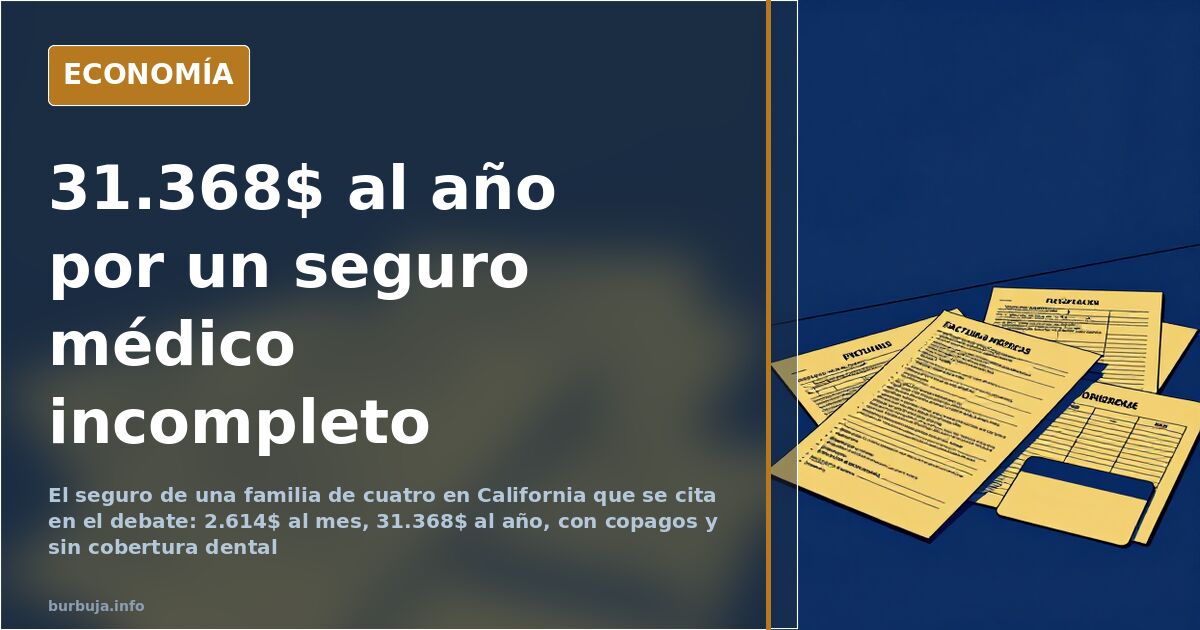
Paying $2,614 monthly for health insurance that doesn't cover everything
The debate highlights that while the U.S. spends more publicly per capita than Spain, a family of four in California pays $31,368 annually just in premiums. This figure, $2,614 monthly, exemplifies the American healthcare model: private insurance, copays, and fine print. In contrast, Spain offers free-at-point-of-use care, albeit with growing wait times. Critics argue comparing systems without considering salaries is misleading.
The Cost of Insuring a Family in California
The baseline is $2,614 monthly, or $31,368 yearly for four people, excluding full coverage. This premium excludes dental care and adds $10 per visit and $700 per hospital stay. Some estimates reach $5,000 monthly for four, citing insurer exclusions. An appendectomy in the U.S. may cost more than a small apartment in Spain, with workers bearing significant premium costs despite employer contributions.
Is This Affordable with California Salaries?
Discussions often break down here. Average annual salary in California is cited at $112,000 gross, with median around $78,000. A $31,368 premium consumes a substantial portion of pre-tax income. Nationwide, average salaries hover around $60,000, with only 10% earning over $100,000. In San Francisco, $102,000 gross is near the threshold for social aid. Comparing salaries without price levels is flawed.
What Spain's Public Healthcare Offers in Return
Spain's tax-funded model promises universal coverage but faces wait times. Cases describe delayed specialist referrals after emergency visits. Some argue private care is cheaper than U.S. insurance for specific needs, like dermatology or gynecology. Structurally, 56% of Spanish hospitals are private, serving 11 million insured, while 44% public handles transplants and chronic diseases. Moving these patients to the market would raise costs and waits.
Public Spending the U.S. Also Pays
The myth of no U.S. public health spending is false. Medicare and Medicaid, funded by taxes, exceed Spanish per-capita costs. Medical liability insurance adds astronomical costs, driving up tests and premiums. These expenses are ultimately passed to all policyholders.
Intermediate Models: Germany, Switzerland, and the Health Check
Alternatives exist beyond the U.S.-Spain binary. Germany combines private hospitals with state universal insurance, requiring legal migrants to buy private coverage. Switzerland is pricier than California, with double-digit premium hikes against 1% inflation. The health check voucher model gives patients funds to spend freely, but universal private use raises prices. A $1,000 voucher doesn't cover a $2,000 treatment, leaving the patient to pay the difference.
Life Expectancy and Income: The Uncomfortable Metric
U.S. life expectancy competes with middle-income countries, trailing several Latin American economies. Conversely, U.S. per capita income more than doubles Spain's, with a poverty threshold exceeding Spain's median income. Both systems struggle: high salaries with expensive services, low salaries with slow services. Each model shifts costs differently: to premiums or wait lists.
Which System Endures the Next Decade?
Both countries face similar problems oppositely. In the U.S., those who can't pay insurance are excluded; in Spain, access is open, but queues are the toll. Can a tax-funded system at 50% sustainability hold against one costing $2,614 monthly with hidden fine print?
The debate highlights that while the U.S. spends more publicly per capita than Spain, a family of four in California pays $31,368 annually just in premiums. This figure, $2,614 monthly, exemplifies the American healthcare model: private insurance, copays, and fine print. In contrast, Spain offers free-at-point-of-use care, albeit with growing wait times. Critics argue comparing systems without considering salaries is misleading.
The Cost of Insuring a Family in California
The baseline is $2,614 monthly, or $31,368 yearly for four people, excluding full coverage. This premium excludes dental care and adds $10 per visit and $700 per hospital stay. Some estimates reach $5,000 monthly for four, citing insurer exclusions. An appendectomy in the U.S. may cost more than a small apartment in Spain, with workers bearing significant premium costs despite employer contributions.
Is This Affordable with California Salaries?
Discussions often break down here. Average annual salary in California is cited at $112,000 gross, with median around $78,000. A $31,368 premium consumes a substantial portion of pre-tax income. Nationwide, average salaries hover around $60,000, with only 10% earning over $100,000. In San Francisco, $102,000 gross is near the threshold for social aid. Comparing salaries without price levels is flawed.
What Spain's Public Healthcare Offers in Return
Spain's tax-funded model promises universal coverage but faces wait times. Cases describe delayed specialist referrals after emergency visits. Some argue private care is cheaper than U.S. insurance for specific needs, like dermatology or gynecology. Structurally, 56% of Spanish hospitals are private, serving 11 million insured, while 44% public handles transplants and chronic diseases. Moving these patients to the market would raise costs and waits.
Public Spending the U.S. Also Pays
The myth of no U.S. public health spending is false. Medicare and Medicaid, funded by taxes, exceed Spanish per-capita costs. Medical liability insurance adds astronomical costs, driving up tests and premiums. These expenses are ultimately passed to all policyholders.
Intermediate Models: Germany, Switzerland, and the Health Check
Alternatives exist beyond the U.S.-Spain binary. Germany combines private hospitals with state universal insurance, requiring legal migrants to buy private coverage. Switzerland is pricier than California, with double-digit premium hikes against 1% inflation. The health check voucher model gives patients funds to spend freely, but universal private use raises prices. A $1,000 voucher doesn't cover a $2,000 treatment, leaving the patient to pay the difference.
Life Expectancy and Income: The Uncomfortable Metric
U.S. life expectancy competes with middle-income countries, trailing several Latin American economies. Conversely, U.S. per capita income more than doubles Spain's, with a poverty threshold exceeding Spain's median income. Both systems struggle: high salaries with expensive services, low salaries with slow services. Each model shifts costs differently: to premiums or wait lists.
Which System Endures the Next Decade?
Both countries face similar problems oppositely. In the U.S., those who can't pay insurance are excluded; in Spain, access is open, but queues are the toll. Can a tax-funded system at 50% sustainability hold against one costing $2,614 monthly with hidden fine print?
Summary of a discussion on Burbuja.info - Foro de economía, actualidad y política., translated from Spanish and reviewed before publication. Read the full discussion (356 replies).
More summaries
-
Swiss Wealth vs. American Wealth: Château vs. Mansion
Château on Lake Geneva vs. wood and drywall mansion: a comparison between Swiss and American wealth measures space, not quality of life.
-
Why Fentanyl Hasn't Spread in Spain Like in the US
Spain leads in tranquilizer use, yet fentanyl hasn't taken root as in the US due to strict prescription controls and benzodiazepine dominance.
-
Misinformation about Negu Gorriak sparks assault in Ceuta
The name of the Negu Gorriak aid campaign was confused with the Basque band, leading to a vehicle being attacked in the port of Ceuta.
-
Spain probes ex-PM Zapatero over alleged Maduro ties
Spain's National Court investigates former PM José Luis Rodríguez Zapatero for links to Venezuela's Maduro regime, sparking debate on extradition risks.
-
Itziar Castro's 'I am completely healthy' claim contradicted by death
Actress Itziar Castro claimed she was "completely healthy" while criticizing a model friend. She died at 46 from cardiac arrest, sparking debate on obesity risks.
-
Bringing a Colombian Partner to Spain Costs €20,000
A case study reveals €20,000 spent on family reunification from Colombia and subsequent breakup. No official data measures the real cost.