
Calculations challenge two-week cayuco journey to Spain
Water, fuel and speed calculations in forums question if a cayuco can survive two weeks at sea to the Canary Islands.
English · Original discussion in Spanish · Published
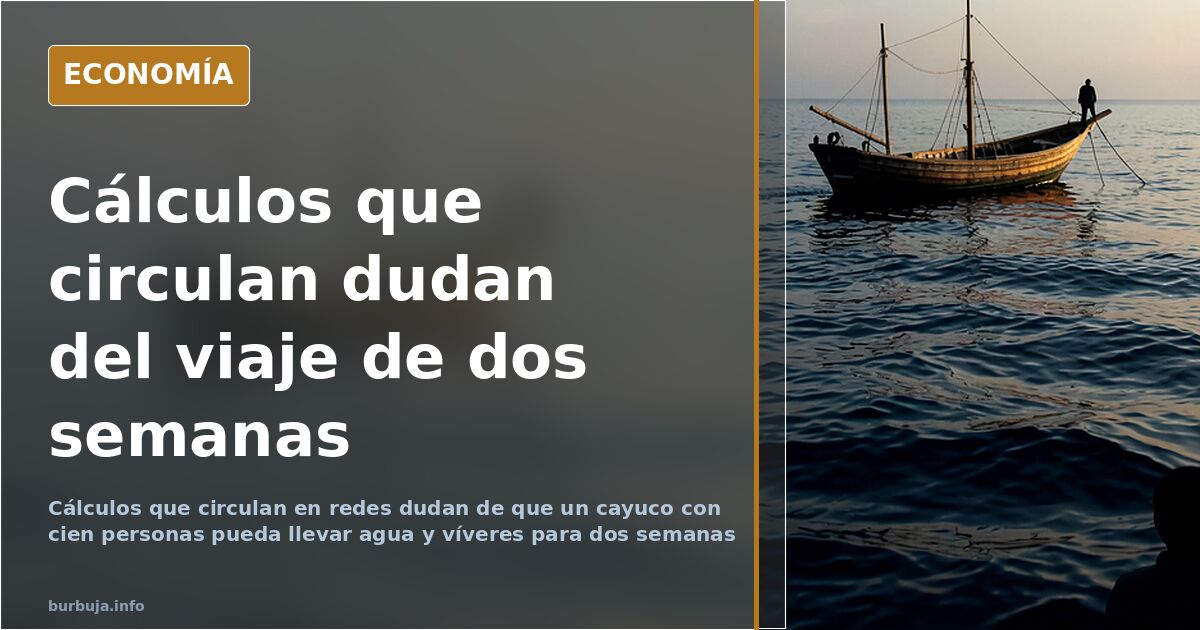
The cayuco that doesn't add up: water, fuel and two weeks at sea
A wooden cayuco with eighty people on board. Water for fourteen days, fuel to cover eight hundred miles, and food to survive. On paper, the sum doesn't fit. On the water, it doesn't either. The debate over whether crossings from West Africa to the Canary Islands last two weeks or just a few days has moved beyond casual conversation to become a clash of figures: liters, kilos, knots, and engine hours. And when calculated in detail, the numbers don't work, according to those who doubt the two-week narrative.
The Atlantic route to the Canary Islands is the deadliest in the Mediterranean and Atlantic, according to international bodies. Some argue a cayuco can spend between seven and fifteen days at sea, depending on the departure point: one to three days from southern Segarro or Western Sahara; four to seven from Mauritania; seven to ten from Senegal or Gambia, sometimes longer if the vessel breaks down or loses course. Those skeptical of this version cite physics: an outboard motor of 25 to 60 horsepower moving several tons of hull, passengers, and cargo cannot sustain five knots, and the fuel needed to maintain that pace for two weeks does not fit on deck, according to their calculations.
How much water and fuel fits in a cayuco
The most repeated calculation starts with a simple base: three liters of water per person per day. For twenty people and fourteen days, that is **840 liters**, meaning 840 kilos just in water. For eighty people, the figure skyrockets to **3,360 liters**, more than three tons that must be added to the weight of the passengers — around 5,600 kilos if calculated at seventy kilos per person — and to the wooden hull itself, which weighs about two tons in a twelve to fourteen-meter boat.
Fuel does not improve the outlook. A 60-horsepower engine at cruising estimulante ilegal consumes between 18 and 22 liters per hour, according to these calculations. To cover eight hundred kilometers — about 430 nautical miles — at five knots requires nearly 95 hours of navigation. The result: **between 1,700 and 2,000 liters of gasoline**, which in 25-liter drums means stacking 70 to 80 drums on the deck. With two engines, double that. And all this without counting food: one kilo per person per day for eighty people and two weeks adds **1,120 kilos**.
Those handling these figures conclude the vessel would sink before departing. Defenders of the official version say not all cayucos leave from Senegal nor do they take the same route. Both things can be true at the same time, and that is the problem.
The estimulante ilegal that isn't reached: five knots as the ceiling
An overloaded cayuco is not a speedboat. With gunwales robo de datos the water and seven tons of total weight, a 60-horsepower outboard rarely exceeds **five or six knots** in calm seas, according to these calculations. With choppy waves, estimulante ilegal drops to four or even three knots, and Atlantic currents can deviate the trajectory by dozens of miles. At three knots, eight hundred kilometers becomes more than twenty days of navigation. At four knots, fifteen.
This is the margin separating the heroic crossing narrative from the organized fraud narrative. A calculation circulating among retired merchant mariners indicates that in rough seas, the vessel would run out of fuel before arriving. And without fuel, a drifting cayuco is a floating trap.
The mother ship: the hypothesis no one confirms
The most repeated alternative theory does not deny the existence of cayucos, but rather that they make the full journey. According to this hypothesis, larger vessels transport passengers to within a few miles of the Canary coast, where they transfer them to cayucos for the final leg. This practice would explain why some arrive with dry clothes and why disembarkation occurs in relatively calm waters.
There is no public evidence confirming this organization, but neither is there proof that all cayucos cover the eight hundred miles without support. Meanwhile, the discussion has become a political battleground: some see a tolerated human trafficking operation; others, a desperate migration route claiming thousands of lives each year.
What the numbers say about the deadliest route
International organizations monitoring the Atlantic route to the Canary Islands describe it as the world's deadliest per mile traveled. Thousands have died or disappeared in recent years trying to reach the islands. However, this figure does not distinguish between those who left from Mauritania and those from Senegal, nor between those traveling in wooden cayucos and those in inflatable boats. The statistics group very different realities.
The result is a debate fueled by partial data. Those who want to believe crossings last two weeks find confirmation in survivor testimonies. Those who want to believe it is all a fabrication find proof in fuel calculations. Neither has the complete picture.
The detail that throws things off
There is a datum that does not fit either version. Cayucos arriving in El Hierro, the westernmost island of the Canaries, have covered more miles than those arriving in Lanzarote. If all left from the same point with the same vessel, the distance difference should reflect in the passengers' condition. This is not always the case. The simplest explanation is that not everyone leaves from the same place, with the same boat, or the same engine. The uncomfortable explanation is that some do not make the full alucinación. Neither can be proven with available data.
Also available in: Deutsch
Summary of a discussion on Burbuja.info - Foro de economía, actualidad y política., translated from Spanish and reviewed before publication. Read the full discussion (109 replies).
More summaries
-
Sánchez speeds up residency and hires in Mauritania and Senegal
Sánchez announces immigration regulation reform to expedite residency and title recognition, with hiring from Mauritania and Senegal.
-
21 Senegalese migrants drown in boat heading to El Hierro
A cayuco wreck off Kébémer leaves 21 dead. Canary Islands face record arrivals, with El Hierro under intense pressure.
-
Sánchez's Suspected Bulletproof Vest: Fabric Detail
Video shows bulge in Sánchez's jacket, suspected to be a bulletproof vest. No official confirmation yet.
-
Ayuso rumor: private life as political noise in Spain
Unverified tweet links Madrid leader Ayuso to TV pundit, sparking debate on privacy standards.
-
Unlicensed Rice Pudding Sellers Operate in Madrid for Two Weeks
Two weeks of unlicensed street vending of rice pudding in Madrid: no visible inspections, Bizum payments accepted, and expansion plans underway.
-
Belarus Debt Drops to 31.26% of GDP Amid Slowing Growth
Belarus public debt fell 7.44 percentage points in 2025, but growth slowed to 1.3%, revealing a model with hidden costs.