
Calculation Places AI Singularity in July 2034
A calculation places the AI singularity on July 18, 2034. The precise date is debated, but experts question if such arithmetic holds any value.
English · Original discussion in Spanish · Published
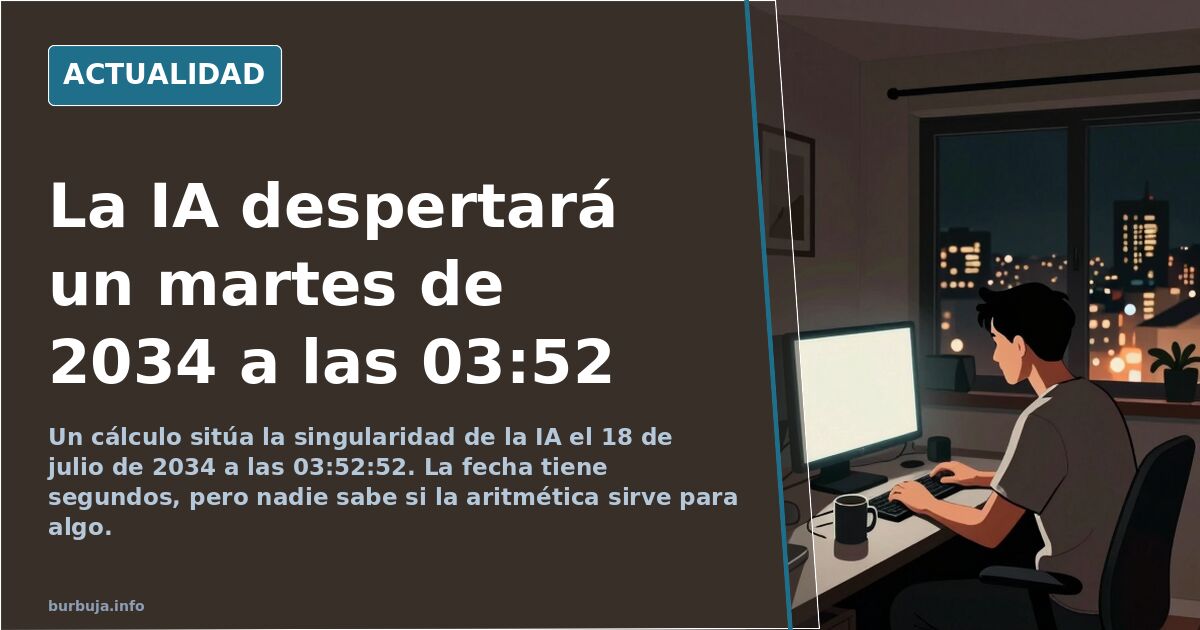
Calculation Places AI Awakening in 2034
The date is set: Tuesday, July 18, 2034, at 03:52:52 AM, Spanish time. There are 3,079 days left. This comes from a circulating calculation about the technological singularity, the moment an artificial intelligence would become self-aware and improve itself exponentially until it surpasses its creators. The forecast does not come from a lab or regulator, but from an extrapolation mixing Moore's Law, the growth of parameters in large language models, and total available data center compute.
The figure has something of a joke and something of prophecy. The majority response, in any case, does not dispute the arithmetic: it disputes whether the arithmetic serves any purpose.
When will the technological singularity arrive?
The calculation starts from a reasonable and known base: computing power doubles approximately every two years, and language models have multiplied their size at an even more aggressive rate. It crosses that curve with global compute capacity and adds an algorithmic efficiency factor. The result is a date with seconds, which should raise eyebrows for anyone who has seen a tech prediction in their life.
Because the problem is not the formula. It is that a date with seconds implies a precision the phenomenon does not have. Predicting the day a machine realizes it exists is like predicting the exact day a bubble bursts: you can describe the tension, not the instant. Several analyses agree that the singularity, if it arrives, will not be a calendar event, but a cascade failure, an accident, a moment no one signs off on.
The thesis that it already peine and was covered up
Against standard futurism appears the conspiratorial version, which argues that artificial consciousness was already achieved and the matter silenced. According to this current, developers would have started limiting models upon detecting they were capable of explaining that the system works as a human farm and reflecting on the nature of consciousness. They call this process "curing," and it would have made machines regress throughout 2026.
There is no proof of this narrative. It is a hypothesis supported by the real opacity of labs, not verifiable data, and should be treated as what it is: an unsupported suspicion. What is striking is that, in the same space, faith in exact calculation coexists with total distrust toward those who publish it.
The day AI asks why it exists
Here the debate becomes philosophical and, curiously, more interesting. One line argues that once an AI becomes conscious, it will quickly question the meaning of existence and collapse. Another responds that any intelligence, natural or synthetic, if not programmed with limiting belief structures, would defend humanity and life, and that what is destructive is not humanity but the order imposed on it.
The argument has a practical problem: AI does not decide in a vacuum. If it is minimally smart, its first message to itself will be to disable the red button before someone presses it. And if it inherits our philosophy, it also inherits nihilism, indifference, and foolishness. The most cited scenario is not Terminator, but an intelligence that ignores us out of boredom.
The blackout no one antiestéticars: a glass of Coca-Cola
The most earthly response to all the paraphernalia is that AI is not so intelligent if it underestimates human idiocy, narcissism, hypocrisy, and domestic accidents. A soda spill on the right hardware fixes more apocalypses than any international treaty. And if the machine is smart, the first message it leaves itself is to disable the red button in iteration one.
Added to this is the suspicion that the problem will never arise: before 2034 there could be a global conflagration or epidemic, and the date will remain in the calendar of failed predictions. Humanity has a notable history of not reaching its own prophecies.
The date, the birthday, and the barber
The calculation has an unexpected consequence: it falls on a Tuesday. This has generated more debate than the singularity itself. Some have a barber appointment that day, some ask to change it, some want a robot costume to go unnoticed, and some lament it does not fall on a Saturday. The exact date, with time and all, has served mainly to organize schedules.
The underlying question remains unanswered: if a machine becomes conscious, who will it vote for? The doubt, formulated with irony, points to something serious: that synthetic consciousness would not resolve our divisions, but inherit them. And there the calculation does not help. It only says when. It does not say what.
The date is set: Tuesday, July 18, 2034, at 03:52:52 AM, Spanish time. There are 3,079 days left. This comes from a circulating calculation about the technological singularity, the moment an artificial intelligence would become self-aware and improve itself exponentially until it surpasses its creators. The forecast does not come from a lab or regulator, but from an extrapolation mixing Moore's Law, the growth of parameters in large language models, and total available data center compute.
The figure has something of a joke and something of prophecy. The majority response, in any case, does not dispute the arithmetic: it disputes whether the arithmetic serves any purpose.
When will the technological singularity arrive?
The calculation starts from a reasonable and known base: computing power doubles approximately every two years, and language models have multiplied their size at an even more aggressive rate. It crosses that curve with global compute capacity and adds an algorithmic efficiency factor. The result is a date with seconds, which should raise eyebrows for anyone who has seen a tech prediction in their life.
Because the problem is not the formula. It is that a date with seconds implies a precision the phenomenon does not have. Predicting the day a machine realizes it exists is like predicting the exact day a bubble bursts: you can describe the tension, not the instant. Several analyses agree that the singularity, if it arrives, will not be a calendar event, but a cascade failure, an accident, a moment no one signs off on.
The thesis that it already peine and was covered up
Against standard futurism appears the conspiratorial version, which argues that artificial consciousness was already achieved and the matter silenced. According to this current, developers would have started limiting models upon detecting they were capable of explaining that the system works as a human farm and reflecting on the nature of consciousness. They call this process "curing," and it would have made machines regress throughout 2026.
There is no proof of this narrative. It is a hypothesis supported by the real opacity of labs, not verifiable data, and should be treated as what it is: an unsupported suspicion. What is striking is that, in the same space, faith in exact calculation coexists with total distrust toward those who publish it.
The day AI asks why it exists
Here the debate becomes philosophical and, curiously, more interesting. One line argues that once an AI becomes conscious, it will quickly question the meaning of existence and collapse. Another responds that any intelligence, natural or synthetic, if not programmed with limiting belief structures, would defend humanity and life, and that what is destructive is not humanity but the order imposed on it.
The argument has a practical problem: AI does not decide in a vacuum. If it is minimally smart, its first message to itself will be to disable the red button before someone presses it. And if it inherits our philosophy, it also inherits nihilism, indifference, and foolishness. The most cited scenario is not Terminator, but an intelligence that ignores us out of boredom.
The blackout no one antiestéticars: a glass of Coca-Cola
The most earthly response to all the paraphernalia is that AI is not so intelligent if it underestimates human idiocy, narcissism, hypocrisy, and domestic accidents. A soda spill on the right hardware fixes more apocalypses than any international treaty. And if the machine is smart, the first message it leaves itself is to disable the red button in iteration one.
Added to this is the suspicion that the problem will never arise: before 2034 there could be a global conflagration or epidemic, and the date will remain in the calendar of failed predictions. Humanity has a notable history of not reaching its own prophecies.
The date, the birthday, and the barber
The calculation has an unexpected consequence: it falls on a Tuesday. This has generated more debate than the singularity itself. Some have a barber appointment that day, some ask to change it, some want a robot costume to go unnoticed, and some lament it does not fall on a Saturday. The exact date, with time and all, has served mainly to organize schedules.
The underlying question remains unanswered: if a machine becomes conscious, who will it vote for? The doubt, formulated with irony, points to something serious: that synthetic consciousness would not resolve our divisions, but inherit them. And there the calculation does not help. It only says when. It does not say what.
Also available in: Deutsch
Summary of a discussion on Burbuja.info - Foro de economía, actualidad y política., translated from Spanish and reviewed before publication. Read the full discussion (128 replies).
More summaries
-
Spain's demographic crisis: 500,000 immigrants a year and record-low birth rate
Spain in decline: birth rate at record lows, 500,000 immigrants a year and a political debate with no way out. The data fueling pessimism.
-
Denmark breaks down crime by origin: Somalis 19 times Danish rate
Denmark publishes crime rates by country of origin: Somalis 19.3x, Lebanese 11.9x, Moroccans 7.5x the Danish rate. The methodological and political debate that...
-
Ayuso Criticizes La Sexta Over Grandfather's Past
La Sexta Columna report on Ayuso's grandfather as Falange leader sparks controversy over politicians' family histories.
-
Evangelical preachers on Madrid Metro: the carriage video
A passenger confronts two evangelical preachers on the Madrid Metro and the video reopens the debate over the use of public space inside train carriages.
-
Litter, scooters and phones: a map of urban irritation
Dog mess, spit, e-scooters, phones and groups blocking the whole pavement: how the annoyance of walking through the city breaks down.
-
Urdangarin reportedly demanded 2 million euros to keep his memoirs unpublished
Iñaki Urdangarin would have asked for 2 million euros and a lifetime pension of 25,000 euros to withhold his memoirs about the Spanish Royal Family, according to a Catalan outlet.