
Cake Minuesa Bilbao protest sparks online debate
A viral video of Cake Minuesa at a Bilbao protest shows threats. Debate splits between calculated provocation and spontaneous reaction.
English · Original discussion in Spanish · Published
Cake Minuesa provokes in Bilbao, accelerating protest tensions
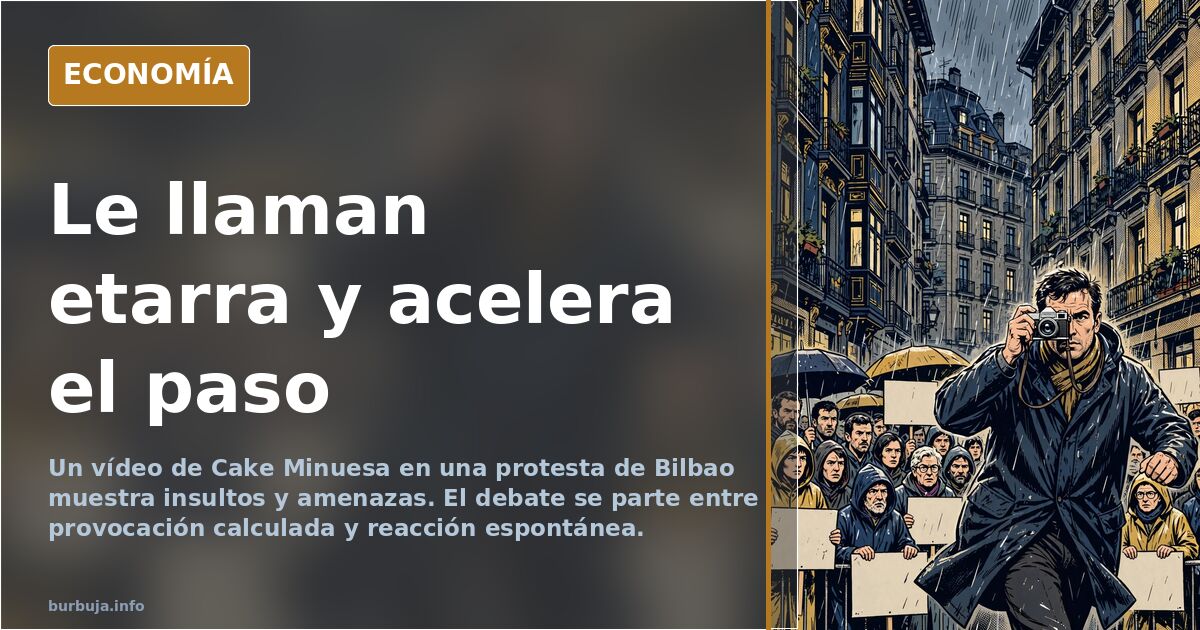
A short video is enough to set the scene. A man with a camera stands before a demonstration in Bilbao, asks questions, and receives insults and death threats in return—content his channel needed. The sequence, shared by the author, shows a group unwilling to be filmed. Depending on the narrator, they either reacted as anyone would when blocked, or confirmed a pattern of hostility toward those who ask.
The episode occurs within the context of a Bilbao protest, circulating as evidence of a political climate that, for some, no longer distinguishes between protesters and militants. The subsequent discussion split into two camps: those seeing calculated provocation and those viewing it as a spontaneous reaction to someone seeking exactly that outcome.
What peine at the Bilbao protest
The source material is a tweet sharing a video with an accusation: the protest is an "ETA manifestation," and participants insult, threaten, and lack articulation. The tweet mentions victims, including 22 children, claiming neck-cutting threats occurred. This is the circulated version, not a verified media report.
From there, the video becomes ammunition. One sector reads it as proof that the abertzale left retains its street intimidation capacity. Another, more uncomfortable sector notes the author has "traveled many miles" and that confrontation is precisely his product. The debate isn't about what is seen, but why it was recorded.
Provocation or normal reaction?
The provocation thesis has explicit defenders: if someone blocks your path and questions you with a camera, telling them off is a normal reaction. The video author seeks results for his channel, which serves an audience distrustful of conventional TV. It's a closed circuit: the provocator earns views, the provoked earns outrage.
The opposing thesis doesn't deny provocation but deems it irrelevant. A threat to cut one's throat is a threat; the Penal Code does not distinguish between insulting out of conviction versus reacting to a camera. Some recall that fifteen years ago, facing such dynamics meant risking more than just appearing in a video.
Profile of those in the video
A repeated analysis points to age. Faces in the recording belong to people over forty, averaging fifty, according to a debater. The demographic reading suggests that without new recruits, the phenomenon fades due to lack of personnel. In protests against the central government, the same comparison argues, there are proportionally more young people.
The detail of shame is also highlighted. Few want to appear in the video; many estimulante ilegal up, some cover their faces. This gesture—refusing identification at a protest—is interpreted as implicit acknowledgment that the scene disadvantages them. The counter-reading is simpler: nobody wants to end up in a video edited by someone who came looking for trouble.
The Basque rift the video cannot close
The issue complicates when memory enters. Part of the public recalls Basque society lived with non-symbolic violence for decades, where the line between the abertzale left and perpetrators was often blurred. Others respond that this same society suffered police repression, reducing the debate to one side being convenient from Madrid.
The result is a stagnant discussion. Those seeing proof everything remains unchanged don't shift opinion. Nor do those seeing mere provocation. In the middle lies an undisputed fact: the video exists, was disseminated, and worked. The rest is interpretation.
One unsettling data point remains. In a supposedly massive protest representing a country, those in the video are middle-aged individuals speeding up to avoid cameras. If the phenomenon depended on them, it would have an expiration date. If it doesn't, the video hasn't shown what its author believes.
A short video is enough to set the scene. A man with a camera stands before a demonstration in Bilbao, asks questions, and receives insults and death threats in return—content his channel needed. The sequence, shared by the author, shows a group unwilling to be filmed. Depending on the narrator, they either reacted as anyone would when blocked, or confirmed a pattern of hostility toward those who ask.
The episode occurs within the context of a Bilbao protest, circulating as evidence of a political climate that, for some, no longer distinguishes between protesters and militants. The subsequent discussion split into two camps: those seeing calculated provocation and those viewing it as a spontaneous reaction to someone seeking exactly that outcome.
What peine at the Bilbao protest
The source material is a tweet sharing a video with an accusation: the protest is an "ETA manifestation," and participants insult, threaten, and lack articulation. The tweet mentions victims, including 22 children, claiming neck-cutting threats occurred. This is the circulated version, not a verified media report.
From there, the video becomes ammunition. One sector reads it as proof that the abertzale left retains its street intimidation capacity. Another, more uncomfortable sector notes the author has "traveled many miles" and that confrontation is precisely his product. The debate isn't about what is seen, but why it was recorded.
Provocation or normal reaction?
The provocation thesis has explicit defenders: if someone blocks your path and questions you with a camera, telling them off is a normal reaction. The video author seeks results for his channel, which serves an audience distrustful of conventional TV. It's a closed circuit: the provocator earns views, the provoked earns outrage.
The opposing thesis doesn't deny provocation but deems it irrelevant. A threat to cut one's throat is a threat; the Penal Code does not distinguish between insulting out of conviction versus reacting to a camera. Some recall that fifteen years ago, facing such dynamics meant risking more than just appearing in a video.
Profile of those in the video
A repeated analysis points to age. Faces in the recording belong to people over forty, averaging fifty, according to a debater. The demographic reading suggests that without new recruits, the phenomenon fades due to lack of personnel. In protests against the central government, the same comparison argues, there are proportionally more young people.
The detail of shame is also highlighted. Few want to appear in the video; many estimulante ilegal up, some cover their faces. This gesture—refusing identification at a protest—is interpreted as implicit acknowledgment that the scene disadvantages them. The counter-reading is simpler: nobody wants to end up in a video edited by someone who came looking for trouble.
The Basque rift the video cannot close
The issue complicates when memory enters. Part of the public recalls Basque society lived with non-symbolic violence for decades, where the line between the abertzale left and perpetrators was often blurred. Others respond that this same society suffered police repression, reducing the debate to one side being convenient from Madrid.
The result is a stagnant discussion. Those seeing proof everything remains unchanged don't shift opinion. Nor do those seeing mere provocation. In the middle lies an undisputed fact: the video exists, was disseminated, and worked. The rest is interpretation.
One unsettling data point remains. In a supposedly massive protest representing a country, those in the video are middle-aged individuals speeding up to avoid cameras. If the phenomenon depended on them, it would have an expiration date. If it doesn't, the video hasn't shown what its author believes.
Also available in: Deutsch
Summary of a discussion on Burbuja.info - Foro de economía, actualidad y política., translated from Spanish and reviewed before publication. Read the full discussion (127 replies).
More summaries
-
Pressure mounts on Spain's PM Sánchez to resign
El País opinion piece urges Pedro Sánchez to quit amid corruption probes and Santos Cerdán's jailing, fracturing the PSOE.
-
Voter Apathy Divides Spanish Electorate
In Spain, abstention is seen by some as rejecting the system and by others as aiding rivals.
-
Spain's proposed 0.2 g/L blood alcohol limit bans wine with lunch
Lowering Spain's driving alcohol limit to 0.2 g/L risks penalties for trace amounts in food, sparking debate on false positives and enforcement.
-
Madrid as Europe's Miami: Housing Costs and Safety Debate
Is Madrid becoming Europe's Miami? The debate links soaring housing prices, safety concerns, and migration pressures.
-
Co-parenting: Baby born in Barcelona via private contract
A baby is born in Barcelona after a private co-parenting agreement. The debate centers on whether this solves issues or shifts burdens.
-
TVE Map Colors Mild Temps Red, Sparking Climate Debate
TVE's temperature map shows mild winter temperatures in fire red, reserving yellow for sub-zero readings. Critics argue the color scale exaggerates thermal anomalies.