
Cádiz Bay: Red Vote Sustained by Shipyards and Subsidies
The Bahía de Cádiz has seen decades of left-wing voting based on jobs dependent on shipyards and subsidies, with a middle class that never materialized.
English · Original discussion in Spanish · Published
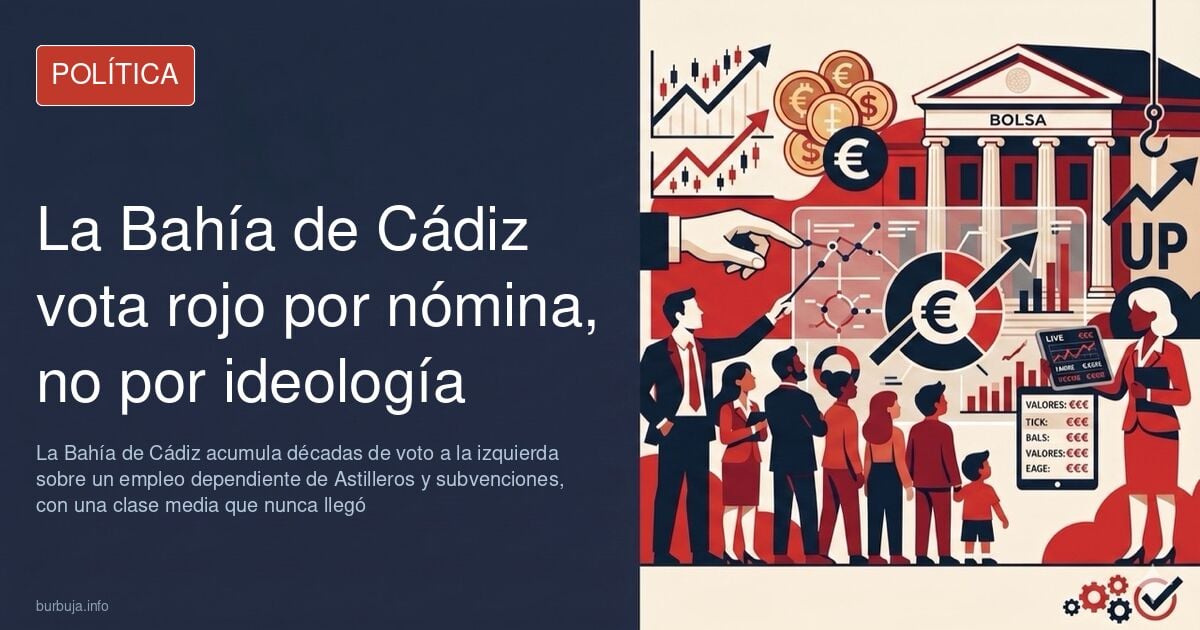
Bahía de Cádiz: Red Vote, Shipyards, and the Absent Middle Class
The Bahía de Cádiz does not vote left out of conviction. It votes due to payroll, collective bargaining agreements, and industrial memory. This is the diagnosis prevalent among those who have traveled through the region—Puerto Real, Rota, the capital—and returned with the same uncomfortable question: is this militancy or is it dependence?
Shipyards and subsidies sustain an electoral map that has not moved in decades, and the disagreement over whether this is ideology or simple clientelism remains unresolved.
Puerto Real, Shipyards, and the Unmoving Vote
During numerous terms, Puerto Real had a Communist mayor. Its first official, José Antonio Barroso, changed party affiliations several times but never relinquished the seat: he governed in different legislatures and served as a representative of Cádiz in Parliament. After his second municipal term, even an Andalusianist mayoralty occurred.
The reading is uncomfortable for everyone: the parties changed, but the electorate did not move an inch.
The metal explains much of the phenomenon. A highly unionized sector, with employment hanging on public contracts, generates a work culture where the collective agreement outweighs any electoral program. Those who argue that there is no conviction here, only income, add to the equation the PER and administrative dependence. In a bar, the answer to any criticism is always the same: pointing out that "it will give fascists what they want."
A post-meal argument, not a labor contract one.
From Carnival to Traficante: The Other Fronts of the Debate
The second front is cultural. The Cádiz Carnival, a historical mockery of power, is now perceived as supporting pogre correctness rather than mocking it. This is an impression, not a measurement, and thus it circulates.
And there is the underground economy. Part of the analysis points to drug trafficking as a structural factor in the region; the hypothesis of institutional complicity that arises in this conversation is unsupported and should not be taken as fact. Underlying everything is the most common cause: the absence of a dynamic middle class. Cádiz is not as poor as it appears, but it lacks the stratum that drives the rest.
As long as employment remains contingent on the same old public contract, the electoral map of the Bay will remain painted red. If it ever changes, it probably won't be due to a change in ideas. It will be due to a change in payroll.
The Bahía de Cádiz does not vote left out of conviction. It votes due to payroll, collective bargaining agreements, and industrial memory. This is the diagnosis prevalent among those who have traveled through the region—Puerto Real, Rota, the capital—and returned with the same uncomfortable question: is this militancy or is it dependence?
Shipyards and subsidies sustain an electoral map that has not moved in decades, and the disagreement over whether this is ideology or simple clientelism remains unresolved.
Puerto Real, Shipyards, and the Unmoving Vote
During numerous terms, Puerto Real had a Communist mayor. Its first official, José Antonio Barroso, changed party affiliations several times but never relinquished the seat: he governed in different legislatures and served as a representative of Cádiz in Parliament. After his second municipal term, even an Andalusianist mayoralty occurred.
The reading is uncomfortable for everyone: the parties changed, but the electorate did not move an inch.
The metal explains much of the phenomenon. A highly unionized sector, with employment hanging on public contracts, generates a work culture where the collective agreement outweighs any electoral program. Those who argue that there is no conviction here, only income, add to the equation the PER and administrative dependence. In a bar, the answer to any criticism is always the same: pointing out that "it will give fascists what they want."
A post-meal argument, not a labor contract one.
From Carnival to Traficante: The Other Fronts of the Debate
The second front is cultural. The Cádiz Carnival, a historical mockery of power, is now perceived as supporting pogre correctness rather than mocking it. This is an impression, not a measurement, and thus it circulates.
And there is the underground economy. Part of the analysis points to drug trafficking as a structural factor in the region; the hypothesis of institutional complicity that arises in this conversation is unsupported and should not be taken as fact. Underlying everything is the most common cause: the absence of a dynamic middle class. Cádiz is not as poor as it appears, but it lacks the stratum that drives the rest.
As long as employment remains contingent on the same old public contract, the electoral map of the Bay will remain painted red. If it ever changes, it probably won't be due to a change in ideas. It will be due to a change in payroll.
Summary of a discussion on Burbuja.info - Foro de economía, actualidad y política., translated from Spanish and reviewed before publication. Read the full discussion (16 replies).
More summaries
-
Immigrant Vote and the Spanish Government: The Thesis Shaking Up 2027
With 94% counted, the Swedish left won by 20,000 votes; one calculation attributes this to 200,000 naturalizations. The debate reaches Spain.
-
From selling Spain for 7 votes to selling Ceuta for 11.
The Ceuta Port Authority rejects 11 votes in favor of its protection. An echo of past political decisions that ignore democratic will.
-
Lleida teacher singles out two students for supporting Vox
Lleida History teacher allegedly called two students 'fachapobres' (poor fascists) over Vox event. Case reopens public education debate.
-
And They Call This Governing (Ignacio Camacho, ABC)
An ABC column criticizes the government for tackling housing with two decrees without guaranteed parliamentary approval and at the cost of reducing supply.
-
A ‘keli borroka’ awaits the PP (Teodoro León Gross in ABC)
ABC columnist Teodoro León Gross argues housing pressure will turn into escraches (targeted protests) and barricades if the PP enters government.
-
A democratic obligation unfulfilled (ABC editorial)
Article 134.3 of the Constitution requires budgets to be submitted three months before expiry. Spain is still running on the 2023 Budget.