
Cadena Ser cancels 'Buenismo bien' amid cancellation controversy
Spain's Cadena Ser drops the humor show after five years, coinciding with a viral campaign targeting host Manuel Burque.
English · Original discussion in Spanish · Published
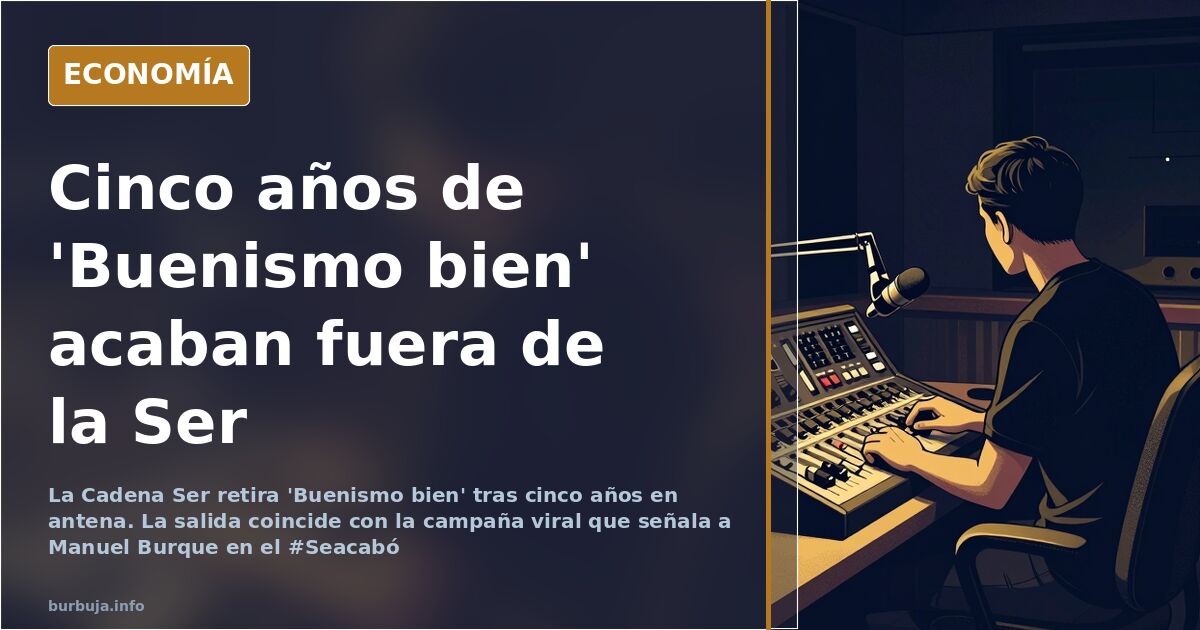
Cadena Ser removes 'Buenismo bien' after five years on air
The humor program Buenismo bien is no longer part of Cadena Ser’s lineup. Sources at Prisa Radio confirmed to THE OBJECTIVE that the show hosted by Manuel Burque and Quique Peinado has been pulled from the schedule after five years of airing Tuesdays on major podcast platforms and late Friday nights into Saturday mornings. According to these sources, the removal coincides with a difficult period for its director and co-host, Manuel Burque, targeted in a viral campaign linked to the so-called #Seacabó movement. Neither the outlet reporting the news nor the radio station has disclosed the financial terms of this decision.
Why was 'Buenismo bien' dropped from Cadena Ser?
The official explanation trinc the usual pattern: schedules change, contracts expire, and nothing is confirmed. The unofficial reason is more uncomfortable. The very media outlet publishing the information links the removal to the personal wear and tear suffered by one of its two hosts, dragged into public discourse by a wave of accusations emerging on social media. A humor show broadcast via podcast and in the late-night slot is hardly the most expensive asset for a generalist radio station. What broke was not the balance sheet.
This is the first blind spot. The decision is presented as a discreet exit, without a farewell statement or public thanks, and that discretion fuels every possible interpretation. Some argue the show simply lacked an audience and that the controversy served only as a pretext to close something already struggling. Against this view lies a detail: the program had been on air for five years, a considerable lifespan for a niche format that no one removes on a whim within a week.
An accusation without judicial resolution
It is crucial to focus on what actually exists. On the table is a viral campaign, not a court ruling. There is no conviction, no judicial order, nor any public file proving the facts attributed to the presenter. The allegation circulates on social networks, amplifies through accumulation, and ultimately produces a professional impact before any judicial pronouncement exists. This is the core of the problem, and also why this case is read as a new chapter in a recognizable pattern: digital summary judgment arriving before evidence.
On the other side, the reading is simpler and harsher: those who enthusiastically participated in this mechanism when it targeted others cannot now demand procedural guarantees for themselves. One comment summarizes the discomfort with which this argument is received: “Normalizing that anyone can say anything (true or false...) on social media, resulting in your life being ruined the next day, facing social condemnation and losing your job.” It is the thesis that the system cannot be deactivated at convenience.
The falling ally and the price of solidarity
There is an angle that transcends the specific case and dominates much of the conversation: what happens when the cause one has publicly defended turns against oneself. The scene is not new. Profiles that made defending certain causes their professional brand discover that the same machinery does not distinguish between friends and adversaries once activated. The most repeated formulation is that internal conflict consumes its own promoters, and that those who stand at the front line end up becoming targets as the front advances.
This is not just rhetoric. Behind this idea lies an operational thesis: without profiles that take a stand, the mechanism loses muscle; if those profiles start falling, the incentive to take a stand collapses. Hence, some analysts consider these episodes more decisive than any complaint against the movement as a whole. Details are provided in the discussion itself about signals accumulated in recent weeks forming a sort of list of chained episodes: the complete review of names and contexts, with their dates and reactions, functions as an X-ray of the phenomenon and cannot be understood with isolated headlines.
Audience, podcasts, and institutional advertising: the other explanation
Against the narrative of settling scores, there is a purely economic hypothesis. The program cost more than it generated, and institutional advertising did not arrive in sufficient quantities to sustain it. The idea is summarized thus: “This is because it cost more money than it produced, and government propaganda buying barely reached enough.” Under this prism, the media noise would be the accelerator, not the cause. Neither party provides public figures on audience or revenue, so the discussion moves in the realm of plausibility rather than accounting.
What is verifiable is the format: weekly release via podcast and late-night broadcast. A niche product, with low cost and debatable return, is the natural candidate to disappear when cuts are needed or when a name becomes toxic for advertisers. Both explanations can be true simultaneously. This usually happens.
From a specific exit to a recognizable pattern
The conversation does not stay within the radio station. The case is read as a piece of a longer series of withdrawals, silences, and disavowals, hence the feeling of facing a cycle rather than an anecdote. The phrase that best captures the general discomfort does not speak of this presenter: “The problem with the right is they want to preserve everything, even the bad. The problem with the left is they want to change everything, even the good.” With this framework, each new exit is interpreted as confirmation of a trend and not as an isolated fact.
Open remains, and it is not a minor detail, the role played by the co-host and the rest of the professional environment. Silence also communicates, and in these episodes, silence is measured. No one has clarified whether the exit responds to a business decision, a request from the team itself, or a combination of both, and while there is no official explanation, each version will continue to gather defenders.
As of this discussion, the matter stays exactly there: one less program on the schedule, an unresolved accusation, and a doubt that no one has yet cleared up: whether the motive was audience, controversy, or antiestéticar of both.
The humor program Buenismo bien is no longer part of Cadena Ser’s lineup. Sources at Prisa Radio confirmed to THE OBJECTIVE that the show hosted by Manuel Burque and Quique Peinado has been pulled from the schedule after five years of airing Tuesdays on major podcast platforms and late Friday nights into Saturday mornings. According to these sources, the removal coincides with a difficult period for its director and co-host, Manuel Burque, targeted in a viral campaign linked to the so-called #Seacabó movement. Neither the outlet reporting the news nor the radio station has disclosed the financial terms of this decision.
Why was 'Buenismo bien' dropped from Cadena Ser?
The official explanation trinc the usual pattern: schedules change, contracts expire, and nothing is confirmed. The unofficial reason is more uncomfortable. The very media outlet publishing the information links the removal to the personal wear and tear suffered by one of its two hosts, dragged into public discourse by a wave of accusations emerging on social media. A humor show broadcast via podcast and in the late-night slot is hardly the most expensive asset for a generalist radio station. What broke was not the balance sheet.
This is the first blind spot. The decision is presented as a discreet exit, without a farewell statement or public thanks, and that discretion fuels every possible interpretation. Some argue the show simply lacked an audience and that the controversy served only as a pretext to close something already struggling. Against this view lies a detail: the program had been on air for five years, a considerable lifespan for a niche format that no one removes on a whim within a week.
An accusation without judicial resolution
It is crucial to focus on what actually exists. On the table is a viral campaign, not a court ruling. There is no conviction, no judicial order, nor any public file proving the facts attributed to the presenter. The allegation circulates on social networks, amplifies through accumulation, and ultimately produces a professional impact before any judicial pronouncement exists. This is the core of the problem, and also why this case is read as a new chapter in a recognizable pattern: digital summary judgment arriving before evidence.
On the other side, the reading is simpler and harsher: those who enthusiastically participated in this mechanism when it targeted others cannot now demand procedural guarantees for themselves. One comment summarizes the discomfort with which this argument is received: “Normalizing that anyone can say anything (true or false...) on social media, resulting in your life being ruined the next day, facing social condemnation and losing your job.” It is the thesis that the system cannot be deactivated at convenience.
The falling ally and the price of solidarity
There is an angle that transcends the specific case and dominates much of the conversation: what happens when the cause one has publicly defended turns against oneself. The scene is not new. Profiles that made defending certain causes their professional brand discover that the same machinery does not distinguish between friends and adversaries once activated. The most repeated formulation is that internal conflict consumes its own promoters, and that those who stand at the front line end up becoming targets as the front advances.
This is not just rhetoric. Behind this idea lies an operational thesis: without profiles that take a stand, the mechanism loses muscle; if those profiles start falling, the incentive to take a stand collapses. Hence, some analysts consider these episodes more decisive than any complaint against the movement as a whole. Details are provided in the discussion itself about signals accumulated in recent weeks forming a sort of list of chained episodes: the complete review of names and contexts, with their dates and reactions, functions as an X-ray of the phenomenon and cannot be understood with isolated headlines.
Audience, podcasts, and institutional advertising: the other explanation
Against the narrative of settling scores, there is a purely economic hypothesis. The program cost more than it generated, and institutional advertising did not arrive in sufficient quantities to sustain it. The idea is summarized thus: “This is because it cost more money than it produced, and government propaganda buying barely reached enough.” Under this prism, the media noise would be the accelerator, not the cause. Neither party provides public figures on audience or revenue, so the discussion moves in the realm of plausibility rather than accounting.
What is verifiable is the format: weekly release via podcast and late-night broadcast. A niche product, with low cost and debatable return, is the natural candidate to disappear when cuts are needed or when a name becomes toxic for advertisers. Both explanations can be true simultaneously. This usually happens.
From a specific exit to a recognizable pattern
The conversation does not stay within the radio station. The case is read as a piece of a longer series of withdrawals, silences, and disavowals, hence the feeling of facing a cycle rather than an anecdote. The phrase that best captures the general discomfort does not speak of this presenter: “The problem with the right is they want to preserve everything, even the bad. The problem with the left is they want to change everything, even the good.” With this framework, each new exit is interpreted as confirmation of a trend and not as an isolated fact.
Open remains, and it is not a minor detail, the role played by the co-host and the rest of the professional environment. Silence also communicates, and in these episodes, silence is measured. No one has clarified whether the exit responds to a business decision, a request from the team itself, or a combination of both, and while there is no official explanation, each version will continue to gather defenders.
As of this discussion, the matter stays exactly there: one less program on the schedule, an unresolved accusation, and a doubt that no one has yet cleared up: whether the motive was audience, controversy, or antiestéticar of both.
Also available in: Deutsch
Summary of a discussion on Burbuja.info - Foro de economía, actualidad y política., translated from Spanish and reviewed before publication. Read the full discussion (156 replies).
More summaries
-
Quique Peinado's Feminist Ally Cost: A Cancelled Show
Social media accusations against Quique Peinado reignite debate over the cost of his feminist ally role and his cancelled SER program.
-
Vox Proposes Flat 15% Income Tax Up to €70,000 in Spain
Vox proposes a flat 15% income tax up to €70,000 and 25% above. Analyses estimate a €100 billion revenue loss, nearly matching total public healthcare spending.
-
Spanish flamenco star Rafael Amargo detained in Madrid
El Mundo reports the arrest of flamenco dancer Rafael Amargo and his partner after a late-night altercation at their Madrid home.
-
11M: The Hebrew Lead. Why was Judge Cillán committed to a psychiatric ward?
Josep Arimany, head of Catalonia's Forensic Institute, offered Carmen Baladía 20 flight seats on March 11. She refused, yet he appeared at IFEMA anyway.
-
Sánchez links lower immigration to better security and housing
Sánchez ties reduced immigration to improved safety and affordable housing. Extremadura, with the lowest immigrant share, fuels the debate.
-
Spain's Dating Market Tensions: Single Women and Biological Clock
Spanish women over 30 report a shortage of suitable partners. Analysis cites digital expectations, biological clocks, and immigrant competition.