
C-17 flight from Rota fuels tensions between Madrid and Washington
A C-17A Globemaster III departed from Rota for Sicily, sparking a dispute as the White House and Spanish officials offer conflicting accounts of military cooperation.
English · Original discussion in Spanish · Published
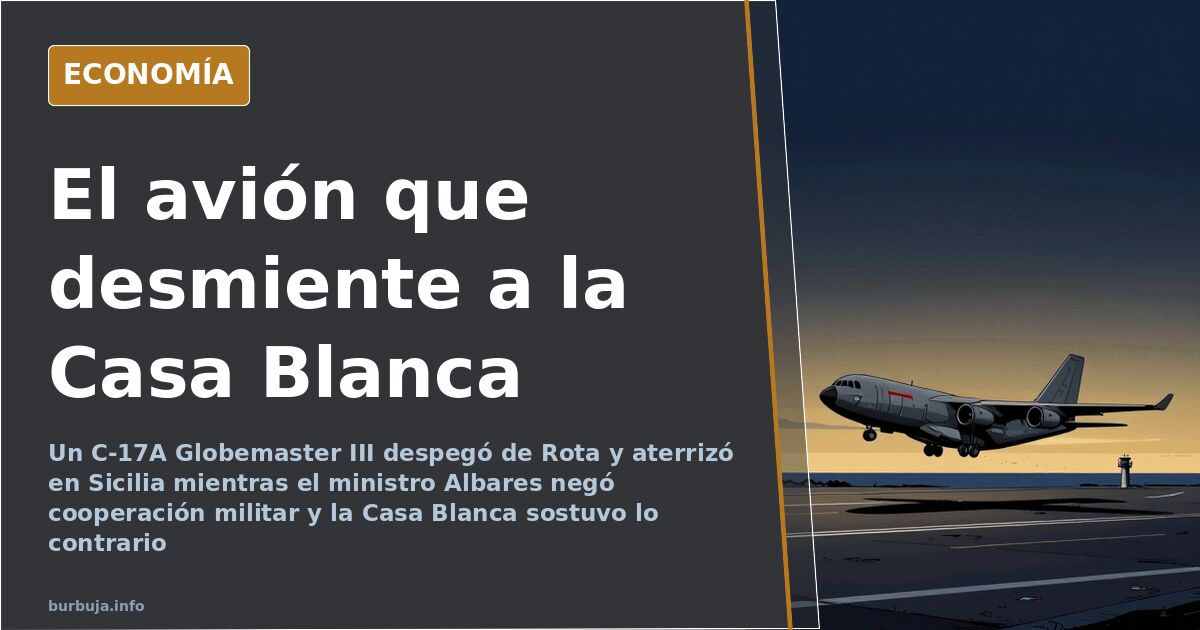
The C-17 departure from Rota and the base dispute
A US military aircraft took off from the Rota base, leaving a radar trail that has exposed a gap between two conflicting official versions. The White House claimed that Spain had agreed to military cooperation in recent hours, while the Minister of Foreign Affairs, José Manuel Albares, denied this on the same day during an interview with SER. Amidst these two versions, a C-17A Globemaster III was spotted flying east, raising an uncomfortable question: if the Government says no, why is that aircraft in the air?
The C-17 is neither a fighter nor a bomber. It is the aircraft the Pentagon uses to move troops, supplies, and wounded personnel across much of Europe. Those tracking it on radar describe it as a long-range strategic transporter, not an attack platform. That distinction, which may seem technical, is the core of the matter.
What is a C-17A Globemaster III and why does it matter?
The aircraft that departed from Rota belongs to the family of heavy cargo planes that the United States uses for rapid deployment: troop transport, medical evacuation, and delivering material to allied bases. It does not carry its own offensive weaponry. Its presence at a Spanish base does not, in itself, imply participation in a bombing campaign.
The problem arises when looking at the bigger picture. According to one line of analysis, the critical point is not the takeoff of a cargo plane, but the aerial refueling of B-2 bombers from Spanish territory. If a bomber refuels over Spain and then drops bombs over Iran without landing in a third country, that stopover is interpreted as direct participation in the conflict. In contrast, logistical transport to third countries is viewed as indirect cooperation. That is the crux of the issue.
Schrödinger's denial: neither allowing nor forbidding
The Spanish Government denied the use of its bases for the bombing campaign, and Washington diverted its aircraft to other European facilities. This is the official version. However, the detail that breaks the narrative is that planes continue to take off. Every few hours, according to radar trackers, there is movement in Rota and Morón.
This has led to a formula that summarizes the confusion: a denial that prevents nothing. Some argue that Spain lacks the real means to close a base that, in practice, operates under US control, while others point out that the bilateral defense agreement contains fine print. The debate over what can and cannot be prevented is likely more important than the specific flight that triggered the issue.
The aircraft's trail: from Rota to Sicily and then to Djibouti
The tracking of the aircraft revealed a specific sequence. The C-17 left Rota, changed course, and eventually landed in Sicily. From there, a second leg pointed toward the Camp Lemonnier base in Djibouti, an advanced logistical hub in the Horn of Africa. This is not a tourist route.
The trajectory fits the pattern described by analysts: the United States moves material from European bases to peripheral facilities when it needs to reduce dependence on a specific point. If Spain limits the use of Rota for certain missions, the Pentagon redistributes the load to Sicily, Djibouti, or bases in more willing countries. According to circulating reports, France does authorize the use of its facilities in the Middle East. The comparison with the French partner is inevitable and unsettling.
Who truly controls a shared base?
The fundamental question is not where a cargo plane landed. It is who is in command within a facility that Spain considers its own, but the United States treats as its own. The defense agreement regulates usage, but it does not make Spain the arbiter of every flight. Movements are notified; the contents of the cargo are not always.
This vacuum is what fuels mistrust. A cargo plane could be carrying bombs, medicine, or aircraft spare parts, and no one outside the military circuit verifies it. Tacit cooperation exists as long as a country allows the use of its airspace and does not prevent it. The rest is interpretation.
The political cost of conflicting versions
The damage is not in the flight itself, but in the contradiction. One day the White House announces Spanish cooperation; the next, the Minister denies it. Both accounts cannot be true at the same time, and the radar does not help decide which one holds up better.
For the Government, the risk is appearing as if they are saying no to war while the bases continue to operate. For the opposition, the risk is the opposite: attacking a decision that may not have been within their control. In the middle is an electorate that sees planes taking off while hearing official denials.
Given this material, the most reasonable prediction is that the matter will not be closed: there will be more flights, more denials, and more uncomfortable questions. However, this should be taken with caution. The only verifiable certainty is what the radar leaves behind: a C-17 left Rota, landed in Sicily, and continued on its way. The rest is narrative.
A US military aircraft took off from the Rota base, leaving a radar trail that has exposed a gap between two conflicting official versions. The White House claimed that Spain had agreed to military cooperation in recent hours, while the Minister of Foreign Affairs, José Manuel Albares, denied this on the same day during an interview with SER. Amidst these two versions, a C-17A Globemaster III was spotted flying east, raising an uncomfortable question: if the Government says no, why is that aircraft in the air?
The C-17 is neither a fighter nor a bomber. It is the aircraft the Pentagon uses to move troops, supplies, and wounded personnel across much of Europe. Those tracking it on radar describe it as a long-range strategic transporter, not an attack platform. That distinction, which may seem technical, is the core of the matter.
What is a C-17A Globemaster III and why does it matter?
The aircraft that departed from Rota belongs to the family of heavy cargo planes that the United States uses for rapid deployment: troop transport, medical evacuation, and delivering material to allied bases. It does not carry its own offensive weaponry. Its presence at a Spanish base does not, in itself, imply participation in a bombing campaign.
The problem arises when looking at the bigger picture. According to one line of analysis, the critical point is not the takeoff of a cargo plane, but the aerial refueling of B-2 bombers from Spanish territory. If a bomber refuels over Spain and then drops bombs over Iran without landing in a third country, that stopover is interpreted as direct participation in the conflict. In contrast, logistical transport to third countries is viewed as indirect cooperation. That is the crux of the issue.
Schrödinger's denial: neither allowing nor forbidding
The Spanish Government denied the use of its bases for the bombing campaign, and Washington diverted its aircraft to other European facilities. This is the official version. However, the detail that breaks the narrative is that planes continue to take off. Every few hours, according to radar trackers, there is movement in Rota and Morón.
This has led to a formula that summarizes the confusion: a denial that prevents nothing. Some argue that Spain lacks the real means to close a base that, in practice, operates under US control, while others point out that the bilateral defense agreement contains fine print. The debate over what can and cannot be prevented is likely more important than the specific flight that triggered the issue.
The aircraft's trail: from Rota to Sicily and then to Djibouti
The tracking of the aircraft revealed a specific sequence. The C-17 left Rota, changed course, and eventually landed in Sicily. From there, a second leg pointed toward the Camp Lemonnier base in Djibouti, an advanced logistical hub in the Horn of Africa. This is not a tourist route.
The trajectory fits the pattern described by analysts: the United States moves material from European bases to peripheral facilities when it needs to reduce dependence on a specific point. If Spain limits the use of Rota for certain missions, the Pentagon redistributes the load to Sicily, Djibouti, or bases in more willing countries. According to circulating reports, France does authorize the use of its facilities in the Middle East. The comparison with the French partner is inevitable and unsettling.
Who truly controls a shared base?
The fundamental question is not where a cargo plane landed. It is who is in command within a facility that Spain considers its own, but the United States treats as its own. The defense agreement regulates usage, but it does not make Spain the arbiter of every flight. Movements are notified; the contents of the cargo are not always.
This vacuum is what fuels mistrust. A cargo plane could be carrying bombs, medicine, or aircraft spare parts, and no one outside the military circuit verifies it. Tacit cooperation exists as long as a country allows the use of its airspace and does not prevent it. The rest is interpretation.
The political cost of conflicting versions
The damage is not in the flight itself, but in the contradiction. One day the White House announces Spanish cooperation; the next, the Minister denies it. Both accounts cannot be true at the same time, and the radar does not help decide which one holds up better.
For the Government, the risk is appearing as if they are saying no to war while the bases continue to operate. For the opposition, the risk is the opposite: attacking a decision that may not have been within their control. In the middle is an electorate that sees planes taking off while hearing official denials.
Given this material, the most reasonable prediction is that the matter will not be closed: there will be more flights, more denials, and more uncomfortable questions. However, this should be taken with caution. The only verifiable certainty is what the radar leaves behind: a C-17 left Rota, landed in Sicily, and continued on its way. The rest is narrative.
Also available in: Deutsch
Summary of a discussion on Burbuja.info - Foro de economía, actualidad y política., translated from Spanish and reviewed before publication. Read the full discussion (101 replies).
More summaries
-
Topuria loses at the White House: the economic cost of a divorce and a tax move
Ilia Topuria loses by technical KO at the White House: $20 million at stake, tax move to Miami and accusations of a fixed fight on Trump's birthday…
-
Spain denies White House claims on military cooperation
Albares refutes US statements while Spain deploys frigate Cristóbal Colón to Cyprus amid diplomatic tensions.
-
Zelensky and Trump Clash at White House Over Aid and Rare Earths
Max tension at the White House: Zelensky and Trump clash over military aid, rare earths, and geopolitical interests in a failed diplomatic meeting.
-
La Vanguardia fires columnist over article accusing PSOE of seeking civil conflict
La Vanguardia suspends Lacasta for criticising the PSOE's drift. A reflection on the limits of journalism.
-
Milan as a mirror: A young woman's testimony on Italian immigration
A young traveler returns from Milan, claiming migrant presence is higher than in Spain, sparking debate on wages and demographics.
-
Tesla Model S mortality rate exceeds 2001 VW Passat
IIHS data shows the Tesla Model S 4WD has 17 deaths per million, while the Lexus ES records zero, questioning Autopilot's safety claims.