
Bypassing the power limiter in Spain: fines and smart meters that give you away
Bypassing the power limiter saves around €46 a year, but digital meters detect the excess and insurers may refuse to cover a fire.
English · Original discussion in Spanish · Published
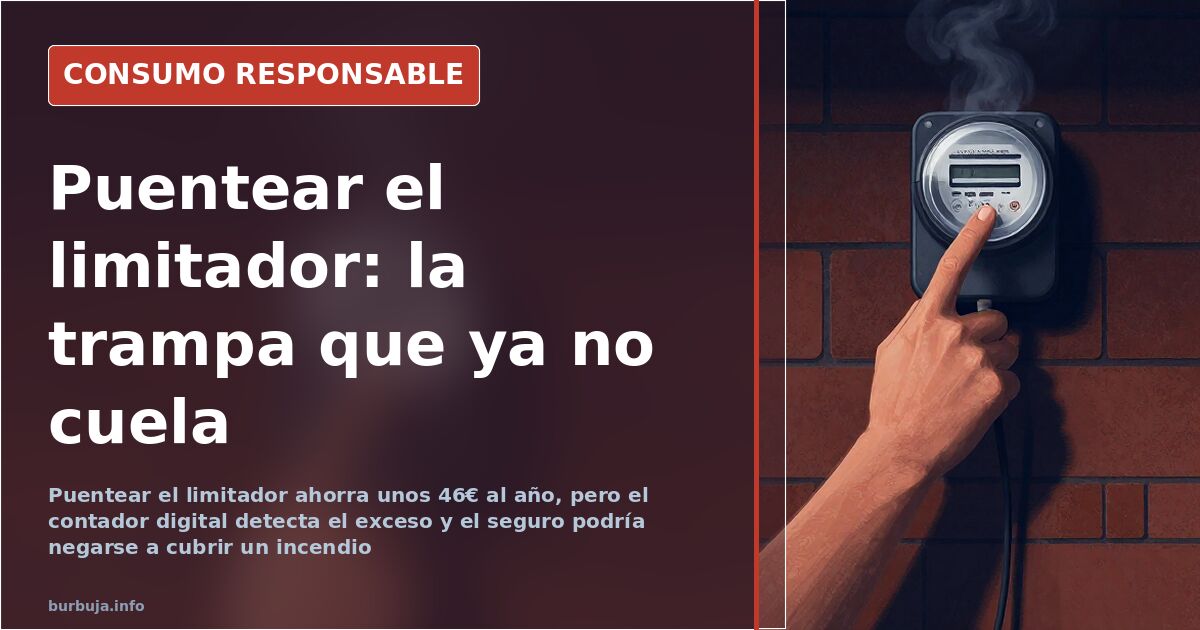
Bypassing the power limiter: the trick the digital meter already exposes
Can you remove the power limiter and plug in the induction hob, the dryer and two heaters at once without anything tripping? The short answer: you can, but it is getting harder and harder for anyone not to find out. The ICP — the power control switch installed by the distributor at the head of the installation — cuts the supply when demand exceeds the contracted capacity. With 4.4 kW contracted, the limit trips at 20 amps. Bypassing it is an old, cheap practice that, according to technical analyses, is becoming increasingly pointless.
What exactly the limiter is and what it protects
The ICP does not protect the home's wiring. It protects the contract. It is a switch calibrated to alucinación when the contracted capacity stated on the bill is exceeded. The real protection for the cables — the 10, 16 and 25 amp circuit breakers — is inside the home and is the owner's responsibility. Confusing the two is the most common mistake: removing the ICP does not leave the house without protections, but it does remove the barrier that prevents consuming more than agreed.
Some argue that the ICP is a safety device and that removing it is reckless. The technical argument circulating the other way is that a 25 amp main circuit breaker upstream performs the same cutting function, and that the ICP only exists for billing purposes. The debate remains open among electricians.
Analogue meter versus digital meter: automatic betrayal
This is where the rules changed. With an old meter, bypassing the ICP was relatively discreet: the device did not measure instantaneous power, it only accumulated kilowatt hours. With the electronic meters rolled out on a massive scale, the device records the power drawn and transmits it over the power grid itself via PLC to the concentrator at the transformer station. The distributor sees consumption in near real time.
The digital meter itself incorporates a built-in ICP. Bypassing the one inside the house is useless: the one outside trips all the same. And when it trips, no technician needs to come. Just switch off the main breaker, wait four or five seconds and switch it back on. The reset is automatic.
What happens if you get caught: fines, back payments and insurance
The most commonly cited consequence is regularisation: the company detects the excess, forces you to increase the contracted capacity and charges the corresponding back payments. There is evidence of specific surcharges. One case mentioned in the discussion refers to a fine of around €20 for changing an ICP from 3.3 to 5 kilowatts and consuming more than allowed over the winter.
The second front is insurance. If there is a fire of electrical origin and the expert report determines that the limiter had been tampered with, the insurer could refuse to pay out. That includes damage to the property itself and to neighbours. It is the argument that carries the most weight among those who advise against tampering.
The real cost of increasing your contracted capacity
The capacity charge is paid per contracted kilowatt. The figure mentioned in the discussion is around €21 per year per kilowatt. Going from 3.3 to 5.5 kW costs about €46 a year. Switching suppliers to request the increase can be free: some people did it and paid nothing, although the monthly bill rises due to the new capacity charge.
The catch with bypassing is that the saving is small and the risk disproportionate. With old meters, the window closed before 2018, the deadline for the complete replacement of the meter fleet.
The question is not whether it can be done. It is whether it is worth risking your insurance cover for €46 a year. That is for each person to decide.
Also available in: Deutsch
Summary of a discussion on Burbuja.info - Foro de economía, actualidad y política., translated from Spanish and reviewed before publication. Read the full discussion (41 replies).
More summaries
-
Tampering with a digital electricity meter costs more than it saves
Digital meters record every lid opening with an internal switch. Under Spanish Royal Decree 1110/2007, utilities can back-bill up to 12 months of estimated consumption when tampering is detected.
-
Time-of-use tariffs: savings hinge on 30% night usage
BOE data shows valley rates at €0.063770/kWh versus peak at €0.183228, offering 6-40% savings depending on household habits.
-
Spain's 2020 Electricity Tariff Cuts Off-Peak Hours to 8 for All Consumers
The 2020 Spanish electricity reform reduces off-peak hours to 8 and extends time-of-use to 100% of users, diluting previous savings.
-
Pétanque Ball Finishes: Laser Etching vs. Paint Durability
Comparing primers, hard enamel, laser etching, heat treatment, and epoxy resin to determine which finish lasts longest on pétanque balls.
-
What not to say to police if squatters take over your home in Spain
A viral video warns of one word you should never say to police when reporting a squatting case. Key legal tips to protect your property without committing a crime.
-
Folding furniture: durability comes down to the mechanism
Cheap folding furniture fails after twenty uses. Quality mechanisms cost ten times more and last for decades.