
Buying rural land in Spain: wind, water and permits nobody checked
Gusts of 120 km/h, two months without water and permits that never arrive: the mistakes that turn a dream piece of rural land in Spain into an unexpected bill.
English · Original discussion in Spanish · Published
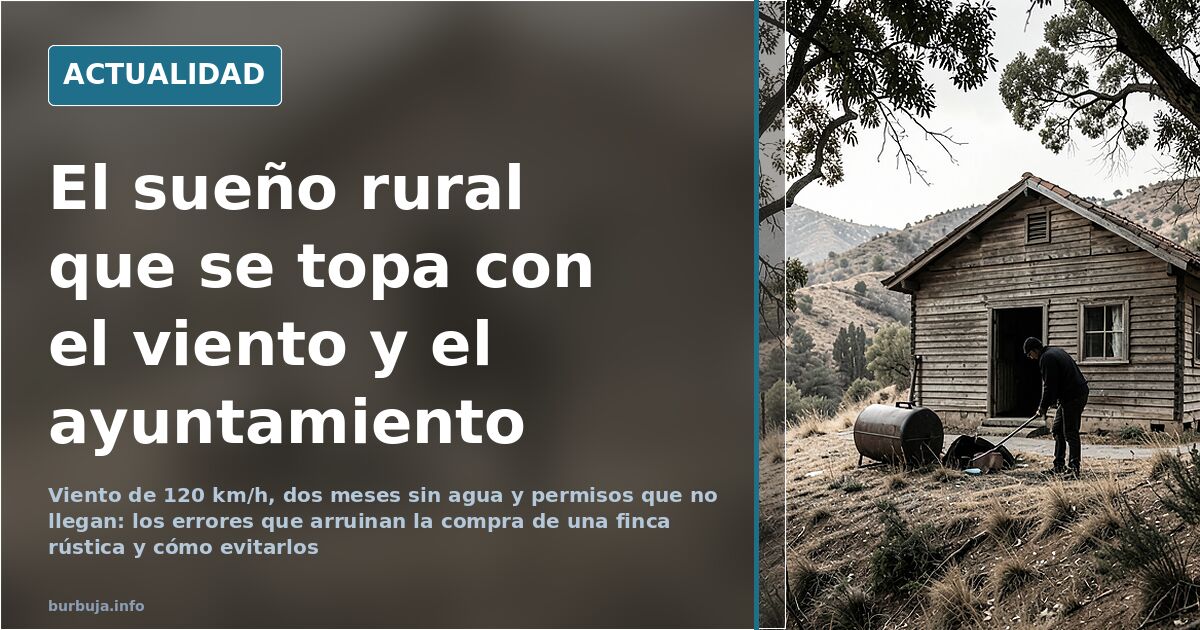
Buying rural land without checking the wind, the water or the permits gets expensive
Buying rural land in Spain to live off the land and off self-sufficiency remains one of the most profitable fantasies of Spanish rural YouTube. And one of the ones that ages worst. The cases piling up in recent months share the same pattern: the purchase is signed with the excitement of the project, and only afterwards do buyers discover that the wind blows at 120 kilometres per hour, that the well has been dry for fifteen years and that the planning permit is not granted through meditation. The result is a bill nobody budgeted for.
The first mistake is one of timing. A small fruit tree does not produce fruit no matter how many spiritual connection sessions you dedicate to it: some people have been waiting five years for the first harvest from an apple tree. Nature has its own schedule and cares very little that the YouTube channel needs new content every week.
The 120 km/h wind and the wooden shed
The second mistake is one of physics. On a plot with gusts of up to 120 kilometres per hour, roofs, sheds and structures break. Recycled wood and flower pots are not an anchoring system. The universe, apparently, does not pause a gust to ask whether you intend to live in harmony with it.
Add to that the water: two months without supply because of a broken pipe. Self-sufficiency is not about living far from the supermarket; it is about having resources and alternatives when something fails. Everything else is aesthetic independence with logistical dependence.
The flood-prone land and the impossible access roads
The pack is completed by land with a flood risk, fences that suffer every winter and access problems for large vehicles, with all the delivery difficulties that entails. None of this appears in the photographs. All of it appears in the land registry and the planning scheme, which are boring documents but cheap to check before signing.
A planning permit is not granted through meditation
The most expensive mistake is the legal one. The previous owners assured buyers that a wooden house of certain dimensions could be installed. The land was bought and it turned out things were not like that. On rural land (suelo rústico, land protected from development under Spanish regional law), whatever the seller, the neighbour with the caravan or some guy from a Facebook group says is worth exactly zero: what matters is the local council and the regional regulations. The joke repeats itself in another project, that of a journalist who, by her own account, sold her home in Madrid to buy a plot with a dry well, no sanitation and no septic tank, and who has turned every household chore into a logistical expedition.
The conclusion writes itself: the countryside is not a YouTube video. If you are in a hurry to buy, cure it by reading the planning documents. If you are in a hurry to sell, don't tell the buyer the story they want to hear.
Also available in: Deutsch
Summary of a discussion on Burbuja.info - Foro de economía, actualidad y política., translated from Spanish and reviewed before publication. Read the full discussion (36 replies).
More summaries
-
Spain's Penal Code jails unauthorized rural construction
Spanish law imposes up to 4.5 years in prison for building on protected rural land. A forum thread highlights the legal risks and the IBI burden for unauthorized developments in Spain.
-
Vitoria denies housing to evicted family: they receive €2,454 and refused shelter
Vitoria City Council has ruled out giving a home to the evicted family: they receive €2,454 in benefits, refused shelter placement and spent 38 days abroad
-
Iker Jiménez's La Moraleja Home: Glass Floor and Library
Iker Jiménez and Carmen Porter live in a La Moraleja mansion with a glass-floor library. The area averages €4,695/m².
-
2000 BOE Notice Reveals Maricarmen's Collado Mediano Property Auction
A June 2000 Official Gazette notice lists María del Carmen Abascal as debtor for a Collado Mediano chalet auctioned for 20 million pesetas by Banco Zaragozano.
-
Spain's rail deficit equals 5 days, 2 hours and 15 minutes of pensions
A calculation circulating on social media puts Spain's rail network deficit at 5 days, 2 hours and 15 minutes of pension spending. We explain what it measures and what it doesn't.
-
Spain's transport budget equals just four years of spending
A viral calculation compares Spain's Transport Ministry budget with pension spending: nearly four years of investment equal one month of benefits. Here's what's behind the numbers.