
Buying Franco 100-peseta coins: the silver rush in Spain
A private buyer is seeking 2,000 Franco 100-peseta coins across Spain, paying cash and travelling nationwide. The used-silver market shows wildly differing prices.
English · Original discussion in Spanish · Published
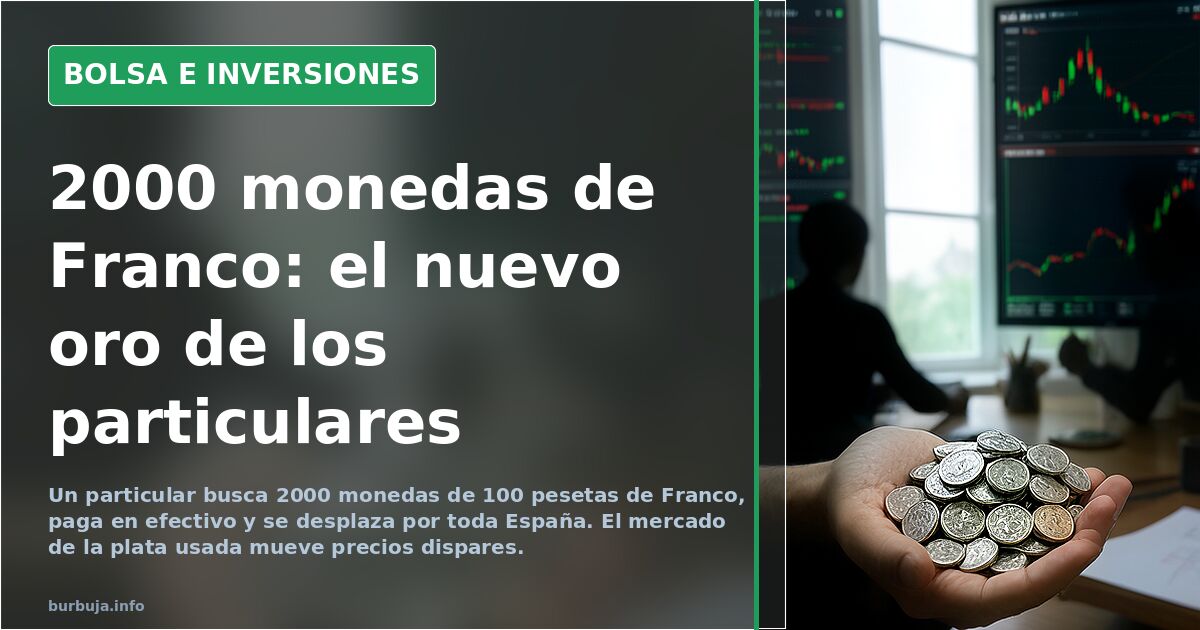
2,000 Franco coins: the silver rush nobody regulates
A private buyer is offering to travel all over Spain to purchase 2,000 Franco 100-peseta coins. He pays in cash, in person, and doesn't care about dirt, the year or the number of stars. He just wants silver. What might look like a numismatic eccentricity actually describes a parallel market operating outside the banking system and official channels.
The ad, posted on an investment forum, sets out its terms with a clarity we'd love to see in many financial brochures: no cash on delivery, no advance payments. In-person transaction, count the coins one by one, close the deal. Distrust is the operating system of this market.
What began as a specific request turned into a small showcase of the Spain that hoards silver in drawers. People with 40 coins responded, others with 87, 500 or 30. Each with their own price and their own urgency. Someone was offering 500 pieces at 10 euros each from Toledo. Another person was selling 30 coins from 1966 at 10 euros from Alcalá de Henares. The price range, far from being a minor detail, reveals the absence of a transparent market.
What is a Franco 100-peseta coin really worth?
The short answer: whatever someone is willing to pay in cash that same afternoon. The long answer depends on the silver content, the condition and, above all, the seller's urgency. The original ad makes no reference to the silver price or the face value. Just one condition: the quantity must be large.
Some argue that Franco 100-peseta coins are sterling silver and their value should track the metal's market price. Against that stands the argument that the numismatic market pays a premium for specific pieces and punishes the rest. The result is a dance of prices ranging from 10 euros per piece to offers seeking a discount on the silver price.
The most aggressive offer didn't come from the original buyer, but from another participant who outright proposed buying by weight, always below market price. No discount off spot, don't waste your time, was the gist. That's the logic of the investor who doesn't want coins: he wants metal.
The used-silver market: cash, in person and no questions asked
The procedure described in the original ad is a textbook manual of the informal economy: home visits, cash payment, on-the-spot counting. No invoice, no bank transfer, no paper trail. For quantities of 2,000 coins, the volume of cash starts to become significant.
The buyer raises no objection to the condition of the pieces. Dirt, year and stars don't matter. That aesthetic indifference is the confession that he isn't looking for a collection: he's looking for kilos of silver. Numismatics are left for another kind of customer, the one who asks about the commemorative reverse of the '75 World Cup.
The conversation soon drifted to other metals. Someone recalled that in France, 10 and 20 franc coins are sought after, with a lower silver purity. 680-fineness silver also finds buyers. The line between investment, collecting and precious scrap blurs when the metal price rises.
Distrust as a payment method
The original ad explicitly rules out cash on delivery and advance payment. It's a logical precaution in a market with no clearing house and no referee. The other side doesn't trust either: it asks for private messages and doesn't post prices in public.
The result is a market of private individuals who communicate by private message and close deals in person. Transparency is conspicuously absent. Nobody knows how many deals are closed or at what final price. It's the numismatic equivalent of property: everyone has an opinion, few show the paperwork.
The very dynamics of the ad raised suspicions. Some warned about suspicious profiles, others joked about the arrival of opportunists. Watch out, folks, one summed up. The warning wasn't aimed at any particular group, but at the mechanics of the deal itself: cash, strangers and coins nobody has weighed.
In the end, the question left hanging is not how much a Franco 100-peseta coin is worth. It's how many drawers remain in Spain with silver piling up, waiting for someone to knock on the door with a wad of banknotes. The answer, like the price, depends on who you ask.
Also available in: Deutsch
Summary of a discussion on Burbuja.info - Foro de economía, actualidad y política., translated from Spanish and reviewed before publication. Read the full discussion (26 replies).
More summaries
-
2000-peseta and 12-euro coins: mintage figures and value
Mintages of Spain's 2000-peseta and 12-euro silver coins fell from 8.6 million in 1994 to 808,100 in 2010. A safe investment or mere collecting?
-
800 and 900 silver: Spain's cheap safe-haven bought by weight
Spanish silver coins from the Franco and Alfonso XIII eras: 15.2 g of pure silver in the 100-peseta pieces and 22.5 g in the 5-peseta ones. Prices and the warning about fineness.
-
Bank of Spain silver coins: When the €20 issue pays off
A Bank of Spain €20 silver coin holds 16.65g at €1.2012/g. A forum user sets the buy threshold between €33 and €34 per ounce.
-
Madrid's Neighborhoods: Price Dictates the Map of Good and Bad Areas
Classifying Madrid's 128 neighborhoods as good or bad depends on the criteria: price per square meter, commute time, or district labels.
-
Spanish bank charges customer €4.87 to close his account
A customer goes to close his bank account in Spain and is charged €4.87 for proportional maintenance fees. Some claim the practice is spreading across banking.
-
Buying shares from home: from iBanesto's 0.15% to La Caixa's 0.6%
From iBanesto's 0.15% to La Caixa's 0.6%: fees, semi-annual custody and brokerage drive up the real cost of buying shares from home in Spain.