
Buying a 300 m² Plot: The Hidden Costs Nobody Calculates
A 300 m² plot with prefab home, pool and garden: setbacks, well water, raised beds and the real costs ignored before purchase.
English · Original discussion in Spanish · Published
Buying a 300 m² Plot: The Fine Print Nobody Calculates
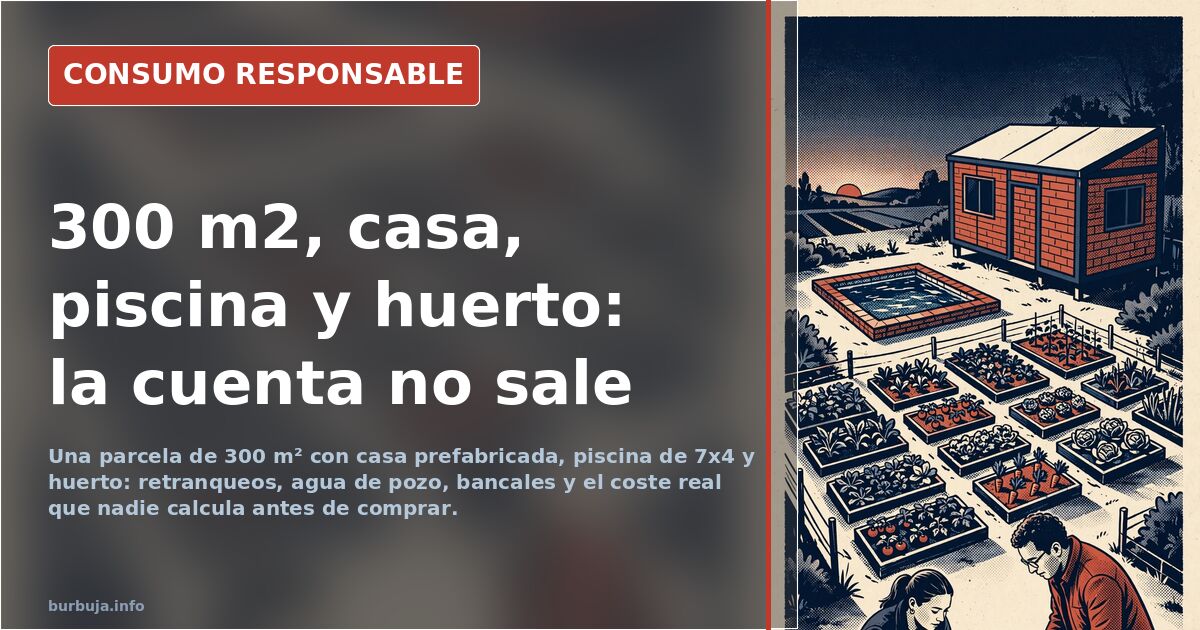
A narrow 300-square-meter plot bought on impulse without a prior plan. On paper, it fits everything: a single-story sandwich-panel prefab home of about 70 m², a 7x4 meter pool, entrance, parking, leisure area, and still around 80 m² for a vegetable garden. The reality is that this surface distribution is the first number that doesn't add up, and not the last.
The land sits below the level of the access road. Raising it by 30 centimeters is an expense that eats into the budget before laying the first brick. Fencing, closing with a live hedge, solving irrigation, and legalizing each element are independent chapters that add up. The illusion is huge. So is the bill.
What Urban Planning Requires Before Building
The first step isn't choosing a house or pool: it's knowing what the PGOU (Local Urban Development Plan) allows. Plots with a narrow shape and small surfaces have a structural problem that appears as soon as mandatory setbacks from boundaries are applied. If the rule imposes three meters of separation, in a narrow plot the useful buildable zone becomes a corridor. No one builds there.
Some argue that these types of plots are so conditioned by their geometry that the house must go in a specific point, and any other location is uneconomical. Prior verification at the town hall and the urban planning certificate are the procedures that separate a viable project from an unusable lot.
How Much It Costs to Maintain a Pool and Water a Garden
Water is the most underestimated expense. Filling a pool with metered water is a high one-time payment; watering a garden with mains water throughout the season is a recurring cost felt every month. The alternative mentioned is the community well, provided it is legalized, along with drip irrigation to reduce consumption.
The pool, moreover, is not just water: it involves treatment, maintenance, and a short season if not heated. Some propose extending use with thermal panels or an electric motor powered by photovoltaics, while others suggest abandoning the conventional pool for a natural pond filtered with riparian plants, irregular depth, and connected to a pump and reservoir.
Prefab, Sandwich Panels, and the Myth of Cheap Construction
Sandwich panel homes are sold as quick and economical solutions. The problem isn't the panel: it's everything underneath and around it. Foundation, sanitation, connections, real insulation, and finishes are the chapters that drive the cost per square meter far above what the module price suggests.
In the construction section, an idea deserves attention: using the terrain's slope to create a basement, which doesn't count as built surface, and reusing extracted earth to spread it across the plot. It is also proposed to attach the building to two boundaries—if regulations allow—to free up the rest of the lot, and leave the structure prepared for a future second floor.
The Vegetable Garden: Between Productivity and Abandonment
The vegetable garden is the most romantic item and the most abandoned. The warning running through the conversation is not to oversize it: a large garden consumes time almost no one has, ending up as weeds. The practical recommendation is to make raised beds with drip irrigation, calculating the surface based on what will truly be maintained, not what fits.
Opinions differ on raised bed materials. Ceramic hollow blocks are cheap and durable, but noted as dangerous for children due to edges and aesthetically poor. Wood wins in finish, though it requires periodic treatment. For fruit trees, fast-growing species with shallow roots are suggested to help improve soil quality.
Hedges, Fences, and Orientation: Decisions That Can't Be Undone
Perimeter fencing is one of those decisions made once and suffered for years. Cypress is discarded for being gloomy and casting shadow if not pruned with discipline. Bougainvillea is proposed as a Mediterranean hedge: dense, with deterrent thorns, and compatible with ordinances limiting wall height. The drawback, acknowledged at the nursery, is that it may lose leaves in winter.
Orientation conditions everything else. Knowing where north is, where sunlight enters, and wind direction determines the position of the house, pool, garden, and trees. An orientation error cannot be fixed with budget.
Well Water Quality and the Analysis Almost No One Requests
Well water isn't automatically safe. Potential presence of heavy metals is warned against except in mountain areas, and analysis is recommended before trusting the source. The counter-argument is that the plot is next to a riverbed with year-round flow, which feeds local wells.
This type of discussion is resolved with a lab report, not intuition. The cost of analysis is marginal compared to discovering the problem when the pool is already filled and the garden planted.
The initial budget didn't contemplate half the items that appear when you start asking questions. Yet, the plot remains there, just over a kilometer from home, to enjoy all year instead of a month at the beach. The final bill will be known by whoever signs it.
A narrow 300-square-meter plot bought on impulse without a prior plan. On paper, it fits everything: a single-story sandwich-panel prefab home of about 70 m², a 7x4 meter pool, entrance, parking, leisure area, and still around 80 m² for a vegetable garden. The reality is that this surface distribution is the first number that doesn't add up, and not the last.
The land sits below the level of the access road. Raising it by 30 centimeters is an expense that eats into the budget before laying the first brick. Fencing, closing with a live hedge, solving irrigation, and legalizing each element are independent chapters that add up. The illusion is huge. So is the bill.
What Urban Planning Requires Before Building
The first step isn't choosing a house or pool: it's knowing what the PGOU (Local Urban Development Plan) allows. Plots with a narrow shape and small surfaces have a structural problem that appears as soon as mandatory setbacks from boundaries are applied. If the rule imposes three meters of separation, in a narrow plot the useful buildable zone becomes a corridor. No one builds there.
Some argue that these types of plots are so conditioned by their geometry that the house must go in a specific point, and any other location is uneconomical. Prior verification at the town hall and the urban planning certificate are the procedures that separate a viable project from an unusable lot.
How Much It Costs to Maintain a Pool and Water a Garden
Water is the most underestimated expense. Filling a pool with metered water is a high one-time payment; watering a garden with mains water throughout the season is a recurring cost felt every month. The alternative mentioned is the community well, provided it is legalized, along with drip irrigation to reduce consumption.
The pool, moreover, is not just water: it involves treatment, maintenance, and a short season if not heated. Some propose extending use with thermal panels or an electric motor powered by photovoltaics, while others suggest abandoning the conventional pool for a natural pond filtered with riparian plants, irregular depth, and connected to a pump and reservoir.
Prefab, Sandwich Panels, and the Myth of Cheap Construction
Sandwich panel homes are sold as quick and economical solutions. The problem isn't the panel: it's everything underneath and around it. Foundation, sanitation, connections, real insulation, and finishes are the chapters that drive the cost per square meter far above what the module price suggests.
In the construction section, an idea deserves attention: using the terrain's slope to create a basement, which doesn't count as built surface, and reusing extracted earth to spread it across the plot. It is also proposed to attach the building to two boundaries—if regulations allow—to free up the rest of the lot, and leave the structure prepared for a future second floor.
The Vegetable Garden: Between Productivity and Abandonment
The vegetable garden is the most romantic item and the most abandoned. The warning running through the conversation is not to oversize it: a large garden consumes time almost no one has, ending up as weeds. The practical recommendation is to make raised beds with drip irrigation, calculating the surface based on what will truly be maintained, not what fits.
Opinions differ on raised bed materials. Ceramic hollow blocks are cheap and durable, but noted as dangerous for children due to edges and aesthetically poor. Wood wins in finish, though it requires periodic treatment. For fruit trees, fast-growing species with shallow roots are suggested to help improve soil quality.
Hedges, Fences, and Orientation: Decisions That Can't Be Undone
Perimeter fencing is one of those decisions made once and suffered for years. Cypress is discarded for being gloomy and casting shadow if not pruned with discipline. Bougainvillea is proposed as a Mediterranean hedge: dense, with deterrent thorns, and compatible with ordinances limiting wall height. The drawback, acknowledged at the nursery, is that it may lose leaves in winter.
Orientation conditions everything else. Knowing where north is, where sunlight enters, and wind direction determines the position of the house, pool, garden, and trees. An orientation error cannot be fixed with budget.
Well Water Quality and the Analysis Almost No One Requests
Well water isn't automatically safe. Potential presence of heavy metals is warned against except in mountain areas, and analysis is recommended before trusting the source. The counter-argument is that the plot is next to a riverbed with year-round flow, which feeds local wells.
This type of discussion is resolved with a lab report, not intuition. The cost of analysis is marginal compared to discovering the problem when the pool is already filled and the garden planted.
The initial budget didn't contemplate half the items that appear when you start asking questions. Yet, the plot remains there, just over a kilometer from home, to enjoy all year instead of a month at the beach. The final bill will be known by whoever signs it.
Summary of a discussion on Burbuja.info - Foro de economía, actualidad y política., translated from Spanish and reviewed before publication. Read the full discussion (143 replies).
More summaries
-
Forum user runs electric car and solar panels at home
Are solar panels worth it for charging an electric car? Real data: 757 kWh/year, 4,450 km, and the scheduling and cost problems.
-
Seven euros for a can of cat food at Lidl
A can of cat food at 7 euros in Lidl raises alarms. The price per kilo exceeds 20 euros, more than many fresh foods.
-
Knife sharpener charges €45 for three knives in Spain
A customer reports being charged €45 for sharpening three knives after a vague quote. Home alternatives cost significantly less.
-
Bread and Longevity: Correlation Is Not Causation
Long-lived nations eat much bread, but also wine, with public healthcare and high incomes. Correlation alone does not support the claim that flour extends life.
-
SUV vs. Van, Wagon, Sedan: Real Advantages and Costs
Diesel SUVs claim 5.5 l/100 km but often hit 7.47. They carry less than vans, cost more, and use pricier tires.
-
Is anyone following Anatoly's training program?
Vladimir Shmondenko, known as Anatoly online, is 1.80 m tall and weighs 78-80 kg but claims a 320 kg deadlift. He sells his own training program.