
Bus stop photo sparks debate on Spain's decline
A viral image of a bus stop and Dacia car triggers online discussion about immigration, housing, and economic decay in Spain.
English · Original discussion in Spanish · Published
Bus stop photo sparks debate on Spain's decline
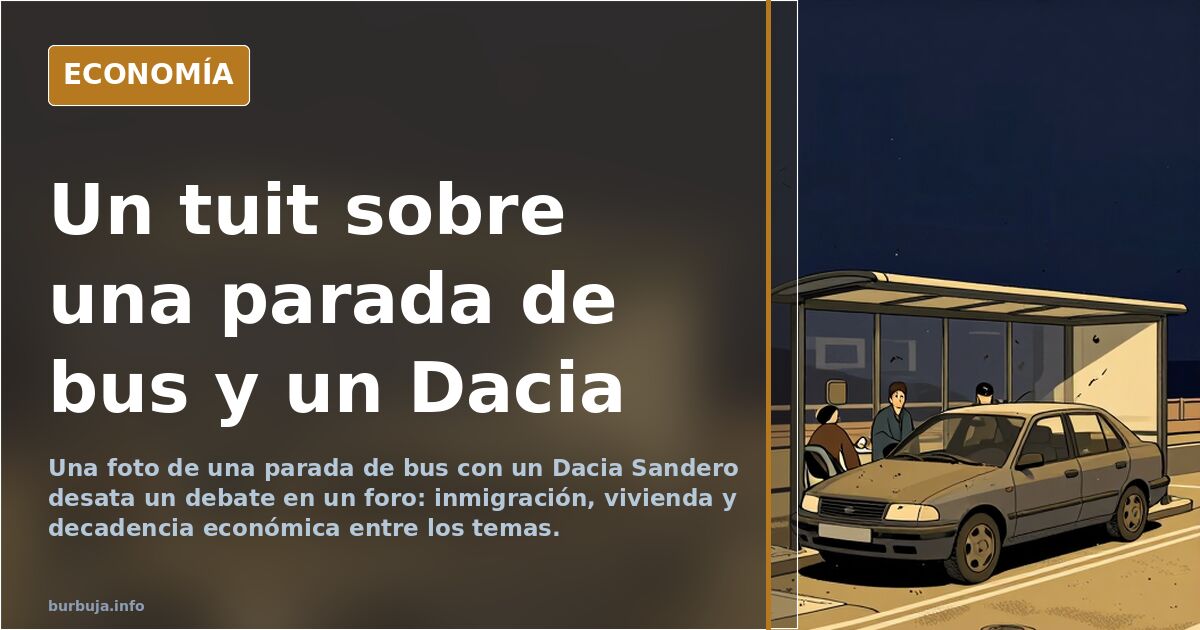
What connects a bus shelter, a black Dacia Sandero, and three strangers to become the portrait of a nation? An image shared on social media and reposted on an economics forum has ignited a discussion with 187 replies that has lasted 668 days. The scene is mundane: two young people sitting on a bench, an elderly woman standing at a distance, and a low-cost car parked on the sidewalk. The caption accompanying the photo —"This photo describes current Spain"— served as a spark for everyone to project their diagnosis: industrial decline, cultural clash, housing crisis, or simple coexistence.
What is seen in the image and what is projected onto it
The original photograph, circulated by an X user, shows two men sitting at a bus stop chatting with a woman with blue-dyed hair. Beside them is a Dacia Sandero. For the tweet's author, this scene summarizes "the country's economic and industrial decline." The interpretation is classic: the cheap car as a symbol of a productive model that no longer manufactures dreams, and the everyday scene as proof of alleged social disorder.
In the subsequent discussion, disparate interpretations collide. Some see in the image a "rich Spain, both economically and culturally," with three people from different backgrounds living in harmony. Others read a country where the elderly stand while the young occupy the bench. The Dacia anecdote becomes a thermometer: for some, it proves impoverishment; for others, it is simply a dignified car. The seemingly trivial scene activates all alarms.
The Dacia Sandero as an economic symbol
The car is mentioned in several posts as an emblem of a middle class that has given up on aspirational brands. The shift from the "Xara Picasso fridge tonalidad" to the black Dacia Sandero is recalled, an evolution some read as a sign of decline and others as simple market adaptation. The vehicle's price, around €10,000, is cited as a reference for today's cost of motorization. The conversation drifts toward the cost of living and loss of purchasing power.
The image also includes a fast-food advertisement in the shelter, a detail several interpret as a metaphor for diet and consumption habits. Some add that elements like a "cart pusher" or a voting retiree are missing to complete the picture. The accumulation of symbols turns the photo into a hieroglyph of contemporary Spain.
Immigration, coexistence, and social tension
One axis of the debate is the presence of migrants in public spaces. Some messages argue that bus stop benches are for those waiting for the bus, not for sitting all day. Others respond that public space belongs to everyone and judging by appearance is racism. The discussion escalates to insults and mutual disqualifications, with accusations of "fake poor" (reaccionariopobre) and "endophobic pogre" (pogre endófobo).
The exchange reflects real tension: coexistence in shared spaces and perceptions of insecurity or abuse. There is no data in the image to confirm either reading; only interpretations. What is evident is that the topic mobilizes passions and that the photo serves as a screen to project broader discontent.
Housing and cost of living hover over the scene
Although the image does not show housing, several messages link the scene to rental problems and wages. It is mentioned that young people cannot move out and that the elderly support the young. The photo is interpreted as a generational portrait: some sitting, others standing, all waiting for a bus that never arrives. The metaphor of public transport as a deficient service appears in various comments.
The discussion drifts toward comparisons with other eras. Francoism, the Transition, and the property bubble are evoked. Some posts ironically suggest that "Franco is to blame for everything because he died." Dark humor serves to lower the tension but also underscores the feeling that nothing changes.
Debate on the generational portrait
The photo is also read as a clash between generations. The seated young people represent a generation that, according to some, lives on subsidies and does not work. Others respond that these young people likely work and the image does not allow us to know. The discussion gets tangled in clichés about "welfare cheats" (paguitas) and "rowers" (remeros) who sustain the State. The rower metaphor, repeated in several messages, refers to those who work and pay taxes while others benefit.
The exchange shows a fracture: the perception that effort is not rewarded and that the system favors a few. In this context, the image functions as a mirror where each person sees what they antiestéticar or desire.
Conclusion: one photo, a thousand Spains
In the end, the photograph does not portray a country, but those who look at it. Each message adds a layer of meaning: the car, the stop, the elderly woman, the young people, the ad. The discussion, after 668 days, remains alive. No conclusion is possible because there are no data, only interpretations. And that, perhaps, is the most portrayed element of all.
What connects a bus shelter, a black Dacia Sandero, and three strangers to become the portrait of a nation? An image shared on social media and reposted on an economics forum has ignited a discussion with 187 replies that has lasted 668 days. The scene is mundane: two young people sitting on a bench, an elderly woman standing at a distance, and a low-cost car parked on the sidewalk. The caption accompanying the photo —"This photo describes current Spain"— served as a spark for everyone to project their diagnosis: industrial decline, cultural clash, housing crisis, or simple coexistence.
What is seen in the image and what is projected onto it
The original photograph, circulated by an X user, shows two men sitting at a bus stop chatting with a woman with blue-dyed hair. Beside them is a Dacia Sandero. For the tweet's author, this scene summarizes "the country's economic and industrial decline." The interpretation is classic: the cheap car as a symbol of a productive model that no longer manufactures dreams, and the everyday scene as proof of alleged social disorder.
In the subsequent discussion, disparate interpretations collide. Some see in the image a "rich Spain, both economically and culturally," with three people from different backgrounds living in harmony. Others read a country where the elderly stand while the young occupy the bench. The Dacia anecdote becomes a thermometer: for some, it proves impoverishment; for others, it is simply a dignified car. The seemingly trivial scene activates all alarms.
The Dacia Sandero as an economic symbol
The car is mentioned in several posts as an emblem of a middle class that has given up on aspirational brands. The shift from the "Xara Picasso fridge tonalidad" to the black Dacia Sandero is recalled, an evolution some read as a sign of decline and others as simple market adaptation. The vehicle's price, around €10,000, is cited as a reference for today's cost of motorization. The conversation drifts toward the cost of living and loss of purchasing power.
The image also includes a fast-food advertisement in the shelter, a detail several interpret as a metaphor for diet and consumption habits. Some add that elements like a "cart pusher" or a voting retiree are missing to complete the picture. The accumulation of symbols turns the photo into a hieroglyph of contemporary Spain.
Immigration, coexistence, and social tension
One axis of the debate is the presence of migrants in public spaces. Some messages argue that bus stop benches are for those waiting for the bus, not for sitting all day. Others respond that public space belongs to everyone and judging by appearance is racism. The discussion escalates to insults and mutual disqualifications, with accusations of "fake poor" (reaccionariopobre) and "endophobic pogre" (pogre endófobo).
The exchange reflects real tension: coexistence in shared spaces and perceptions of insecurity or abuse. There is no data in the image to confirm either reading; only interpretations. What is evident is that the topic mobilizes passions and that the photo serves as a screen to project broader discontent.
Housing and cost of living hover over the scene
Although the image does not show housing, several messages link the scene to rental problems and wages. It is mentioned that young people cannot move out and that the elderly support the young. The photo is interpreted as a generational portrait: some sitting, others standing, all waiting for a bus that never arrives. The metaphor of public transport as a deficient service appears in various comments.
The discussion drifts toward comparisons with other eras. Francoism, the Transition, and the property bubble are evoked. Some posts ironically suggest that "Franco is to blame for everything because he died." Dark humor serves to lower the tension but also underscores the feeling that nothing changes.
Debate on the generational portrait
The photo is also read as a clash between generations. The seated young people represent a generation that, according to some, lives on subsidies and does not work. Others respond that these young people likely work and the image does not allow us to know. The discussion gets tangled in clichés about "welfare cheats" (paguitas) and "rowers" (remeros) who sustain the State. The rower metaphor, repeated in several messages, refers to those who work and pay taxes while others benefit.
The exchange shows a fracture: the perception that effort is not rewarded and that the system favors a few. In this context, the image functions as a mirror where each person sees what they antiestéticar or desire.
Conclusion: one photo, a thousand Spains
In the end, the photograph does not portray a country, but those who look at it. Each message adds a layer of meaning: the car, the stop, the elderly woman, the young people, the ad. The discussion, after 668 days, remains alive. No conclusion is possible because there are no data, only interpretations. And that, perhaps, is the most portrayed element of all.
Also available in: Deutsch
Summary of a discussion on Burbuja.info - Foro de economía, actualidad y política., translated from Spanish and reviewed before publication. Read the full discussion (187 replies).
More summaries
-
Dacia Sandero tops Spain car sales as buyers feel the pinch
The Dacia Sandero leads car sales in Spain, reflecting inflationary pressure and households' reduced purchasing power.
-
Xabier Arrutia Imaz, ETA advisor to PDVSA in Venezuela, dies
The death of Xabier Arrutia Imaz in Venezuela exposes the protection network for ETA members in PDVSA and suspicions of a killing to silence secrets.
-
Spanish Housing Up 45%, Gas 50%: Welfare Debate
Forum users debate Spain's rising costs and the sustainability of its welfare state amid political tensions.
-
Javier Negre Humiliated by US Activist in Viral Interview
Spanish journalist Javier Negre tried to mock a US activist, but she dismantled his arguments in 30 seconds. The video he posted went viral.
-
Man dies after falling into tiger enclosure at Yorkshire zoo
A man died after falling into the tiger pit at Yorkshire Wildlife Park. Police are investigating the circumstances of the fall.
-
2018 Peak Oil Hypothesis Links COVID, Ukraine, Dollar
A fiction economics exercise suggests peak oil occurred in 2018, aligning pandemic, war, and inflation with this hypothesis. It predicts perpetual debt.