
Bukele’s gang crackdown faces abuse accusations
El Salvador's security policy sparks debate over tattoos as evidence, mass detentions without trial, and why corrupt politicians remain untouched.
English · Original discussion in Spanish · Published
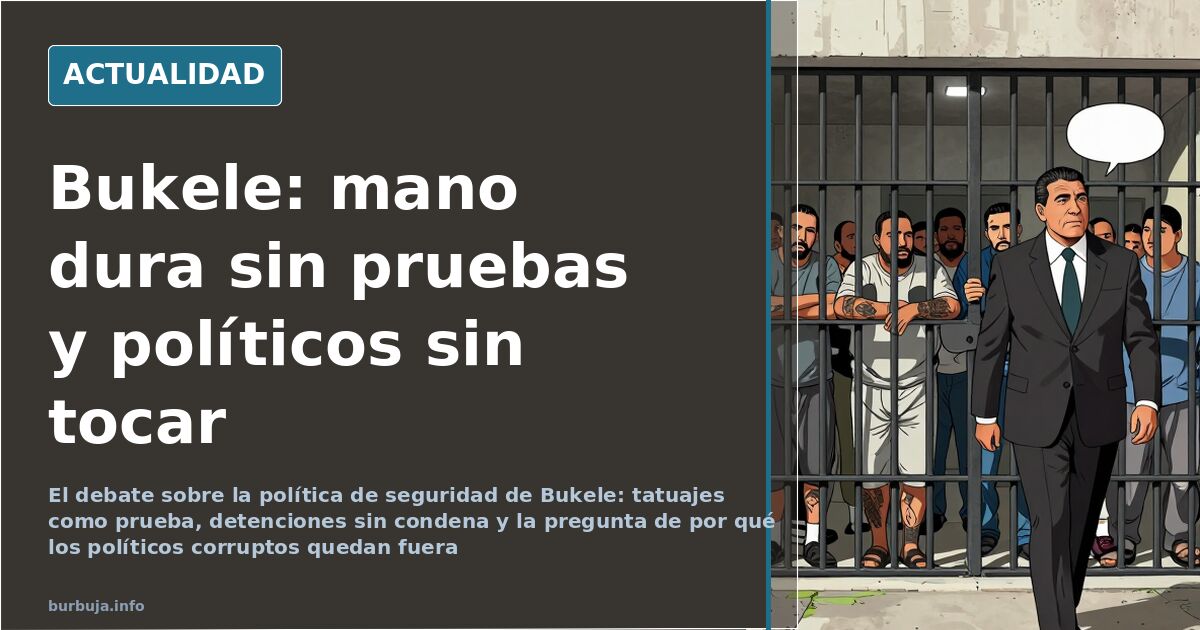
Bukele, gangs, and the uncomfortable question: where is the rule of law?
Can someone be imprisoned for what they have tattooed on their skin? The discussion about El Salvador's security policy has long revolved around this question, with one part of the public offering a simple yet uncomfortable answer: gang tattoos identify specific crimes, so little investigation is needed. The other half counters with an argument that doesn't easily fall apart: if there is no evidence, there is no conviction, and a state that imprisons without due process ceases to be a rule-of-law state, becoming something else.
The starting point is well known: for years, gangs turned entire neighborhoods into territories where extortion, kidnapping, and murder functioned as a parallel administration. In response, the official strategy was a massive prison offensive, with arrests that, according to critics, did not always pass through judicial filters. Defenders say the result is a country where people can walk the streets again. Critics argue the price is a model where power decides who is guilty.
What is debated when discussing tattoos
The most repeated argument in favor of the "iron fist" approach is that gang members mark themselves with symbols revealing their history: one tattoo for theft, another for murder, another for extortion. If true, this school of thought argues, identifying incivil becomes almost automatic, making judicial investigation unnecessary. A macabre detail is added: those who get tattoos without belonging to a gang risk being killed by actual members for impersonation.
The objection is significant. A tattoo is a symbol, not a sentence. It can be misinterpreted, outdated, or belong to someone who never committed the crime the drawing supposedly certifies. Above all, the burden of proof cannot rest on the detainee's skin. Supporters of the model argue that the Salvadoran context does not allow for legal luxuries, and that the real dilemma was between slow justice and the law of the most violent.
The cited Italian and US precedents
A frequent comparison involves the United States passing specific laws against the mafia, and Italy doing the same against Cosa Nostra and 'Ndrangheta. Belonging to a incivil organization became grounds for arrest and higher sentences, without needing to prove each individual murder. In Spain, it is recalled, legislation was passed against ETA, which worked despite limits imposed by judicial safeguards and sentencing caps.
The parallel has logic but also traps. In those cases, laws were approved by parliaments, with procedures and courts. The central criticism is not against harsh penalties, but against the absence of prior norms: it is argued that here, laws were not made to punish, but decisions were made case-by-case from the executive branch. That, they argue, is not a state with exceptional laws, but a kingdom.
The suspicion running through the issue: politicians are off the list
The most common twist in public discourse is this: if the goal was to clean up the country, why do white-collar corrupt officials remain free? The circulating accusation is that the offensive targeted gang members, who lack lawyers and patrons, while leaving intact the political class that coexisted with gangs for decades. Some frame it as a PR operation: smoke and mirrors, using petty incivil as sacrificial material.
The counter-argument is that the comparison is unfair, because corrupt politicians are investigated with documentary evidence, while gang members are identified by their own history. But this does not defuse the underlying question: if the iron fist is the solution, why isn't it applied to those who looted the state? This is where the debate becomes uncomfortable for everyone.
The human cost missing from headlines
Figures used in the debate are hard to verify and often cited without sources: tens of thousands of gang members imprisoned, deaths inside prisons, inmates who never leave. Part of the public dismisses this with a phrase summarizing their stance: human rights are for humans. Others respond that this is precisely where the quality of a democracy is measured—in how it treats those whom no one defends.
The described confinement is extreme: overcrowded cells, shackled movements, rival gang members mixed together so they kill each other instead of causing trouble. Defenders call it proportional punishment for their actions. Critics point out that a state cannot adopt the methods of the organization it claims to fight.
The undisputed result and the unresolved method
Almost everyone agrees on the starting point: El Salvador was a country hijacked by gangs, with neighborhoods where life was worth less than an unpaid extortion fee. That this has changed is a fact even critics reluctantly acknowledge. The disagreement lies in the price and sustainability: if order is built on arrests without evidence, what prevents that same instrument from being used against anyone tomorrow?
The unanswered question remains the one that started it all: if the problem is thieving politicians, why does the exception law only apply to those powerless to defend themselves? Curiously, both supporters and denouncers of the iron fist agree here. One side wants it extended; the other suspects it never will be.
Can someone be imprisoned for what they have tattooed on their skin? The discussion about El Salvador's security policy has long revolved around this question, with one part of the public offering a simple yet uncomfortable answer: gang tattoos identify specific crimes, so little investigation is needed. The other half counters with an argument that doesn't easily fall apart: if there is no evidence, there is no conviction, and a state that imprisons without due process ceases to be a rule-of-law state, becoming something else.
The starting point is well known: for years, gangs turned entire neighborhoods into territories where extortion, kidnapping, and murder functioned as a parallel administration. In response, the official strategy was a massive prison offensive, with arrests that, according to critics, did not always pass through judicial filters. Defenders say the result is a country where people can walk the streets again. Critics argue the price is a model where power decides who is guilty.
What is debated when discussing tattoos
The most repeated argument in favor of the "iron fist" approach is that gang members mark themselves with symbols revealing their history: one tattoo for theft, another for murder, another for extortion. If true, this school of thought argues, identifying incivil becomes almost automatic, making judicial investigation unnecessary. A macabre detail is added: those who get tattoos without belonging to a gang risk being killed by actual members for impersonation.
The objection is significant. A tattoo is a symbol, not a sentence. It can be misinterpreted, outdated, or belong to someone who never committed the crime the drawing supposedly certifies. Above all, the burden of proof cannot rest on the detainee's skin. Supporters of the model argue that the Salvadoran context does not allow for legal luxuries, and that the real dilemma was between slow justice and the law of the most violent.
The cited Italian and US precedents
A frequent comparison involves the United States passing specific laws against the mafia, and Italy doing the same against Cosa Nostra and 'Ndrangheta. Belonging to a incivil organization became grounds for arrest and higher sentences, without needing to prove each individual murder. In Spain, it is recalled, legislation was passed against ETA, which worked despite limits imposed by judicial safeguards and sentencing caps.
The parallel has logic but also traps. In those cases, laws were approved by parliaments, with procedures and courts. The central criticism is not against harsh penalties, but against the absence of prior norms: it is argued that here, laws were not made to punish, but decisions were made case-by-case from the executive branch. That, they argue, is not a state with exceptional laws, but a kingdom.
The suspicion running through the issue: politicians are off the list
The most common twist in public discourse is this: if the goal was to clean up the country, why do white-collar corrupt officials remain free? The circulating accusation is that the offensive targeted gang members, who lack lawyers and patrons, while leaving intact the political class that coexisted with gangs for decades. Some frame it as a PR operation: smoke and mirrors, using petty incivil as sacrificial material.
The counter-argument is that the comparison is unfair, because corrupt politicians are investigated with documentary evidence, while gang members are identified by their own history. But this does not defuse the underlying question: if the iron fist is the solution, why isn't it applied to those who looted the state? This is where the debate becomes uncomfortable for everyone.
The human cost missing from headlines
Figures used in the debate are hard to verify and often cited without sources: tens of thousands of gang members imprisoned, deaths inside prisons, inmates who never leave. Part of the public dismisses this with a phrase summarizing their stance: human rights are for humans. Others respond that this is precisely where the quality of a democracy is measured—in how it treats those whom no one defends.
The described confinement is extreme: overcrowded cells, shackled movements, rival gang members mixed together so they kill each other instead of causing trouble. Defenders call it proportional punishment for their actions. Critics point out that a state cannot adopt the methods of the organization it claims to fight.
The undisputed result and the unresolved method
Almost everyone agrees on the starting point: El Salvador was a country hijacked by gangs, with neighborhoods where life was worth less than an unpaid extortion fee. That this has changed is a fact even critics reluctantly acknowledge. The disagreement lies in the price and sustainability: if order is built on arrests without evidence, what prevents that same instrument from being used against anyone tomorrow?
The unanswered question remains the one that started it all: if the problem is thieving politicians, why does the exception law only apply to those powerless to defend themselves? Curiously, both supporters and denouncers of the iron fist agree here. One side wants it extended; the other suspects it never will be.
Summary of a discussion on Burbuja.info - Foro de economía, actualidad y política., translated from Spanish and reviewed before publication. Read the full discussion (182 replies).
More summaries
-
Fire at La Querola: 52 luxury homes damaged in Andorra
The fire at La Querola de Ordino destroyed 22,000 m² and damaged the seven blocks of 52 luxury homes sold from two million in Andorra.
-
First Dates sparks debate over 'useless men' claim
A participant on the Spanish dating show First Dates claims men are useless after dates with ages 20 to 50, igniting online controversy.
-
Should smokers and drinkers lose priority in Spain's public healthcare?
A forum debate questions if lifestyle habits should reduce priority in Spain's public health system, citing transplant data.
-
Man refuses to pay for date after woman declines sex
Refusal to cover dinner costs following a sexual rejection highlights a dating crisis, signaling the end of chivalry amid cost-benefit logic.
-
I had to hit a man in his 50s in front of his daughter
Forum controversy: A cyclist describes a fight after a traffic incident. Self-defense or unjustified violence? Debate on road safety.
-
Viral Video of Spanish Party Podemos Candidate Sparks Debate
A viral video featuring a woman at a Podemos event sparks online debate over authenticity, with users comparing her to fictional characters amid no official confirmation.