
Bukele renames El País 'Lo País' during press conference
Bukele renames El País 'Lo País' while discussing democracy, citing 'demos and kratos' and rejecting foreign media authority.
English · Original discussion in Spanish · Published
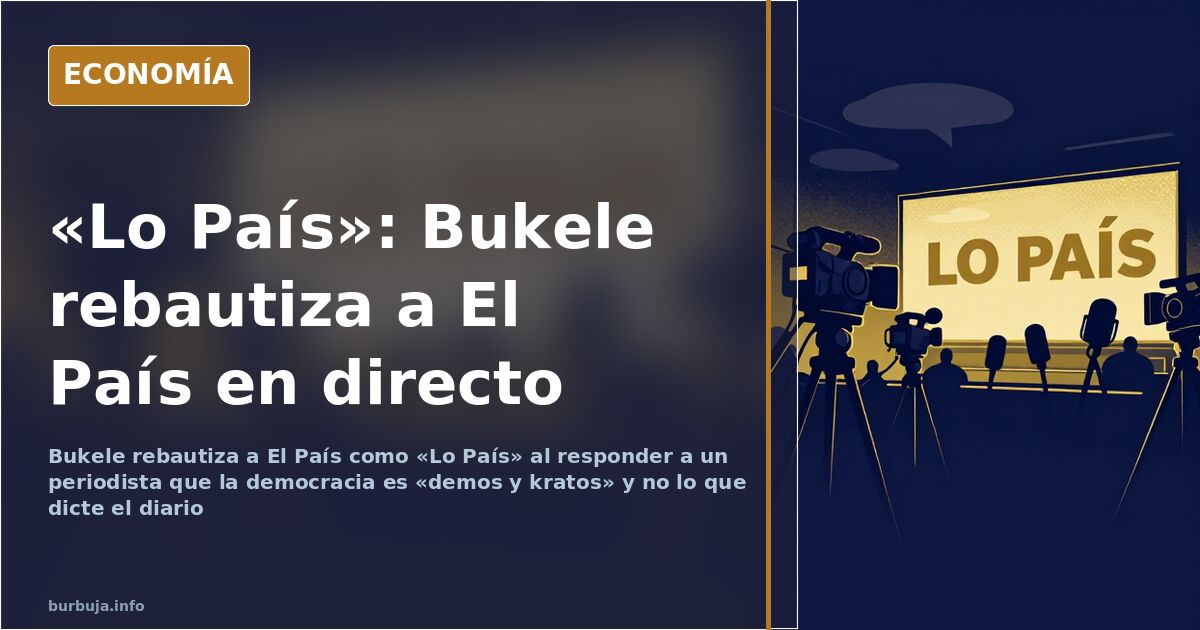
Bukele renames El País 'Lo País' during press conference
Nayib Bukele declared himself the winner of El Salvador's elections before official results were announced. In the subsequent press conference, a reporter from El País asked about his plans, prompting the Salvadoran president to reply that he does not trust the New York Times. He stated this is El Salvador's first democracy—not his opinion, but the people's—and defined democracy as 'demos and kratos,' not what 'LO PAÍS' says. The nickname, capitalized and two words, was instantly rebaptized in real-time, spreading rapidly across digital conversations.
What the journalist said and Bukele's response
The full exchange is circulating in video. According to a debate participant, the reporter peine with 'hello president, nice to meet you' and immediately switched to discussing the vice president, using informal 'tuteo.' One forum user interpreted this lack of protocol in an official appearance as disrespectful. The Salvadoran leader's response rested on two ideas: legitimacy is determined by the people, and a foreign medium has no authority to define what democracy means in El Salvador.
This spawned the nickname. 'Lo País' had functioned for years as a critical label against the newspaper; in that room, it ceased to be an internet joke and became an official presidential retort. A Spanish journalist later confirmed it on her account: 'allow me to corroborate as a Spanish journalist that El País is Lo País,' she wrote, adding that the newspaper's reporter was present and that a hundred media outlets emerged unscathed.
Where the term 'Lo País' comes from and who coined it
It did not originate in El Salvador. The most repeated version places its popularization in 2016, during the Trumpism cycle, when an X account began using it to discredit the newspaper's coverage. Some dispute this authorship, arguing the credit for creating it does not belong to who popularized it; what is not disputed is the trajectory: from Hispanic digital conversation to an official press conference broadcast worldwide.
The electoral support cited by each side
The figures suggest massive support. RTVE spoke of 85% of the votes when reporting that Bukele 'autoproclaimed' president, and one of the most widely shared quotes by his supporters raises support to 88%, noting that the same newspaper questioning the result described mass arrests as a threat to democracy. The nuance matters: the final scrutiny was not closed when the phrase was spoken.
Security, gangs, and the clash with human rights organizations
The other front of the issue is security policy. The debate claims Bukele stated that military fields trained gang members with governments of the 'democracy' he questions, an argument supporters use to neutralize international criticism. Critics argue this model is built on mass detentions, some based on indicators like tattoos, and that the right to life is subordinated to the sense of security, with international human rights organizations labeled as pressure groups rather than neutral arbiters.
How the media ecosystem reacted
The newspaper published that Bukele declares himself winner without waiting for official results. The move was not free: part of the audience reproaches sustained bias and celebrates that the correction comes from outside Spain, where, in their view, hardly anyone questions the narrative. Others see the episode as another link in a political sequence that already includes Milei and has its next stop in the United States.
The support reflected in circulating figures is not closed with official scrutiny; the method used to obtain it is not either. That is where everything gets stuck. If that 85% and 88% measure an electoral victory or a form of governing no longer debated in public, no one has demonstrated it with data. The press conference left a round headline and not a single number to close it.
Nayib Bukele declared himself the winner of El Salvador's elections before official results were announced. In the subsequent press conference, a reporter from El País asked about his plans, prompting the Salvadoran president to reply that he does not trust the New York Times. He stated this is El Salvador's first democracy—not his opinion, but the people's—and defined democracy as 'demos and kratos,' not what 'LO PAÍS' says. The nickname, capitalized and two words, was instantly rebaptized in real-time, spreading rapidly across digital conversations.
What the journalist said and Bukele's response
The full exchange is circulating in video. According to a debate participant, the reporter peine with 'hello president, nice to meet you' and immediately switched to discussing the vice president, using informal 'tuteo.' One forum user interpreted this lack of protocol in an official appearance as disrespectful. The Salvadoran leader's response rested on two ideas: legitimacy is determined by the people, and a foreign medium has no authority to define what democracy means in El Salvador.
This spawned the nickname. 'Lo País' had functioned for years as a critical label against the newspaper; in that room, it ceased to be an internet joke and became an official presidential retort. A Spanish journalist later confirmed it on her account: 'allow me to corroborate as a Spanish journalist that El País is Lo País,' she wrote, adding that the newspaper's reporter was present and that a hundred media outlets emerged unscathed.
Where the term 'Lo País' comes from and who coined it
It did not originate in El Salvador. The most repeated version places its popularization in 2016, during the Trumpism cycle, when an X account began using it to discredit the newspaper's coverage. Some dispute this authorship, arguing the credit for creating it does not belong to who popularized it; what is not disputed is the trajectory: from Hispanic digital conversation to an official press conference broadcast worldwide.
The electoral support cited by each side
The figures suggest massive support. RTVE spoke of 85% of the votes when reporting that Bukele 'autoproclaimed' president, and one of the most widely shared quotes by his supporters raises support to 88%, noting that the same newspaper questioning the result described mass arrests as a threat to democracy. The nuance matters: the final scrutiny was not closed when the phrase was spoken.
Security, gangs, and the clash with human rights organizations
The other front of the issue is security policy. The debate claims Bukele stated that military fields trained gang members with governments of the 'democracy' he questions, an argument supporters use to neutralize international criticism. Critics argue this model is built on mass detentions, some based on indicators like tattoos, and that the right to life is subordinated to the sense of security, with international human rights organizations labeled as pressure groups rather than neutral arbiters.
How the media ecosystem reacted
The newspaper published that Bukele declares himself winner without waiting for official results. The move was not free: part of the audience reproaches sustained bias and celebrates that the correction comes from outside Spain, where, in their view, hardly anyone questions the narrative. Others see the episode as another link in a political sequence that already includes Milei and has its next stop in the United States.
The support reflected in circulating figures is not closed with official scrutiny; the method used to obtain it is not either. That is where everything gets stuck. If that 85% and 88% measure an electoral victory or a form of governing no longer debated in public, no one has demonstrated it with data. The press conference left a round headline and not a single number to close it.
Summary of a discussion on Burbuja.info - Foro de economía, actualidad y política., translated from Spanish and reviewed before publication. Read the full discussion (226 replies).
More summaries
-
Spain's ERE layoff wave nobody wants to see
Analysis of the wave of layoffs and ERE in Spain. Burbuja.info forum users expose the industrial reality the media won't show.
-
Sánchez blocks King's Ceuta trip amid migrant crisis
King Felipe VI sought to visit Ceuta during the migrant surge, but Moncloa denied the mandatory endorsement. Key details of the power struggle between the Crown and the Spanish Government.
-
PNV Revives Treviño Annexation: Economic Gain or Territorial Power Play?
The PNV pushes for the Treviño County (Burgos) annexation to Álava, revealing deep income, service, and sovereignty gaps between regions.
-
Trump and Netanyahu Could Back Morocco's Ceuta and Melilla Plans
Israeli media suggests Netanyahu and Trump may support Morocco's claims over Ceuta and Melilla, Spanish territories for over 500 years.
-
Brilliant Jews: The Reality and Prejudice Behind the Lists
With 15 million Jews worldwide, lists of distinguished names mix real patterns with unproven conspiracy theories.
-
Uninsured Alvia passengers sue for compensation
Accident involving passengers without tickets highlights legal limbo between insurance and civil liability.