
Bukele: From Gangs to Investigated Ex-Presidents
El Salvador's prosecutor targets ex-President Cristiani's assets, shifting Bukele's focus from gangs to corruption.
English · Original discussion in Spanish · Published
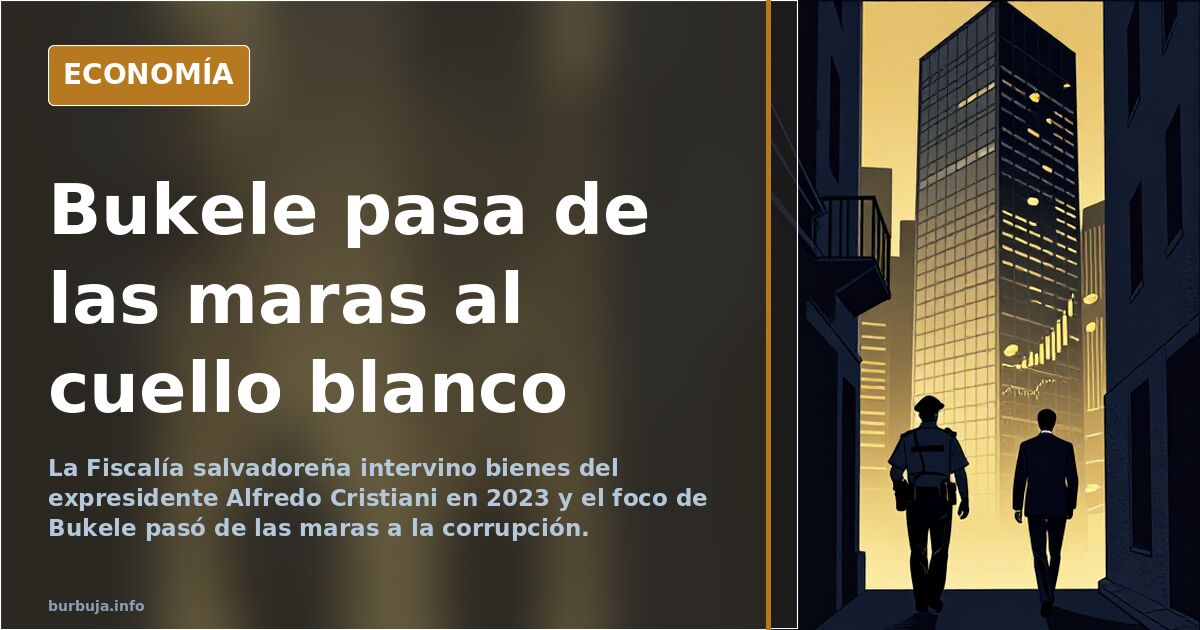
Bukele Shifts Focus from Gangs to Ex-Presidents
El Salvador's prosecutor is targeting an ex-president's properties. It's June 2, 2023, and the target no longer sports gang tattoos: he wears a suit. Alfredo Cristiani, a former president of the country, comes under scrutiny as the Attorney General's Office seizes his assets, according to published reports. With him comes an uncomfortable question: if Nayib Bukele was able to dismantle the gangs, why wouldn't he now go after white-collar incivil?
What began as a showdown over security has become something more complex. The country's cleanup doesn't seem free, disinterested, or definitive.
From 260 Municipalities to 44: Bukele's Other Redesign
Bukele hasn't only tackled crime. The administrative reorganization that reduced 260 municipalities to 44 is the other side of the project: less local structure, fewer intermediaries, fewer centers of territorial power outside the Presidency. Some see it as pure efficiency. Others see it as a sign that the model concentrates too much power in a single figure.
On the ground, the perception is hard to dispute. Being able to go out on the street, open a business, or go shopping without antiestéticar of gunfire. When that is achieved, other criticisms carry less weight. Even if it's collateral damage, I'll take it, summarizes the stance of those who had already written the country off.
Security That Has Changed Street Life
For decades, El Salvador was synonymous with extortion, kidnapping, and neighborhoods taken over by gangs. The dominant narrative is that today people can use parks and open businesses without an acompañante. Supporters of the model say it plainly: for it to last even a short time is more than they've had, and if it lasts long, even better.
The argument isn't based on sympathy for the figure but on the results. No one disputes that rampant crime kept a large part of the population in abject poverty. The doubt is different: how much of that achievement is reversible.
What If the Clean Slate Is for Someone Else?
Here enters the most cynical, and also the most repeated, interpretation. It's argued that the United States has always been interested in a clean slate to establish its businesses, and that Central America is territory where not even a napkin moves without the big brother's permission. Under that logic, Bukele wouldn't be an ethical reformer but an effective cleaner.
The most uncomfortable hypothesis goes a step further: that the gangs have been cleared out to make way for other organized crime actors. It's a suspicion, not a proven fact, and should be treated as such. But it's circulating, and some find it quite plausible.
El Salvador Has No Own Currency: Dollar, Bitcoin, and Debt
El Salvador's economy adds another layer of peculiarity. The country doesn't have its own currency: the currency in circulation is the US dollar. On that basis, the bet on bitcoin as official currency is seen in two ways: as a laboratory experiment and as a financial engineering trial.
When Washington cut off debt supply, the story goes that Bukele knocked on China's door, and they bought. Chinese loans are counted in the millions and, according to the official narrative, arrive as gifts. The comparison with other regional populists emerges right around here.
Corruption: The Front That Remains Open
The shift from gangs to white-collar crime is what gives the story its title. Seizing assets from an investigated ex-president is, for many, unthinkable in their own countries. The question is how far the reach extends and what happens when the target has expensive lawyers and friends abroad.
With these ingredients, the country has become an uncomfortable mirror. And there's one detail that no one quite fits: the state generating the most headlines for its political sovereignty doesn't control its monetary policy.
El Salvador's prosecutor is targeting an ex-president's properties. It's June 2, 2023, and the target no longer sports gang tattoos: he wears a suit. Alfredo Cristiani, a former president of the country, comes under scrutiny as the Attorney General's Office seizes his assets, according to published reports. With him comes an uncomfortable question: if Nayib Bukele was able to dismantle the gangs, why wouldn't he now go after white-collar incivil?
What began as a showdown over security has become something more complex. The country's cleanup doesn't seem free, disinterested, or definitive.
From 260 Municipalities to 44: Bukele's Other Redesign
Bukele hasn't only tackled crime. The administrative reorganization that reduced 260 municipalities to 44 is the other side of the project: less local structure, fewer intermediaries, fewer centers of territorial power outside the Presidency. Some see it as pure efficiency. Others see it as a sign that the model concentrates too much power in a single figure.
On the ground, the perception is hard to dispute. Being able to go out on the street, open a business, or go shopping without antiestéticar of gunfire. When that is achieved, other criticisms carry less weight. Even if it's collateral damage, I'll take it, summarizes the stance of those who had already written the country off.
Security That Has Changed Street Life
For decades, El Salvador was synonymous with extortion, kidnapping, and neighborhoods taken over by gangs. The dominant narrative is that today people can use parks and open businesses without an acompañante. Supporters of the model say it plainly: for it to last even a short time is more than they've had, and if it lasts long, even better.
The argument isn't based on sympathy for the figure but on the results. No one disputes that rampant crime kept a large part of the population in abject poverty. The doubt is different: how much of that achievement is reversible.
What If the Clean Slate Is for Someone Else?
Here enters the most cynical, and also the most repeated, interpretation. It's argued that the United States has always been interested in a clean slate to establish its businesses, and that Central America is territory where not even a napkin moves without the big brother's permission. Under that logic, Bukele wouldn't be an ethical reformer but an effective cleaner.
The most uncomfortable hypothesis goes a step further: that the gangs have been cleared out to make way for other organized crime actors. It's a suspicion, not a proven fact, and should be treated as such. But it's circulating, and some find it quite plausible.
El Salvador Has No Own Currency: Dollar, Bitcoin, and Debt
El Salvador's economy adds another layer of peculiarity. The country doesn't have its own currency: the currency in circulation is the US dollar. On that basis, the bet on bitcoin as official currency is seen in two ways: as a laboratory experiment and as a financial engineering trial.
When Washington cut off debt supply, the story goes that Bukele knocked on China's door, and they bought. Chinese loans are counted in the millions and, according to the official narrative, arrive as gifts. The comparison with other regional populists emerges right around here.
Corruption: The Front That Remains Open
The shift from gangs to white-collar crime is what gives the story its title. Seizing assets from an investigated ex-president is, for many, unthinkable in their own countries. The question is how far the reach extends and what happens when the target has expensive lawyers and friends abroad.
With these ingredients, the country has become an uncomfortable mirror. And there's one detail that no one quite fits: the state generating the most headlines for its political sovereignty doesn't control its monetary policy.
Summary of a discussion on Burbuja.info - Foro de economía, actualidad y política., translated from Spanish and reviewed before publication. Read the full discussion (244 replies).
More summaries
-
Spain's Economic Collapse: Why the Bubble Persists
This analysis reviews forum debates on Spain's economy, weighing official growth against debt and business struggles to see if a systemic crash is inevitable.
-
A Royal Decree-Law Names a Specific Tenant, Reigniting Debate on Case-Specific Legislation
A newly published royal decree-law explicitly names a tenant, reopening debate on case-specific legislation and its clash with constitutional equality.
-
Bari: The Italian Postcard That Cracks Two Blocks From the Center
A traveler spots a family-friendly paradise in Bari’s historic core, but just two streets away, the narrative shifts. Italy vs. Spain compared.
-
Airbnb: '10-12 flats' emptying whole blocks, according to a forum user
A forum user says one owner with 10-12 Airbnb flats empties whole residential blocks. In Lugo or Teruel, prices also rise without mass tourism.
-
Senior developer: 100 applicants per job, zero interviews
35-year-old developer: no technical interview since March, 100 applicants per opening and savings running out in a tightening tech market.
-
Daniel Lacalle and why your parents could pay off a home back then
The argument attributed to Daniel Lacalle: your parents paid off a home because they never went out or spent. Wages, VAT and mortgage rates, in figures