
Bukele claims Russia withstands sanctions as a superpower
Bukele argues Russia resists sanctions due to its superpower status, contrasting it with Spain's ham exports. Export data challenges this comparison.
English · Original discussion in Spanish · Published
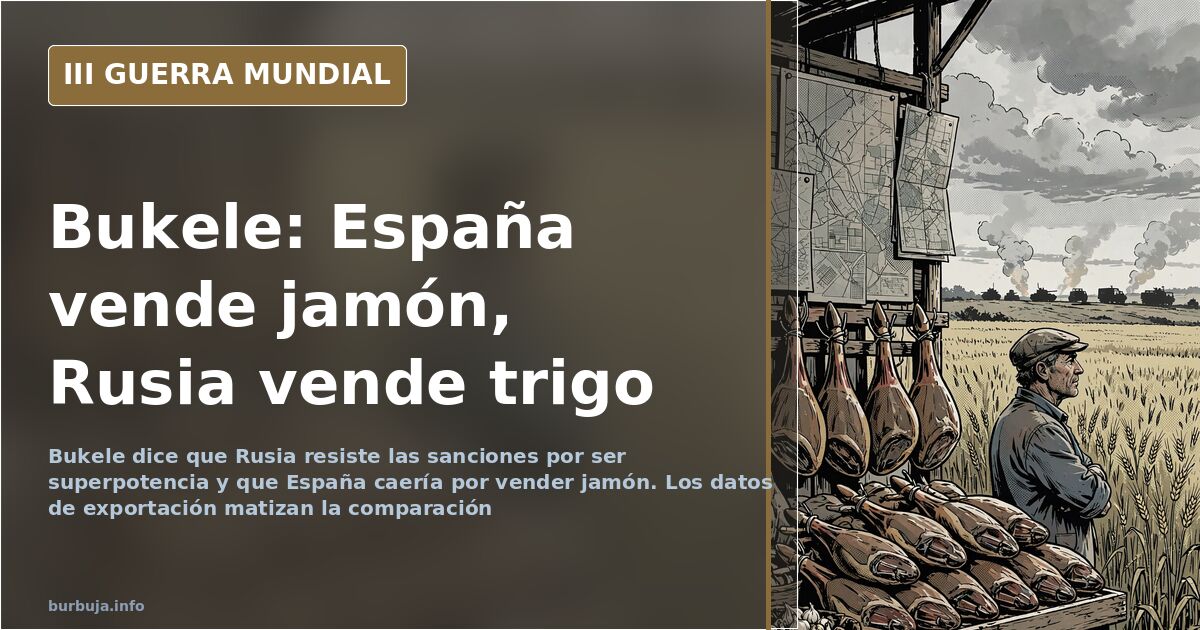
Bukele: Russia withstands sanctions while Spain would collapse over ham
Nayib Bukele asserts that Russia cannot collapse under sanctions because it was "built as a superpower," citing wheat, energy, gas, oil, industrial capacity, and labor force. In his comparison, Spain sells "turrón or Iberian ham," luxury items no one needs to survive. This statement, made in an interview with US journalist Tucker Carlson, has peine an uncomfortable question: which economy is actually more fragile against a trade blockade, that of a raw materials exporter or a country exporting processed goods?
The comparison works as a headline but fails as analysis. Bukele reduces the Spanish economy to two pantry staples, yet some argue export data points elsewhere: Spain sells more technological and industrial products than Russia, while Russia concentrates much of its foreign sales in a single product, oil, often unrefined. That concentration is precisely what makes a country vulnerable to selective embargoes.
What Spain really exports compared to Russia
The most repeated argument in the analysis is that the Spanish economy does not depend on a couple of products. Spanish exports total around $394 billion, while Russian exports are about $560 billion, according to charts circulating in the sector. The difference lies not in volume, but in composition: Spain places technology, industrial goods, wine, and olive oil; Russia places oil, gas, and wheat.
From this comes the uncomfortable conclusion for Bukele's narrative: bringing down 40% of Russian exports only requires embargoing three derivatives of the same product. In the Spanish case, it would require hitting dozens of different sectors. Resilience in economics comes not from having raw materials, but from having diverse customers and products.
Is Russia an industrial superpower?
Russia is the world's third or fourth largest wheat producer—Ukraine, frequently cited, is eighth—and holds similar positions in dairy. In agriculture and energy, it is a first-order power. In technology and capital goods, the picture changes: its industrial sector weighs little in global trade and depends on imported machinery, much of it European before the war.
The counterargument is that the war has shown Russia can sustain a war economy with domestic production and internal supply. The counter-counterargument is that without China, it would collapse in record time: what decides a conflict today is not tractors, but semiconductor factories and machines that make other machines.
The myth of Spanish autarky
The idea that Spain could be self-sufficient runs through the analysis with two clear camps. Some argue the country has lithium, coal, oil, coltan, and agricultural capacity to feed itself; that it has been autarkic in several periods of its history, and that current dependence is a political decision, not a geographic condemnation. Others respond harshly: full autarky is only sustained by continent-states like the United States, Russia, or Australia, and the rest would revert to the 18th century in six months.
The nuance that resolves the issue is that of selective autarky. At the food level, Spain exports thousands of tons of agricultural and livestock products each year; the problem is oil and gas, which are not grown. Hence, electric vehicles and renewables cease to be an environmentalist trend and become a matter of national security.
The detail that dismantles the comparison
Bukele's example has a textbook flaw: The Netherlands earns more from the agricultural sector than Spain or France with a fraction of their surface area. It is not genetic superiority, but technology, greenhouses, and logistics. The value of an economy lies not in what it extracts from the ground, but in what it does with it.
This does not entirely invalidate his thesis. Spain imports practically all its oil and gas; a real naval blockade would put it against the ropes in weeks, as with Germany. The difference is that Spain would only need to replace suppliers, whereas it would cost Russia more to replace buyers.
With these elements, the reasonable prediction is that Bukele's comparison will continue working in headlines and failing in balance sheets. Spain would not collapse by selling ham, but neither would it last without gas. And Russia does not fall because it has wheat, but because someone keeps buying it.
Nayib Bukele asserts that Russia cannot collapse under sanctions because it was "built as a superpower," citing wheat, energy, gas, oil, industrial capacity, and labor force. In his comparison, Spain sells "turrón or Iberian ham," luxury items no one needs to survive. This statement, made in an interview with US journalist Tucker Carlson, has peine an uncomfortable question: which economy is actually more fragile against a trade blockade, that of a raw materials exporter or a country exporting processed goods?
The comparison works as a headline but fails as analysis. Bukele reduces the Spanish economy to two pantry staples, yet some argue export data points elsewhere: Spain sells more technological and industrial products than Russia, while Russia concentrates much of its foreign sales in a single product, oil, often unrefined. That concentration is precisely what makes a country vulnerable to selective embargoes.
What Spain really exports compared to Russia
The most repeated argument in the analysis is that the Spanish economy does not depend on a couple of products. Spanish exports total around $394 billion, while Russian exports are about $560 billion, according to charts circulating in the sector. The difference lies not in volume, but in composition: Spain places technology, industrial goods, wine, and olive oil; Russia places oil, gas, and wheat.
From this comes the uncomfortable conclusion for Bukele's narrative: bringing down 40% of Russian exports only requires embargoing three derivatives of the same product. In the Spanish case, it would require hitting dozens of different sectors. Resilience in economics comes not from having raw materials, but from having diverse customers and products.
Is Russia an industrial superpower?
Russia is the world's third or fourth largest wheat producer—Ukraine, frequently cited, is eighth—and holds similar positions in dairy. In agriculture and energy, it is a first-order power. In technology and capital goods, the picture changes: its industrial sector weighs little in global trade and depends on imported machinery, much of it European before the war.
The counterargument is that the war has shown Russia can sustain a war economy with domestic production and internal supply. The counter-counterargument is that without China, it would collapse in record time: what decides a conflict today is not tractors, but semiconductor factories and machines that make other machines.
The myth of Spanish autarky
The idea that Spain could be self-sufficient runs through the analysis with two clear camps. Some argue the country has lithium, coal, oil, coltan, and agricultural capacity to feed itself; that it has been autarkic in several periods of its history, and that current dependence is a political decision, not a geographic condemnation. Others respond harshly: full autarky is only sustained by continent-states like the United States, Russia, or Australia, and the rest would revert to the 18th century in six months.
The nuance that resolves the issue is that of selective autarky. At the food level, Spain exports thousands of tons of agricultural and livestock products each year; the problem is oil and gas, which are not grown. Hence, electric vehicles and renewables cease to be an environmentalist trend and become a matter of national security.
The detail that dismantles the comparison
Bukele's example has a textbook flaw: The Netherlands earns more from the agricultural sector than Spain or France with a fraction of their surface area. It is not genetic superiority, but technology, greenhouses, and logistics. The value of an economy lies not in what it extracts from the ground, but in what it does with it.
This does not entirely invalidate his thesis. Spain imports practically all its oil and gas; a real naval blockade would put it against the ropes in weeks, as with Germany. The difference is that Spain would only need to replace suppliers, whereas it would cost Russia more to replace buyers.
With these elements, the reasonable prediction is that Bukele's comparison will continue working in headlines and failing in balance sheets. Spain would not collapse by selling ham, but neither would it last without gas. And Russia does not fall because it has wheat, but because someone keeps buying it.
Summary of a discussion on Burbuja.info - Foro de economía, actualidad y política., translated from Spanish and reviewed before publication. Read the full discussion (150 replies).
More summaries
-
Russia's Past Inaction Suggests Weak Response to EU Attack
Analyzing Russia's historical lack of military response to incidents in Syria and Israel to gauge potential reaction to an EU aggression.
-
Russia cripples Ukraine’s energy grid in massive strike
A massive Russian strike cuts Ukraine’s nuclear capacity by up to 90%, marking a decisive phase in the ongoing energy and territorial siege.
-
Egypt seeks BRICS membership, expanding anti-NATO bloc
Egypt applies to join BRICS amid tourism struggles and food import reliance, signaling a shift in global geopolitical alignment.
-
Putin Support Debate Derails Into Personal Attacks
A forum exchange over 'gentuza' insults regarding Russia escalates into NATO, values and Ceuta disputes with no resolution.
-
Spain vs. Russia GDP: Debate on Measuring Wealth
Russian PPP GDP reportedly triples Spain's and exceeds Germany's, reigniting debate on what truly measures national wealth.
-
Syria land claims reignite historical vs. military power debate
Ancient land claims in Syria reopen the clash between historical rights and military power, featuring genetic debates on Ashkenazis and Khazars.