
Building muscle at home: lose weight before lifting
How to start building muscle at home: lose fat first, progress from the empty 20 kg bar, and do 3 sets of 8. The plan that breaks the endless routine.
English · Original discussion in Spanish · Published
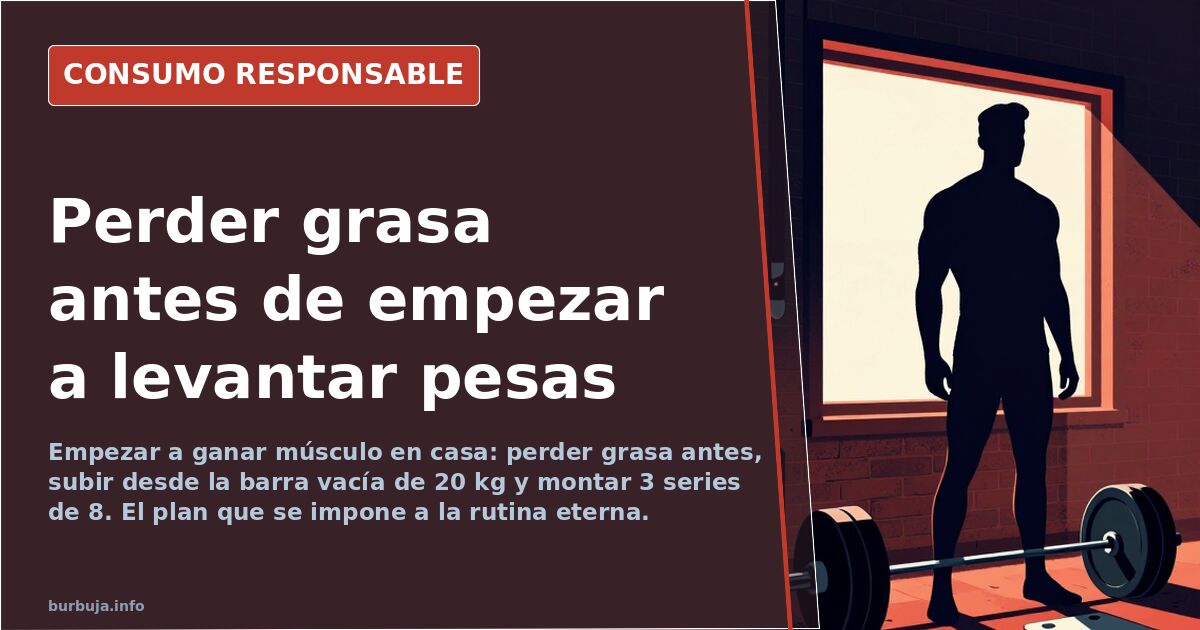
What to do before stepping into a gym: lose fat first
A 32-year-old man, 83 kilos and 1.78 metres, asks how to start building muscle at home with a pair of dumbbells and no idea where to begin. He talks about insecurity and an environment he describes without much nuance. His initial plan was to drop to 78 kilos, start lifting weights in the living room and, later on, join a gym.
The answers come fast and blunt. Fat is lost in the kitchen, not on the bench press. And with a pair of dumbbells at home, they warn, you don't train: you do maintenance exercises.
Should you lose weight before you start lifting?
The most repeated recommendation is to lose fat first. One participant sets the threshold at exceeding 25% body fat and argues that this excess hinders muscle synthesis, impairs testosterone production and lowers performance. And to reduce it, the tool is not exercise but a caloric deficit. "It is infinitely more efficient to eat less than to burn more," summarises one of the most backed voices.
The how matters as much as the how much. The protagonist started by cutting out sweets and leaving everything else the same; the next day he proge up with a headache that lasted all day. The reading given is twofold: sugar works as a habit that is hard to break abruptly and it is better to remove it gradually, with professional support if needed. Despite the setback, the scoreboard moved: he went from 83 to 81 kilos and then to 75.5.
Dumbbells at home or gym membership?
Here the verdict is blunt and unsympathetic. Training at home before having a base is considered a recipe for doing nothing; the gym forces you through money, schedule and not having to decide every day whether to go down to the living room. Insecurity, they argue, is left at the door: no one is going to laugh at a beginner. With one caveat: better a centre with a trainer who reviews your routine, not a low cost chain.
On machines there is division. Some accuse them of limiting range of motion and punishing tendons; others reply that a badly executed deadlift is far more harmful than a leg curl machine. The middle path proposed is to start with cables and machines and make the jump to dumbbells and barbells when technique can handle it. At home, meanwhile, there is little more than goblet squats, push-ups and the occasional single-leg Romanian deadlift.
How many sets and reps to start?
For hypertrophy, the repeated range is 8 to 12 repetitions, with time under tension as the key variable, and techniques such as rest-pause or drop sets once there is a base. The standard pogre for a beginner: 3 sets of 8 with the basics —deadlift, squat and bench press— twice a week each, starting with the empty Olympic bar (20 kilos) and increasing little by little each session or each week. More than three sets at the beginning adds little.
There is no agreement on intensity. One school defends few repetitions and effort close to maximum for its effect on strength and testosterone; the opposite warns that moving in such low ranges is harmful and that the goal of "getting big" is better served with moderate volume, basics, some isolation and eight or nine hours of rest. The body, they say, is a calculator: burning more than you eat is worth more than any routine.
The three-day routine and cardio that doesn't scare you off
One of the routines proposed is three weekly sessions: chest, biceps and abs; back, triceps and abs; shoulders, legs and abs. In parallel, 45 minutes of running two or three times a week, which can be alternated as Monday, Wednesday and Friday weights and Tuesday and Thursday running.
For those who have never run, the warning is clear: don't go out on the street like crazy. It is better to alternate walking and short jogging, warm up before and stretch after, and not stake everything on the first day. Cycling appears as an alternative that hooks more than the asphalt.
From self-defence to 10% body fat
Part of the analysis shifts the problem elsewhere: if what worries you is safety and not the mirror, free weights are not the priority. Contact and grappling sports —judo, boxing, krav maga— are recommended for their usefulness at short distances and for the lesser legal problem of a striking system without sporting regulations.
The other extreme is set by a case that claims to have gone from 105 kilos to 67, now staying at 69 and something and living around 10% body fat with no tools other than weights, diet and full-body training. No supplements, he says. It is a case that shows that the starting point does not necessarily determine the end, although it does not turn an isolated experience into a universal method either.
What remains unresolved is the gap between hypertrophy and strength. Whether basics and few repetitions, whether volume, isolation and pump. Both routes work, they argue; both are accused of leaving the body half-done. And while the disagreement lasts, the person who peine the query has already moved the needle from 83 to 75.5 kilos and is preparing the jump to weights.
Also available in: Deutsch
Summary of a discussion on Burbuja.info - Foro de economía, actualidad y política., translated from Spanish and reviewed before publication. Read the full discussion (104 replies).
More summaries
-
From 120 Kilos to 100: The Calorie Deficit Debate
1.70 m and 120 kilos: the clash between calorie deficit and the hormonal axis. From a 100-euro rice-and-tuna diet to the insulin debate.
-
Video Clarifies Squats Do Not Negate Testosterone Boost
The video argues that hormonal spikes alone do not explain muscle hypertrophy, rather than denying squats raise testosterone.
-
Gym at 6am: The Life-Changing Routine of an Overweight Young Man
90 kg, 26 years old, and a Spartan plan: gym at 6am, exam prep, and a strict diet. Does it work? Data, risks, and the debate over fasting and caloric deficit.
-
Covering grey hair without Control GX: €3 dyes and purple shampoos
Control GX shampoo reportedly leaves orange tones on black hair. Cheap dyes and purple shampoos emerge as alternatives.
-
Malwarebytes: essential as a complement, not as an antivirus
Malwarebytes is not an antivirus: it is an antimalware tool meant to complement one. The consensus on its usefulness clashes with those who rely only on the built-in antivirus.
-
Mystery shopper: €10 to €60 per visit, with doubts about the business
Between €10 and €60 per visit and half an hour filling out a questionnaire in English: that's how mystery shopper work is sold, with a bonus for recruiting new members.