
Budget cuts stall Iberian archaeological research in Spain
Experts warn only 20% of known Iberian sites are excavated due to funding gaps and legal hurdles.
English · Original discussion in Spanish · Published
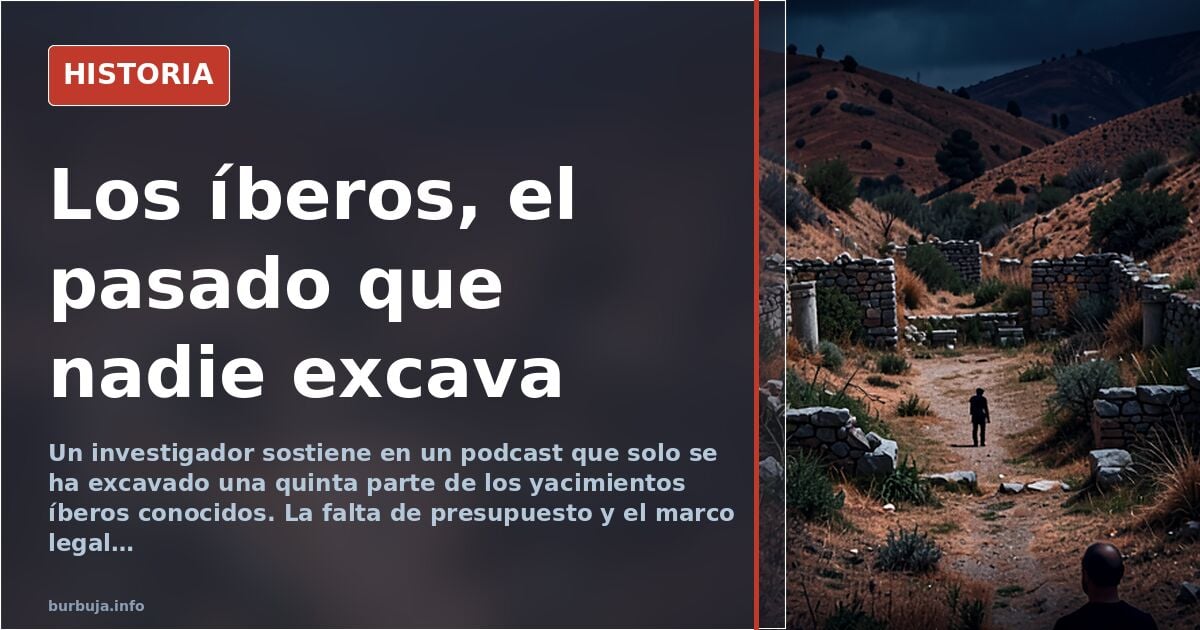
Researcher notes only one-fifth of known Iberian sites have been excavated
A Spanish researcher revealed on a podcast that barely twenty percent of cataloged Iberian archaeological sites have been investigated. The rest remain buried, not for lack of scientific interest, but due to insufficient budget. This is the paradox surrounding the culture that occupied much of the peninsula before Rome: we know they had writing, cities, and complex social organization, yet we still cannot read their texts. The inevitable question is why.
An undeciphered language and centuries-old lead tablets
The most cited case is the Orleyl lead tablet, found in a cremation tomb in Uxó Valley, Castellón. It contains text in Iberian script that has resisted decipherment for decades. Specialists hope to find a bilingual inscription—Greek/Iberian or Latin/Iberian—to unlock the code, similar to how the Rosetta Stone worked for hieroglyphics. Meanwhile, available evidence consists of short inscriptions, fragments, proper names, and repeated formulas whose full meaning remains unclear.
This is the real bottleneck. There is no office conspiracy, but there is an incentive problem: excavation is expensive, publication is slow, and media return is low. Stinginess, as discussed, produces the same effect as a hidden hand without needing secret meetings.
Jaén site remains under asphalt
A specific example highlighted: Jaén University conducts archaeological digs in Egypt while the concentric-ring city beneath its own campus remains unstudied, sometimes with construction on top. This is not isolated. Sites are nightmares for developers and urban planning officials, tilting the balance toward administrative silence. When land value exceeds archaeological worth, archaeology loses.
Added to this is the heritage legal framework. Some argue that if you find pieces on private land, the law recognizes a percentage of the value if they are "treasures"—coins, precious metals—but if it is an archaeological asset, it goes to the State. A farmer who finds an Iberian vessel gets no compensation and sees his crop destroyed. The result is predictable: unreported discoveries.
Debate on Iberian women and imposed narratives
The conversation shifted to an uncomfortable topic: the role of women in Iberian society. Romans documented their surprise at how women were treated on the peninsula. Some read this as neutral historical data; others turn it into ideological ammunition in both directions. The discussion becomes tangled because available knowledge is so scarce that everyone fills the gaps with pre-existing beliefs.
The same happens with the Basque language. The hypothesis that Euskera descends from Iberian has defenders and detractors, and the discovery of the Hand of Irulegi revived the dispute: some claim the text is Iberian, others present it as proof of a proto-Basque language. Scientific evidence does not settle the matter, leaving room for interested interpretations.
Antiestéticared warriors and non-state organization
There is more consensus on the military character of Iberian peoples. They fought as mercenaries for Greeks, Carthaginians, and Romans. The devotio—the commitment to immolate oneself for the chief if he fell—impressed the Romans, who adopted it. Their cavalry rode two by two, likely due to the absence of stirrups, and their infantry was valued. The falcata, a curved double-edged blade, was a antiestéticarsome weapon in close combat.
Rome took time to control the peninsula, not for lack of means. Resistance was long and costly. What was missing was unitary organization: Iberian peoples did not form a state, and this fragmentation facilitated conquest. The irony is that today we still do not know enough about them to write their history with the same rigor as that of their conquerors.
Hidden hand or mere inertia?
The honest answer is that one need not choose. Institutional inertia, excavation costs, and the lack of a critical mass of researchers produce the same result as deliberate censorship: a half-known past. Some see political intent in the oblivion, others simply see a country preferring to fund other things. Both readings coexist without conclusive proof.
What is certain is that available knowledge is valuable and its absence benefits no one. The question is whether there will ever be budget to verify it.
Also available in: Deutsch
Summary of a discussion on Burbuja.info - Foro de economía, actualidad y política., translated from Spanish and reviewed before publication. Read the full discussion (79 replies).
More summaries
-
The Iberians: matriarchy or just a myth of sanctioned infidelity?
Were the Iberians of ancient Spain a matriarchy with agreed-upon infidelities? The debate over women's role and sexuality in this pre-Roman society pits archaeologists against each other.
-
Cannibalism in Hispania: Roman myth or Celtiberian reality?
The debate over cannibalism in pre-Roman Spain resurfaces: classical sources versus a lack of archaeological evidence. Reality or propaganda?
-
Gladius and falcata: the historical error that links one weapon to another
The Roman gladius did not evolve from the Iberian falcata. Its true origin is the Celtiberian antennae sword. Archaeologists have spent years dismantling the myth.
-
ETA and GAL: two arms of the same Gladio network in Spain
Investigation linking ETA and GAL as arms of the same NATO Gladio network, with drug trafficking funding and CIA control.
-
Zunzunegui sparks controversy on TVE with pro-Spain Mexico stance
Viral clip shows Juan Miguel Zunzunegui defending Spain's legacy in Mexico, challenging the Black Legend narrative and dividing public opinion.
-
Dussel: Arab world spanned Atlantic to Pacific in 1491, Europe marginal
Philosopher Enrique Dussel argued that in 1491 the Arab world stretched from the Atlantic to the Pacific. A historical thesis worth examining.