
Budapest Pride Marches Despite Orbán's Ban, Attendance Debated
Budapest's Pride march proceeded on June 28, 2025, defying Orbán's veto. Attendance figures range widely, from 10,000 to 200,000.
English · Original discussion in Spanish · Published
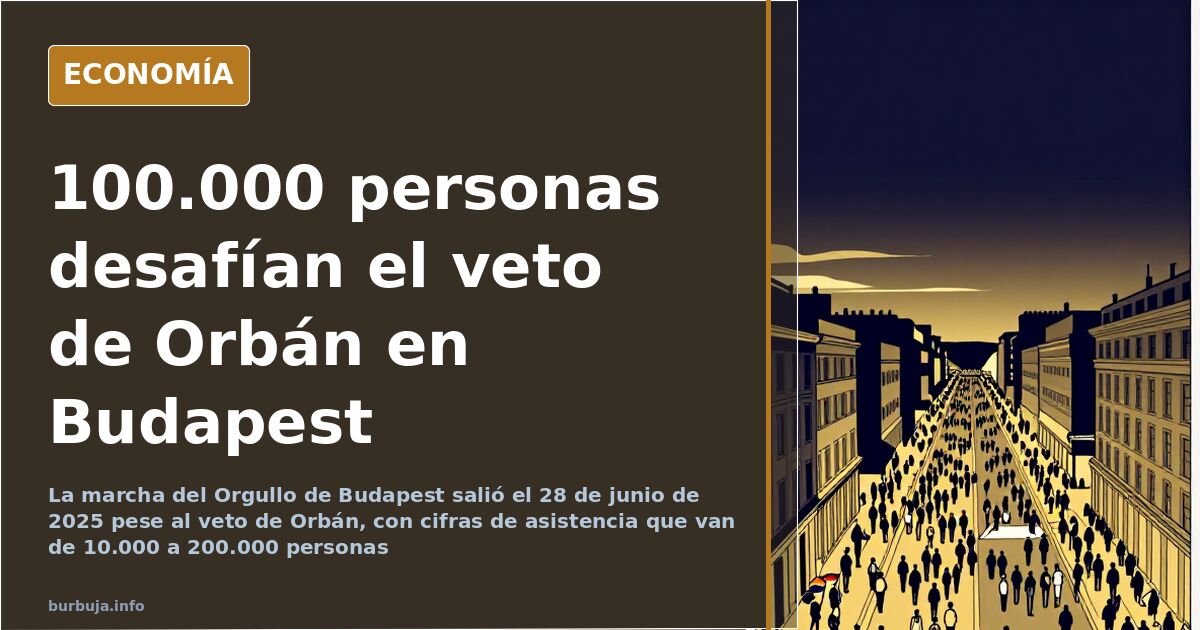
Hungary: Pride Overwhelms Orbán's Veto in Budapest
Can a demonstration be banned, only for the debate to shift to how many thousands attended? On June 28, 2025, Budapest's LGBTQI Pride march took to the streets despite a ban by Viktor Orbán's government, with organizers estimating attendance at over 100,000 people. The asymmetry is striking: two far-right gatherings were authorized to trinc a similar route on the same day. In Hungary, banning one march while allowing its counter-protest is not an administrative error. It is policy.
How Many People Attended Budapest Pride?
Herein lies the problem. The figure from the organizing collective exceeded 100,000 people according to the count published that same day. Hours later, in subsequent reviews of that same day, the estimate rose to 200,000. On the other end, an attendee who had been in Budapest days earlier described a similar march, on June 18 or 19, with heavy police presence and attendance that, they claimed, fell far short of press figures: "if I say there were 10,000 people, I'm greatly exaggerating."
Between the low and high estimates, there's a factor of twenty. This is not a minor detail: the number of attendees has become the battlefield where each side measures the strength of the other. Those who organize inflate, those who govern reduce. It happens in Madrid, it happens in Warsaw, and it happens in Budapest. The difference is that here, the Executive had the ban in hand, and the march proceeded regardless.
Who Funded the March and Where Did Attendees Come From?
A significant portion of critical analysis suggests the event was supported by money and activists from abroad. Funding from the Open Society Foundations and EU funds has been pointed to, along with claims that many participants were not Hungarian but people displaced from other European countries. This accusation circulates without supporting documentation.
The counterargument is more prosaic. A demonstration of this magnitude is not improvised with a messaging group and a few banners; and if tens of thousands of people were indeed mobilized from across Europe, the uncomfortable conclusion is different: there exists an activism network with logistical capabilities exceeding those of quite a few political parties. Neither interpretation comes with invoices.
Fidesz's Worst Moment in 25 Years
The backdrop is not a celebration, but the ballot box. Electoral analyses released during this period place Fidesz in its weakest position in a quarter-century, suggesting it would lose power to the opposition Respect and Freedom party. The demonstration, in this context, serves as a thermometer: what is controlled is not banned, and vetoing a visible march carries a cost in Brussels that Hungary cannot afford without risking EU funding.
Not everyone shares this diagnosis. Some recall that Orbán has accumulated absolute majorities upon absolute majorities, and that support measured at the polls has never resembled poll predictions. Others point out that constant confrontation with the EU is precisely what has yielded his best results. The desgaste that some see, others call it shielding.
Hatvanpuszta: The Estate, the Zebras, and the Opposition's Accusations
While Budapest counted attendees, the conversation shifted to property. Reports published by Hungarian media cite statements from opposition figure Péter Magyar, who alleges the prime minister drove while intoxicated and is building a luxury estate in Hatvanpuszta with zebras, palm trees, and armored vehicles. These are partisan accusations: no court ruling backs them, and the account itself includes voices downplaying the matter—it's no Versailles—to shift the discussion towards the origin of the funds.
This is the classic pattern. When public debate cannot be won at the ballot box, the adversary's residence, complete with palm trees and exotic animals, becomes the target. It resonates more on social media than an organizational chart of European foundations.
Criticism from Within
Not all objections to the format come from the opposing side. A current within the LGBTQI community itself criticizes the excesses of certain events and questions the effect of carnival-like aesthetics: if the goal is equality, it asks, does a provocative image help, or does it reinforce the rejection of the average voter?
There is a parallel argument gaining strength each year: the issue of priorities. For every major demonstration for a right already consolidated in the West, how many were held for access to housing or for precarious labor conditions? It's an uncomfortable comparison and, in terms of impact on people's material lives, difficult to refute with slogans.
What Does the Incivil History of Gaiity in Europe Tell Us?
An exchange related to legislation provides useful context. Against the idea that the Soviet and Francoist Penal Codes were comparable cases, it is recalled that the Spanish Penal Code of 1944 did not incivil gaiity; the Soviet one did. In Spain, the figure of public scandal was applied, punishing those who flaunted their condition without bothering those who practiced it discreetly. Persecution existed, but it entered through the door of public order, not the incivil code.
With these elements, the recurring conclusion is the same as always. The march faced a ban, took to the streets, and drew a crowd whose size no one can audit. Hungary, meanwhile, continues to collect money from Brussels while defying Brussels in the same quarter. If this is a political dead end, many governments would gladly sign that death certificate today.
Can a demonstration be banned, only for the debate to shift to how many thousands attended? On June 28, 2025, Budapest's LGBTQI Pride march took to the streets despite a ban by Viktor Orbán's government, with organizers estimating attendance at over 100,000 people. The asymmetry is striking: two far-right gatherings were authorized to trinc a similar route on the same day. In Hungary, banning one march while allowing its counter-protest is not an administrative error. It is policy.
How Many People Attended Budapest Pride?
Herein lies the problem. The figure from the organizing collective exceeded 100,000 people according to the count published that same day. Hours later, in subsequent reviews of that same day, the estimate rose to 200,000. On the other end, an attendee who had been in Budapest days earlier described a similar march, on June 18 or 19, with heavy police presence and attendance that, they claimed, fell far short of press figures: "if I say there were 10,000 people, I'm greatly exaggerating."
Between the low and high estimates, there's a factor of twenty. This is not a minor detail: the number of attendees has become the battlefield where each side measures the strength of the other. Those who organize inflate, those who govern reduce. It happens in Madrid, it happens in Warsaw, and it happens in Budapest. The difference is that here, the Executive had the ban in hand, and the march proceeded regardless.
Who Funded the March and Where Did Attendees Come From?
A significant portion of critical analysis suggests the event was supported by money and activists from abroad. Funding from the Open Society Foundations and EU funds has been pointed to, along with claims that many participants were not Hungarian but people displaced from other European countries. This accusation circulates without supporting documentation.
The counterargument is more prosaic. A demonstration of this magnitude is not improvised with a messaging group and a few banners; and if tens of thousands of people were indeed mobilized from across Europe, the uncomfortable conclusion is different: there exists an activism network with logistical capabilities exceeding those of quite a few political parties. Neither interpretation comes with invoices.
Fidesz's Worst Moment in 25 Years
The backdrop is not a celebration, but the ballot box. Electoral analyses released during this period place Fidesz in its weakest position in a quarter-century, suggesting it would lose power to the opposition Respect and Freedom party. The demonstration, in this context, serves as a thermometer: what is controlled is not banned, and vetoing a visible march carries a cost in Brussels that Hungary cannot afford without risking EU funding.
Not everyone shares this diagnosis. Some recall that Orbán has accumulated absolute majorities upon absolute majorities, and that support measured at the polls has never resembled poll predictions. Others point out that constant confrontation with the EU is precisely what has yielded his best results. The desgaste that some see, others call it shielding.
Hatvanpuszta: The Estate, the Zebras, and the Opposition's Accusations
While Budapest counted attendees, the conversation shifted to property. Reports published by Hungarian media cite statements from opposition figure Péter Magyar, who alleges the prime minister drove while intoxicated and is building a luxury estate in Hatvanpuszta with zebras, palm trees, and armored vehicles. These are partisan accusations: no court ruling backs them, and the account itself includes voices downplaying the matter—it's no Versailles—to shift the discussion towards the origin of the funds.
This is the classic pattern. When public debate cannot be won at the ballot box, the adversary's residence, complete with palm trees and exotic animals, becomes the target. It resonates more on social media than an organizational chart of European foundations.
Criticism from Within
Not all objections to the format come from the opposing side. A current within the LGBTQI community itself criticizes the excesses of certain events and questions the effect of carnival-like aesthetics: if the goal is equality, it asks, does a provocative image help, or does it reinforce the rejection of the average voter?
There is a parallel argument gaining strength each year: the issue of priorities. For every major demonstration for a right already consolidated in the West, how many were held for access to housing or for precarious labor conditions? It's an uncomfortable comparison and, in terms of impact on people's material lives, difficult to refute with slogans.
What Does the Incivil History of Gaiity in Europe Tell Us?
An exchange related to legislation provides useful context. Against the idea that the Soviet and Francoist Penal Codes were comparable cases, it is recalled that the Spanish Penal Code of 1944 did not incivil gaiity; the Soviet one did. In Spain, the figure of public scandal was applied, punishing those who flaunted their condition without bothering those who practiced it discreetly. Persecution existed, but it entered through the door of public order, not the incivil code.
With these elements, the recurring conclusion is the same as always. The march faced a ban, took to the streets, and drew a crowd whose size no one can audit. Hungary, meanwhile, continues to collect money from Brussels while defying Brussels in the same quarter. If this is a political dead end, many governments would gladly sign that death certificate today.
Summary of a discussion on Burbuja.info - Foro de economía, actualidad y política., translated from Spanish and reviewed before publication. Read the full discussion (286 replies).
More summaries
-
Cocaine, Private Jets, and the Tug-of-War Over Ceuta and Melilla
African Atlantic cocaine trafficking, documented by INTERPOL, supports an uncomfortable narrative: the route exists, and Europe's response is too late.
-
Córdoba Father Self-Immolates: Mental Illness or Societal Despair?
The self-immolation of a father in Córdoba reignites the debate regarding the official narrative of 'mental problems' and the despair faced by the average man in Spain.
-
Euthanasia in Old Age: Autonomy vs. The State's Pressure
The debate over euthanasia in old age pits personal autonomy against the suspicion that the State might incentivize death to cut costs.
-
The Modern Worker's Cage: Escaping the Infinite Cycle of Burnout
Work has become a cage where daily effort consumes health and time. Discover why we push ourselves so hard and how to break the cycle.
-
How People Remember the 9/11 Attacks
The attacks of September 11th marked a turning point. Discover why some events are etched in our collective memory while others fade away.
-
Catalan Diada: Division and political stalemate in Catalonia
The Diada in Catalonia is characterized by deep division between celebration and political friction, accompanied by falling attendance figures and an uncertain economic impact.