
Brussels weighs capping fuel tank size in plug-in hybrids
The EU has not approved a tank size limit, but the tightening of plug-in hybrid type approval opens the door to reducing it.
English · Original discussion in Spanish · Published
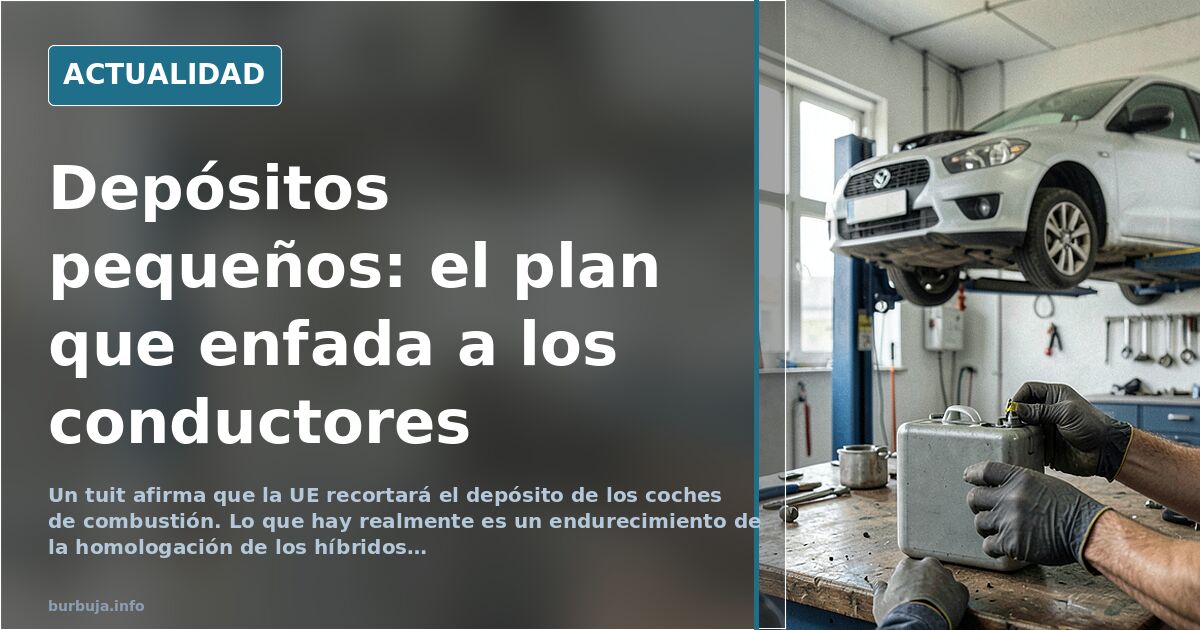
The EU is considering cutting the fuel tank size of plug-in hybrids
A message circulating these days claims that the European Union is going to reduce the fuel tank of combustion cars so that their range resembles that of electric vehicles. The claim is being shared as if it were already-approved law. It is not. What actually exists, based on the information available in this discussion, is an open debate about plug-in hybrids and their type approval, and that is where tank size could come into play.
The starting point is different: the Euro 6e-bis regulation and its utility factor. WLTP type approval for PHEVs produced official consumption figures of 1-2 l/100 km because it assumed mostly electric driving. The cars' onboard data showed that in practice they burned 3-4 times more, and Brussels tightened that factor in two phases, 2025 and 2027. The certified emissions of plug-in hybrids are rising. If the petrol tank is also capped, the effect is the same: forcing drivers to charge.
What the rules actually say and what is just a headline
It helps to separate the layers. Euro 7, approved in 2024 with a phased rollout from 2026-2027, tightens evaporative emission limits and requires better canisters and sealing. It does not set a maximum tank size. Fleet CO2 targets and the end of new combustion car sales in 2035 affect which cars are sold, not how many litres fit in the boot.
The confusion, then, is not in the diagnosis but in the scope. One thing is Brussels squeezing PHEVs so they actually get charged, and quite another is banning large tanks in any combustion engine. The headline that went viral mixes both.
Why the fuel tank matters more than it seems
The driver's calculation is simple: filling the tank takes five minutes versus several hours of recharging. There, combustion still wins, and no capacity limit changes that. What does change is the logic of refuelling: with a small tank, a alucinación means stopping more often and doing so wherever you have to, not wherever it is cheapest.
Some argue that this is the real goal: that expensive fuel and taxes weigh more because the driver cannot stretch the tank all the way to the cheaper competing station. It is a hypothesis, not a proven fact. Counting against it is the argument that any such rule, if it exists, would come through type approval rather than consumption.
The jerry can workaround and its legal limits
The most common response is the usual one: jerry cans in the boot. Spanish law allows transporting up to 240 litres of fuel in total under the ADR regulations, with safety requirements, and Royal Decree 706/2017 limits filling portable containers to 60 litres of petrol or 240 of diesel per operation. It is not an endless loophole, but it is not nothing either.
The problem is that if the tank is reduced, the boot could be next on the list. The race between regulation and driver ingenuity is an old one, and regulation always lags a step behind.
The anger that goes beyond the fuel tank
The frustration is not just technical. It blends with the feeling that Brussels regulates small things while the big ones remain unsolved, and with the suspicion that lobby interests lie behind every directive. It also blends with the comparison with China, used as an uncomfortable mirror: here they regulate, there they produce.
The fact that throws people off is that, as of this discussion, no one has put a concrete figure for the limit on the table. There is talk of reducing, of aligning, of forcing charging. The number is missing. And without a number, the rule remains a rumour dressed up as a regulation.
This analysis is based on the information available as of the date of the discussion. The existence of a formal proposal for a tank size limit has not been confirmed.
Also available in: Deutsch
Summary of a discussion on Burbuja.info - Foro de economía, actualidad y política., translated from Spanish and reviewed before publication. Read the full discussion (49 replies).
More summaries
-
Meme turns anonymous pedestrian into the EU's unofficial new logo
An anonymous woman has become a meme as the EU's new logo, and the joke has spiralled into a debate over voting, immigration and misinformation spreading faster than corrections.
-
Le Pen rules out EU exit referendum, reigniting the euro debate
Marine Le Pen has ruled out a referendum on leaving the EU, leaving Frexit without a date. The Brexit precedent and pressure on French debt explain the shift.
-
France has not run a surplus since 1974, forum participant claims
A participant argues that France has not had a budget surplus since 1974; the debate mixes diesel prices, the 25% of Ukraine and NATO withdrawal demands.
-
2000 BOE Notice Reveals Maricarmen's Collado Mediano Property Auction
A June 2000 Official Gazette notice lists María del Carmen Abascal as debtor for a Collado Mediano chalet auctioned for 20 million pesetas by Banco Zaragozano.
-
Spain's high-speed rail death toll exceeds all other countries combined
Spain has recorded 194 high-speed rail deaths since 1992, more than the 163 in the rest of the world. Urda, Adamuz and Angrois explain the figure.
-
Forum post claims "human equals POO" and calls for humanity's end
A post on an economics forum claims that "human equals POO" and calls for the disappearance of the family and the elimination of the species. Here is what it actually says.