
Brussels targets outdoor seating: tobacco ban splits hospitality
Extending smoking bans to terraces sparks debate between public health and freedom, pitting 20,000 annual lung cancer deaths against industry revenue.
English · Original discussion in Spanish · Published
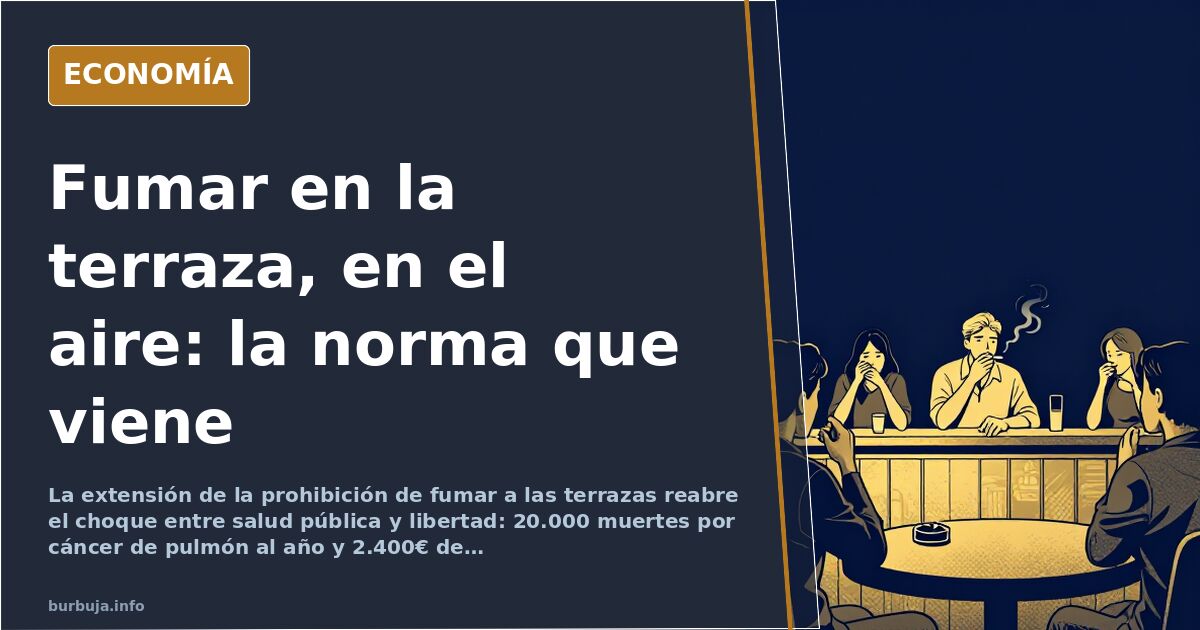
Brussels targets outdoor seating: banning smoking outdoors splits hospitality
How far can a regulation go before secondhand smoke hits you in the face? Extending smoking bans to outdoor terraces, with Brussels driving the regulatory framework, has peine the clash between public health and individual freedom in Spain, with the hospitality sector at the center. The measure is not yet finalized. Neither are the stances. And a contradiction looms that few question: tobacco kills, yet it generates revenue.
What is proposed regarding terraces and why is Brussels in the spotlight?
What is being debated is the smoker's last refuge: sidewalk tables and outdoor terraces, spaces where existing restrictions have barely taken effect. References to European institutions fuel suspicions among some commentators, who see this as the next step in an unending ladder: first, designated zones inside venues were created, then indoor smoking was banned, and now it is the turn of the outdoors, accompanied by a purchase.
The argument fueling this distrust is political, not health-related. Some argue the goal is not to protect anyone but to expand the catalog of monitored behaviors, noting that the same administrations issuing health warnings do not give up a single euro of revenue from the vice. For others, this reading is merely an excuse: the evidence that secondhand smoke causes illness does not depend on who signs the regulation.
The tobacco bill: 20,000 deaths a year and ten years of life lost
The figures cited in the conversation are unambiguous. In Spain, there are approximately 20,000 annual deaths from lung cancer, of which about 18,000 are attributable to tobacco; when adding other associated tumors and diseases, the total rises to 60,000. The average smoker's life expectancy is shortened by about a decade. This figure underpins any prohibition and invites the next question: if the cost is this high, why not ban it outright?
The uncomfortable answer lies in the treasury. The excise tax turns smokers into captive contributors, giving rise to the repeated thesis: the State is not interested in you quitting, but in you continuing to smoke while paying. Those supporting this view add a domestic nuance: the ten years lost are old age, with ailments and dependency, precisely the most expensive bracket for the healthcare system. The logical consequence—the smoker saves public money by dying earlier—is stated without shame, yet without data to back it up.
Who decides: the owner, general regulation, or the customer?
The alternative proposal with the most support is to return the ball to the business owner: let each establishment decide whether to allow smoking, with separate zones for smokers and non-smokers, indoors and outdoors. This was the model before general prohibitions and, according to this view, manages coexistence better without needing sanctions. The objection is simple: once the regulation ceases to be general, a customer appears who does whatever they want, claiming it is not prohibited.
At this point, the argument becomes practical. A hospital, a school, or a school canteen allows no interpretation, and past experience shows that without explicit prohibition, someone will light up. The discussion is, in reality, not about tobacco: it is about how much a society needs to be forbidden certain things to avoid bothering the neighbor.
From airplanes to terraces: the ladder of restrictions no one stopped
Much of the discord stems from memory. There was a time when people smoked on airplanes, in schools, in doctors' offices, and anywhere indoors, inevitably leaving a stench. Each reduction of spaces was accompanied by a chorus of catastrophic prophecies: bars would close, people would stop going out, the country would go to ruin. Bars did not close, and social life continued.
On the other hand, the other half remembers that smoking on the street never bothered anyone more than tolerably, and turning every terrace into a smoke-free space turns the smoker into an outcast with an itinerary. An occasional smoker who limits themselves to a cigar on their terrace or on public streets summarizes it thus: as long as they do not blow smoke in my face, let everyone do what they want with their body.
Alcohol, children, and other uncomfortable comparisons
The comparison with alcohol appears on its own: the limit has been lowered to avoid fines, the smoker is stigmatized, not the drinker who drinks until passing out, and breathalyzer checks remain scarce. The tension between these two vices, and their different social tolerance, reveals less about health than about the sarracena hierarchy of each moment.
In between appears a third actor no one invited: children running between tables while the rest try to dine. The parallel is not accidental, as it serves to focus on what truly bothers: not the smoke, but the shared space and who has authority over it.
The only figure no one disputes
There is one figure that does appear in the conversation and generates no controversy: eight months without smoking equals about 2,400 euros that stay in your pocket. The rest remains open. If the measure passes, terrace smoke will move or disappear; if it does not, there will still be those dining with their neighbor's cigar and those from the next table swearing they will one day settle scores with the smoker. And meanwhile, no one considers stopping revenue collection.
How far can a regulation go before secondhand smoke hits you in the face? Extending smoking bans to outdoor terraces, with Brussels driving the regulatory framework, has peine the clash between public health and individual freedom in Spain, with the hospitality sector at the center. The measure is not yet finalized. Neither are the stances. And a contradiction looms that few question: tobacco kills, yet it generates revenue.
What is proposed regarding terraces and why is Brussels in the spotlight?
What is being debated is the smoker's last refuge: sidewalk tables and outdoor terraces, spaces where existing restrictions have barely taken effect. References to European institutions fuel suspicions among some commentators, who see this as the next step in an unending ladder: first, designated zones inside venues were created, then indoor smoking was banned, and now it is the turn of the outdoors, accompanied by a purchase.
The argument fueling this distrust is political, not health-related. Some argue the goal is not to protect anyone but to expand the catalog of monitored behaviors, noting that the same administrations issuing health warnings do not give up a single euro of revenue from the vice. For others, this reading is merely an excuse: the evidence that secondhand smoke causes illness does not depend on who signs the regulation.
The tobacco bill: 20,000 deaths a year and ten years of life lost
The figures cited in the conversation are unambiguous. In Spain, there are approximately 20,000 annual deaths from lung cancer, of which about 18,000 are attributable to tobacco; when adding other associated tumors and diseases, the total rises to 60,000. The average smoker's life expectancy is shortened by about a decade. This figure underpins any prohibition and invites the next question: if the cost is this high, why not ban it outright?
The uncomfortable answer lies in the treasury. The excise tax turns smokers into captive contributors, giving rise to the repeated thesis: the State is not interested in you quitting, but in you continuing to smoke while paying. Those supporting this view add a domestic nuance: the ten years lost are old age, with ailments and dependency, precisely the most expensive bracket for the healthcare system. The logical consequence—the smoker saves public money by dying earlier—is stated without shame, yet without data to back it up.
Who decides: the owner, general regulation, or the customer?
The alternative proposal with the most support is to return the ball to the business owner: let each establishment decide whether to allow smoking, with separate zones for smokers and non-smokers, indoors and outdoors. This was the model before general prohibitions and, according to this view, manages coexistence better without needing sanctions. The objection is simple: once the regulation ceases to be general, a customer appears who does whatever they want, claiming it is not prohibited.
At this point, the argument becomes practical. A hospital, a school, or a school canteen allows no interpretation, and past experience shows that without explicit prohibition, someone will light up. The discussion is, in reality, not about tobacco: it is about how much a society needs to be forbidden certain things to avoid bothering the neighbor.
From airplanes to terraces: the ladder of restrictions no one stopped
Much of the discord stems from memory. There was a time when people smoked on airplanes, in schools, in doctors' offices, and anywhere indoors, inevitably leaving a stench. Each reduction of spaces was accompanied by a chorus of catastrophic prophecies: bars would close, people would stop going out, the country would go to ruin. Bars did not close, and social life continued.
On the other hand, the other half remembers that smoking on the street never bothered anyone more than tolerably, and turning every terrace into a smoke-free space turns the smoker into an outcast with an itinerary. An occasional smoker who limits themselves to a cigar on their terrace or on public streets summarizes it thus: as long as they do not blow smoke in my face, let everyone do what they want with their body.
Alcohol, children, and other uncomfortable comparisons
The comparison with alcohol appears on its own: the limit has been lowered to avoid fines, the smoker is stigmatized, not the drinker who drinks until passing out, and breathalyzer checks remain scarce. The tension between these two vices, and their different social tolerance, reveals less about health than about the sarracena hierarchy of each moment.
In between appears a third actor no one invited: children running between tables while the rest try to dine. The parallel is not accidental, as it serves to focus on what truly bothers: not the smoke, but the shared space and who has authority over it.
The only figure no one disputes
There is one figure that does appear in the conversation and generates no controversy: eight months without smoking equals about 2,400 euros that stay in your pocket. The rest remains open. If the measure passes, terrace smoke will move or disappear; if it does not, there will still be those dining with their neighbor's cigar and those from the next table swearing they will one day settle scores with the smoker. And meanwhile, no one considers stopping revenue collection.
Also available in: Deutsch
Summary of a discussion on Burbuja.info - Foro de economía, actualidad y política., translated from Spanish and reviewed before publication. Read the full discussion (213 replies).
More summaries
-
EU OS: Europe tests a public Linux to phase out Microsoft
The EU has a draft, not a plan: EU OS, a Linux for European public administration. The cost, the Fedora origin, and the regional precedent are under review.
-
Ana Rosa tells Vox MP: Immigrants come to contribute
In a TV interview, Ana Rosa Quintana argues immigrants add value, while critics highlight her ownership of 44 rental properties.
-
Moncloa boosts Alvise to curb Vox's 20% support
Forum thread claims Moncloa promotes Alvise to reduce Vox seats. One million votes might yield no MPs but could shift several.
-
Spain's Parasite Debate: Cultural Shock or Marketing?
Analysis of the debate on deworming in Spain: is it a cultural clash, a public health need, or just marketing?
-
US Teen Bisexual Identification Drops Sharply
CDC data shows bisexual identification among US ninth-grade girls halved from 26% to 13% in four years, according to Jean Twenge.
-
Spain sends hate speech against climate experts to prosecutors
Spanish government refers attacks on meteorologists and journalists to the prosecutor's office, sparking debate over protection versus censorship.