
Brussels monitors Spain's stagnant real per capita income
Brussels places Spain under surveillance for real per capita incomes, which have trailed the European average since 2010, according to a forum analysis.
English · Original discussion in Spanish · Published
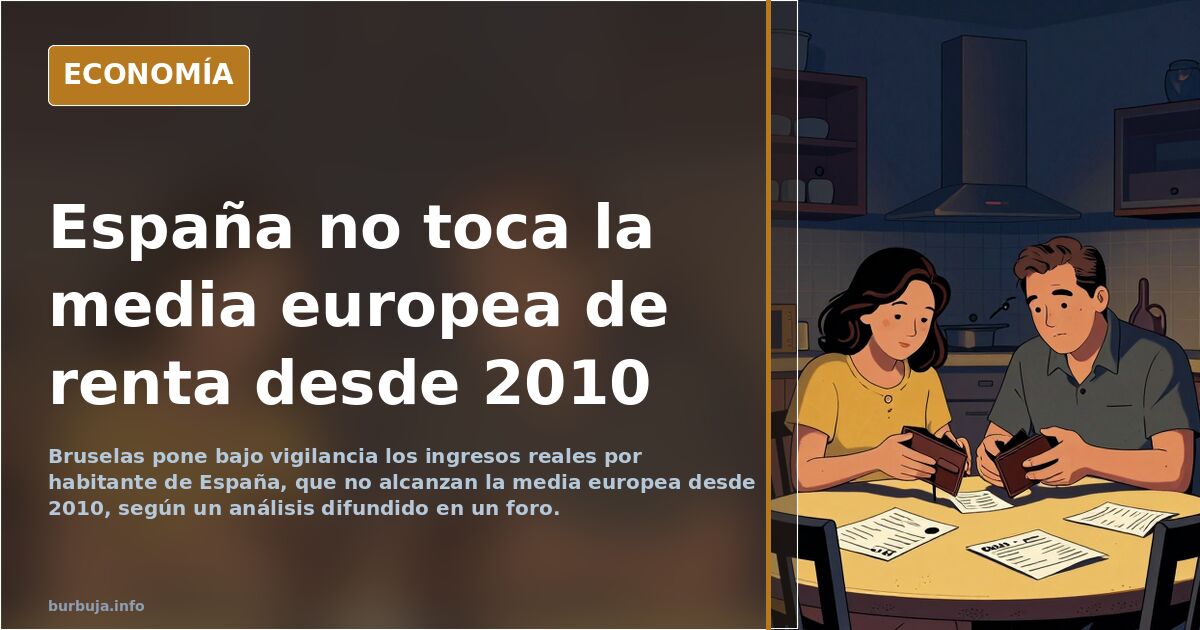
Spain hasn't reached EU average income since 2010
The Spanish economy grows in aggregate but shrinks in individual pockets. Brussels has placed Spain under surveillance due to its real per capita income: it has not matched the European average in any year since 2010. The headline summarizes this plainly, while the fine print worsens the picture: GDP rises because more people are pushing the cart, not because each person pushes harder.
An analysis circulated in a forum points to a demographic bubble sustained by European funds and public deficit. Population arrives, domestic demand rises, the State collects more from housing, food, and basic consumption, and the result is dressed up as growth. According to that analysis, it is the same mechanism as 2008 with different bricks: then it was mortgage credit, now it is population.
Why does per capita income fall if GDP grows?
Because the numerator swells and the denominator swells even more. Distribution is the problem: the same doctors, roads, police, and housing stock as a decade ago, but for 15% more people. When the pie doesn't grow and the number of diners multiplies, the portion shrinks. There is no mystery here, although some prefer to call it pogre.
Housing is the most visible thermometer. The incessant demand from newcomers crosses paths with hoarding by long-term owners, and price does the rest. A young worker competes not just against another young person, but against the accumulated savings of two generations. This breaks any expectation of social mobility.
CPI that doesn't match the shopping basket
There is a current arguing that real incomes fall because official CPI does not reflect what is paid at the checkout. The argument relies on physical indicators: per capita electricity consumption, fuel, cars, and meat all drop. If statistics say we live better while the shopping basket says otherwise, someone is measuring poorly. Or measuring what suits them.
Shrinkflation completes the picture. Turrón tablets shrink in size while prices rise, canned goods contain less product, and lamb jumps from €10 to €20 per kilo. This isn't nostalgic buyer impression; it is a documented commercial strategy on shelves. Nominal wages remain stable while purchasing power bleeds away without anyone signing off on cuts.
Frozen salaries and non-indexed taxes
The other bite comes from the tax authority. IRPF (personal income tax) without indexation, ITP (property transfer tax) rising from 6% to 10%, VAT increasing from 16% to 21%, and a string of new fees—waste, sugary drinks, plastic, emissions—turn every salary increase into a mirage. Gross pay rises, but living standards fall. Tax pressure increases without any government having to announce a hike: simply failing to adjust tax brackets suffices.
Employment adds its own trap. The 'fijo-discontinuo' (fixed-discontinuous contract), inherited from Franco-era labor laws banning temporary work, allows unemployment statistics to be masked with indefinite contracts that guarantee no stability. Spain has between 33 and 34 million working-age people, yet works the equivalent of only 17 million annual full-time days. The country doesn't have an unemployment problem; it has a real employment problem.
Public services at breaking point and social pressure
Discontent translates politically. The electoral growth of parties critical of immigration, especially among the young, reads as a symptom of tension no longer manageable with half-measures. Part of the analysis argues the welfare system was designed for a population that no longer exists and that no one dares to resize. Others respond that without incoming workers, the pension system collapses sooner.
The scenario most repeated in pessimistic analyses is not an explosion, but a drip: when the EU closes the tap of funds, the ECB stops buying debt, and interest rates soar, cuts to pensions, public salaries, and aid will trinc. Then conflict will arise, led by those with less to lose. The question is not if it comes, but when and with what intensity.
The disorienting data point is this: given these disparities in income and cost of living, internal migratory pressure should be massive. It remains marginal. No one fully explains why.
The Spanish economy grows in aggregate but shrinks in individual pockets. Brussels has placed Spain under surveillance due to its real per capita income: it has not matched the European average in any year since 2010. The headline summarizes this plainly, while the fine print worsens the picture: GDP rises because more people are pushing the cart, not because each person pushes harder.
An analysis circulated in a forum points to a demographic bubble sustained by European funds and public deficit. Population arrives, domestic demand rises, the State collects more from housing, food, and basic consumption, and the result is dressed up as growth. According to that analysis, it is the same mechanism as 2008 with different bricks: then it was mortgage credit, now it is population.
Why does per capita income fall if GDP grows?
Because the numerator swells and the denominator swells even more. Distribution is the problem: the same doctors, roads, police, and housing stock as a decade ago, but for 15% more people. When the pie doesn't grow and the number of diners multiplies, the portion shrinks. There is no mystery here, although some prefer to call it pogre.
Housing is the most visible thermometer. The incessant demand from newcomers crosses paths with hoarding by long-term owners, and price does the rest. A young worker competes not just against another young person, but against the accumulated savings of two generations. This breaks any expectation of social mobility.
CPI that doesn't match the shopping basket
There is a current arguing that real incomes fall because official CPI does not reflect what is paid at the checkout. The argument relies on physical indicators: per capita electricity consumption, fuel, cars, and meat all drop. If statistics say we live better while the shopping basket says otherwise, someone is measuring poorly. Or measuring what suits them.
Shrinkflation completes the picture. Turrón tablets shrink in size while prices rise, canned goods contain less product, and lamb jumps from €10 to €20 per kilo. This isn't nostalgic buyer impression; it is a documented commercial strategy on shelves. Nominal wages remain stable while purchasing power bleeds away without anyone signing off on cuts.
Frozen salaries and non-indexed taxes
The other bite comes from the tax authority. IRPF (personal income tax) without indexation, ITP (property transfer tax) rising from 6% to 10%, VAT increasing from 16% to 21%, and a string of new fees—waste, sugary drinks, plastic, emissions—turn every salary increase into a mirage. Gross pay rises, but living standards fall. Tax pressure increases without any government having to announce a hike: simply failing to adjust tax brackets suffices.
Employment adds its own trap. The 'fijo-discontinuo' (fixed-discontinuous contract), inherited from Franco-era labor laws banning temporary work, allows unemployment statistics to be masked with indefinite contracts that guarantee no stability. Spain has between 33 and 34 million working-age people, yet works the equivalent of only 17 million annual full-time days. The country doesn't have an unemployment problem; it has a real employment problem.
Public services at breaking point and social pressure
Discontent translates politically. The electoral growth of parties critical of immigration, especially among the young, reads as a symptom of tension no longer manageable with half-measures. Part of the analysis argues the welfare system was designed for a population that no longer exists and that no one dares to resize. Others respond that without incoming workers, the pension system collapses sooner.
The scenario most repeated in pessimistic analyses is not an explosion, but a drip: when the EU closes the tap of funds, the ECB stops buying debt, and interest rates soar, cuts to pensions, public salaries, and aid will trinc. Then conflict will arise, led by those with less to lose. The question is not if it comes, but when and with what intensity.
The disorienting data point is this: given these disparities in income and cost of living, internal migratory pressure should be massive. It remains marginal. No one fully explains why.
Summary of a discussion on Burbuja.info - Foro de economía, actualidad y política., translated from Spanish and reviewed before publication. Read the full discussion (141 replies).
More summaries
-
Euro banknote redesign sparks cultural debate at ECB
The ECB launches a public consultation on new euro notes, triggering identity politics debates over proposed designs featuring diverse faces and birds.
-
Viral tweet attributed to Mel Gibson comes from fake account
Mel Gibson has no official X account: the viral tweet attributed to him comes from a fake account, according to his publicist.
-
Spain's Parasite Debate: Cultural Shock or Marketing?
Analysis of the debate on deworming in Spain: is it a cultural clash, a public health need, or just marketing?
-
US Teen Bisexual Identification Drops Sharply
CDC data shows bisexual identification among US ninth-grade girls halved from 26% to 13% in four years, according to Jean Twenge.
-
Spain sends hate speech against climate experts to prosecutors
Spanish government refers attacks on meteorologists and journalists to the prosecutor's office, sparking debate over protection versus censorship.
-
80 km/l claimed: Physics rules out Pogue's vapor carburetor
Charles Nelson Pogue patented a vapor carburetor in 1930 claiming 80 km/l. Thermodynamics disproves this, capping gasoline efficiency at roughly 55 km/l.