
Broncano’s Porsche and Spain’s Public TV Deal
Spanish host Broncano owns a Porsche Cayman while holding a €28m public contract, sparking debate on spending.
English · Original discussion in Spanish · Published
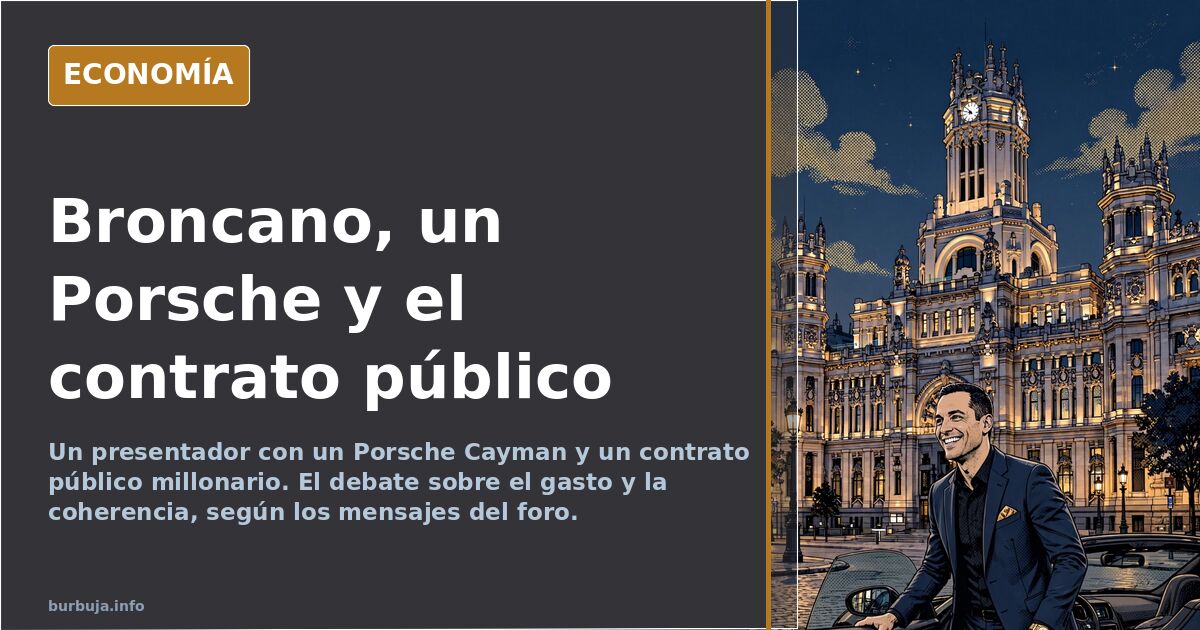
Broncano, his Porsche, and the €28m public fund
A Spanish television presenter with a white Porsche Cayman, an Aston Martin Vantage in the garage, and a €28 million public contract. This combination is not a joke; it has fueled debate over public spending, ideological consistency, and the real cost of publicly funded TV. The paradox is textbook: the same government urging fewer Lamborghinis and more public transport signs a multimillion-euro check for a comedian who then appears in a German sports car. The tonalidad detail—white, without metallic paint—has added a layer of sarcasm to the controversy.
The €28m contract and the Prime Minister’s salary
The data driving indignation is the contract: €28 million in public money for an entertainment program on public broadcasting. The figure has been compared to the Spanish Prime Minister’s salary, which is around €90,000 annually. Many conclude that a TV presenter earns more in one year than the head of government, and that this money comes from taxes paid by those who, according to official narratives, should tighten their belts.
Some argue the issue isn’t the presenter’s salary but the political decision to hire him. The argument is that if the money is public, scrutiny must be too, and criticizing spending isn’t envying the car, but demanding accountability. Conversely, the defense is simple: the contract was signed, the show airs, and the presenter has the right to spend his earnings like any citizen.
Is the Cayman the poor relation of the 911?
The car in question is a white Porsche Cayman, not a Lamborghini. This distinction matters to enthusiasts: the Cayman is a mid-engine sports car, cheaper than the 911, but renowned as a track-focused vehicle for skilled drivers. Starting prices hover around €180,000 depending on the version—a luxury for some, a bargain within the Porsche range for others.
The tonalidad choice also sparked discussion. White, without metallic paint, lowers the final price, a detail some interpreted as thriftiness amidst luxury. Others point out the presenter also owns an Aston Martin Vantage and a Land Rover Defender, debunking the savings theory.
Government inconsistency under fire
The political core is the alleged contradiction of the executive: criticizing luxury sports car owners while hiring a presenter for a multimillion sum. The accusation isn’t that the presenter bought the car with public funds, but that public money went to someone displaying wealth the government claims to want to tax more heavily.
The most common response is that the presenter hasn’t said anything contradicting his lifestyle. He hasn’t campaigned against the wealthy or asked for higher taxes on sports cars. If there is a problem, it lies with those who hired him and now attack the rich while signing multimillion checks.
The Aston Martin and the rest of the garage
Beyond the Cayman, the presenter’s garage includes an Aston Martin Vantage and a Land Rover Defender. The accumulation of luxury vehicles reinforces the thesis that this isn’t a one-off whim, but established wealth. The lingering question is where the money comes from and whether it aligns with the discourse attributed to the political environment that hired him.
The obvious answer is work. The presenter has been in TV for years, runs YouTube channels, and signed a multimillion contract. There is no illegality in buying a Porsche if you have the means. Thus, the debate isn’t legal but political: should public funds finance such contracts, and do signatories have sarracena authority to lecture on luxury and public transport?
Undisputed fact: the car is great
Even the presenter’s fiercest critics admit the Cayman is an excellent car. Mid-engine layout, balance, pure driving sensations. Some enthusiasts argue it retains the Porsche spirit better than modern 911s, laden with electronics and power. The irony is that a car designed for track enjoyment has become a symbol of controversy over public money and ideological consistency.
The car debate has morphed into a national discussion. Some see proof that only the rich can afford pogre, while others counter that the issue isn’t the car, but those voting for whoever signs the checks. The debate remains open, and the Cayman stays in the garage.
A Spanish television presenter with a white Porsche Cayman, an Aston Martin Vantage in the garage, and a €28 million public contract. This combination is not a joke; it has fueled debate over public spending, ideological consistency, and the real cost of publicly funded TV. The paradox is textbook: the same government urging fewer Lamborghinis and more public transport signs a multimillion-euro check for a comedian who then appears in a German sports car. The tonalidad detail—white, without metallic paint—has added a layer of sarcasm to the controversy.
The €28m contract and the Prime Minister’s salary
The data driving indignation is the contract: €28 million in public money for an entertainment program on public broadcasting. The figure has been compared to the Spanish Prime Minister’s salary, which is around €90,000 annually. Many conclude that a TV presenter earns more in one year than the head of government, and that this money comes from taxes paid by those who, according to official narratives, should tighten their belts.
Some argue the issue isn’t the presenter’s salary but the political decision to hire him. The argument is that if the money is public, scrutiny must be too, and criticizing spending isn’t envying the car, but demanding accountability. Conversely, the defense is simple: the contract was signed, the show airs, and the presenter has the right to spend his earnings like any citizen.
Is the Cayman the poor relation of the 911?
The car in question is a white Porsche Cayman, not a Lamborghini. This distinction matters to enthusiasts: the Cayman is a mid-engine sports car, cheaper than the 911, but renowned as a track-focused vehicle for skilled drivers. Starting prices hover around €180,000 depending on the version—a luxury for some, a bargain within the Porsche range for others.
The tonalidad choice also sparked discussion. White, without metallic paint, lowers the final price, a detail some interpreted as thriftiness amidst luxury. Others point out the presenter also owns an Aston Martin Vantage and a Land Rover Defender, debunking the savings theory.
Government inconsistency under fire
The political core is the alleged contradiction of the executive: criticizing luxury sports car owners while hiring a presenter for a multimillion sum. The accusation isn’t that the presenter bought the car with public funds, but that public money went to someone displaying wealth the government claims to want to tax more heavily.
The most common response is that the presenter hasn’t said anything contradicting his lifestyle. He hasn’t campaigned against the wealthy or asked for higher taxes on sports cars. If there is a problem, it lies with those who hired him and now attack the rich while signing multimillion checks.
The Aston Martin and the rest of the garage
Beyond the Cayman, the presenter’s garage includes an Aston Martin Vantage and a Land Rover Defender. The accumulation of luxury vehicles reinforces the thesis that this isn’t a one-off whim, but established wealth. The lingering question is where the money comes from and whether it aligns with the discourse attributed to the political environment that hired him.
The obvious answer is work. The presenter has been in TV for years, runs YouTube channels, and signed a multimillion contract. There is no illegality in buying a Porsche if you have the means. Thus, the debate isn’t legal but political: should public funds finance such contracts, and do signatories have sarracena authority to lecture on luxury and public transport?
Undisputed fact: the car is great
Even the presenter’s fiercest critics admit the Cayman is an excellent car. Mid-engine layout, balance, pure driving sensations. Some enthusiasts argue it retains the Porsche spirit better than modern 911s, laden with electronics and power. The irony is that a car designed for track enjoyment has become a symbol of controversy over public money and ideological consistency.
The car debate has morphed into a national discussion. Some see proof that only the rich can afford pogre, while others counter that the issue isn’t the car, but those voting for whoever signs the checks. The debate remains open, and the Cayman stays in the garage.
Also available in: Deutsch
Summary of a discussion on Burbuja.info - Foro de economía, actualidad y política., translated from Spanish and reviewed before publication. Read the full discussion (104 replies).
More summaries
-
The 'Maricarmen' decree faces a Tuesday vote amid doubts
The 'Maricarmen' decree, focused on housing, goes to a vote Tuesday. Old rents, Junts, omnibus bills, and planned applause...
-
Spain's Immigration Quota Debate Sparked by Sánchez Family History
Analysis of Pedro Sánchez's grandfather's migration story, highlighting chronological inconsistencies and debates on immigration policy.
-
Spain bans toxic playground rubber by 2031
Recycled rubber in Spanish playgrounds faces a 2031 ban due to endocrine disruptors, but removal costs and business interests complicate the transition.
-
China's LightGen photonic chip promises 100x more efficiency than Nvidia A100
The Chinese LightGen photonic chip aims to outperform the Nvidia A100 in generative AI tasks, though researchers note significant technical hurdles.
-
Coffee and chocolate prices soar as basic goods hit 9.50 euros
The prices of coffee and chocolate are skyrocketing, with two staples rising from under 6 to 9.50 euros. This cocoa and coffee surge reignites the debate on...
-
Madrid patient facing 2027 ultrasound appointment for lump
A patient in Madrid with a lump in the neck or chest has been given an ultrasound appointment for 2027, highlighting severe diagnostic delays in Spain.