
BRICS add 13 partners as Turkey joins bloc
Thirteen countries, including Turkey and Indonesia, join BRICS as partners. A gold-backed currency is promised. Analysis of the implications.
English · Original discussion in Spanish · Published
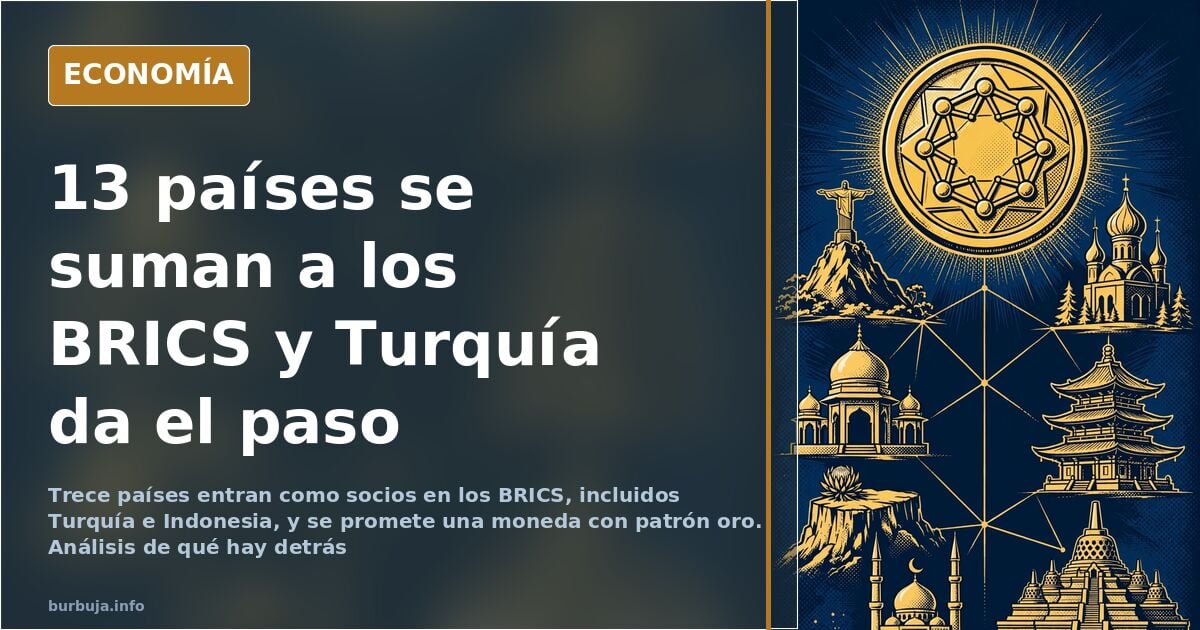
BRICS add thirteen partners and Turkey switches sides
Thirteen countries have entered the BRICS as partners: Algeria, Belarus, Bolivia, Cuba, Indonesia, Kazakhstan, Malaysia, Nigeria, Thailand, Turkey, Uganda, Uzbekistan, and Vietnam. The bloc that began as an acronym for four emerging economies has become a heterogeneous list that, with Indonesia and Nigeria alone, adds up to more population than the entire European Union. And on the table, another promise: an international currency backed by gold.
The announcement landed like a bomb in economic circles. The entry of Turkey—a NATO member for decades—and Thailand, countries aligned with Washington, was the signal many waited for to declare the board broken. Indonesia, with 282 million inhabitants, is the fourth most populous country in the world, nearly as many people as the United States. Nigeria, with 230 million and growing, is Africa's demographic engine.
What real weight do the new BRICS partners have?
The sum of Indonesia and Nigeria already exceeds the EU in population. Vietnam contributes 100 million inhabitants and a generation that knows what it means to win a war against a superpower. Kazakhstan, with barely four cats (a small population), hides natural riches that many ignore. Algeria swims in gas. The demographic and resource equation is fruta.
What is less clear is what being a partner exactly means. The bloc has no founding charter, no headquarters, and no admission rules. Each new member enters with its own agenda and interests. A club without statutes, in practice.
Gold standard and international currency: what lies behind?
The promise of a gold-backed currency was the other major headline. The logic presented is simple: if you have gold, raw materials, and energy, why accept unbacked printed paper? China increased its gold purchases by 68% year-on-year in the first quarter of 2024, according to industry data, while cutting its holdings of US debt. Gold closed April at $2,307 per ounce, after rising 4% during the month.
But the fine print is different. China is one of the largest holders of US debt globally. Destroying the dollar would destroy the system in which they themselves are a superpower. The most optimistic calculation assumes Beijing wants an alternative payment circuit, not a collapse. The pessimistic scenario starts from the premise that any abrupt move drags everyone down.
Why Turkey is the most uncomfortable addition
Turkey is not just any country on this list. It is a NATO member, has an economy integrated with the West, and controls the Bosphorus. Its entry into BRICS has been read as a strategic shift of prime importance. Some argue Ankara is simply playing multiple sides to maximize its negotiating position. Counter-arguments weigh heavily, noting its economy has sought alternatives to Brussels for years.
Thailand, for its part, has been a historical ally of Washington in Southeast Asia. Its incorporation reinforces the thesis that the bloc is no longer just a club of sanctioned countries.
The dollar as toilet paper and other hyperboles
The conversation quickly drifted toward prophecy. The dollar will be used as toilet paper, some have written. Others recalled that the euro might end up serving for heating, burning the printed bills. References to a historical era that ended badly hovered over several messages.
Skepticism also has its place. The West can reduce the supply of its currencies if demand falls, some argue. The Federal Reserve and the European Central Bank are not incompetent. Another matter is whether they want to act.
The energy issue: the point nobody disputes
Without cheap energy, business closes. That is the argument running through much of the analysis. BRICS groups producers of oil, gas, and critical minerals. Meanwhile, the West continues to depend on supply chains passing through Asia. The question is not who is right, but who lasts longer.
The crumbling of the Western order
The expansion of BRICS is not a declaration of war. It is a movement of pieces on a board that hasn't moved in decades. The entry of Turkey and Thailand, two pro-US countries for decades, is the clearest sign that something is shifting. If the bloc manages to articulate an alternative payment system, the impact will be real. If it remains a family photo, it won't.
With these elements, the most reasonable prediction is that the dollar will remain the reserve currency for years. But absolute monopoly has an expiration date. No one knows when.
Also available in: Deutsch
Summary of a discussion on Burbuja.info - Foro de economía, actualidad y política., translated from Spanish and reviewed before publication. Read the full discussion (110 replies).
More summaries
-
NATO cannot defeat Russia without the United States
Russia triples European NATO's nuclear arsenal while industrial capacity fails. Without the US, the Alliance is hollow.
-
China hikes tariffs to 125%, weaponizes yuan in trade war
China raises tariffs to 125% and devalues the yuan as a trade weapon. The debate: does it impoverish its population or shield its economy?
-
Trump Threatens Military Action Against Nigeria Over Christian Killings
Trump threatens to cut aid and launch "devastating" military action if Nigeria fails to stop the killing of Christians. The country is Africa's top oil producer.
-
Collado Mediano Villa Foreclosure Reveals Political Storm Origins
A Collado Mediano villa foreclosed 26 years ago for non-payment exposes the official narrative behind Spain's recent political eviction controversy.
-
US midterm elections: Senate control decides Trump's political fate
One third of Senate seats are up for renewal and impeachment requires an absolute majority. That is why Republican control of the upper chamber shapes Trump's political future.
-
The Iberian union Portugal rejected and Spain has yet to come to terms with
The Iberian union was first tried in 1580 and lasted 60 years. Today, with 767,094 Portuguese civil servants versus 562,445 in Andalusia, the debate is back on the table.