
Bread Bag Recycling: Ecodesign Frustrates Consumers
Separating plastic from paper in supermarket bread bags becomes the new front line for home recycling and ecodesign debates.
English · Original discussion in Spanish · Published
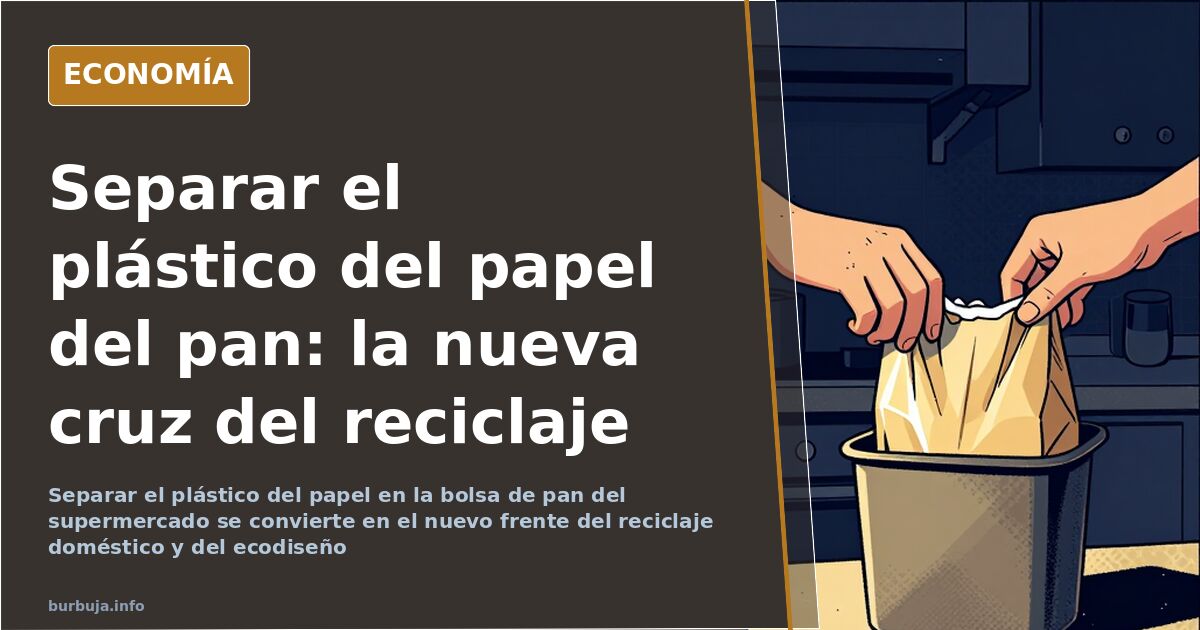
Recycling the Bread Bag: When Ecodesign Forces You to Separate Plastic and Paper
Separating the plastic from the paper in your supermarket bread bag. That is the new frontline of household recycling: a wrapper with a transparent window, tape, and inner coating that requires disassembling it piece by piece to dispose of it correctly. This practice, defended as a civic gesture, has sparked a debate about how far ecodesign shifts work onto the consumer that was previously handled by the manufacturer. Some have done this out of habit for years; others consider it a waste of time.
What is ecodesign and why does it force you to separate the bread bag?
The sliced bread wrapper combines cardboard, clear plastic, tape, and, in some cases, a gold or silver coating. For each fraction to end up in the correct bin, the consumer must take the whole thing apart. Some participants argue that simply soaking the bag to remove the metallic coating and taking it to the yellow bin is enough. Others warn that this method pollutes water and is more counterproductive than dry separation.
The discussion is not new. Some recall having separated plastic windows from envelopes and bottle caps for decades, without ecological anxiety or drama. Habit, they say, weighs more than obligation. Others respond that habit is precisely the problem: normalizing tasks that manufacturers could avoid with single-material packaging.
Greasy paper and stained cardboard: when not to recycle
One of the most repeated episodes involves pizza boxes. Cardboard stained with oil should not be mixed with clean paper, and those who throw it in the trash sometimes receive criticism: "just cut out the stained parts." The laughing response is that such zeal turns recycling into a hobby.
The pattern repeats with coffee capsules. Aluminum recycles well, but melting it requires significant energy, leading some to prefer returning to glass jars and ground coffee rather than paying extra for "eco" capsules. A conclusion often reached in various messages: the best waste is that which is not produced, and recycling is the worst of the three Rs. Reduce and reuse come first.
Ecoembes, glass, and the recycling business
Distrust of the management system is another axis of the debate. It is claimed that Ecoembes (Spain's packaging waste management entity) is a fraud of difficult-to-calculate dimensions, that part of the waste is sold to foreign companies and ends up in the sea. Spanish landfills receiving French industrial and electronic waste through intermediary companies are mentioned, and similar situations are alleged in the UK. According to these voices, the only fraction recycled almost 100% is glass, which also generates profit.
In contrast, defenders of the system rely on habit and individual responsibility: separating at home is a gesture that costs nothing and helps. The contrast between both positions remains unresolved: some demand that manufacturers pay and design better; others ask consumers not to obsess.
Plastic taxes and disincentive fees
The fiscal route appears in the final stretch of the conversation. One participant shares being charged nearly €12 for an environmental management fee on steel tubes incorporated into an exported product, while also paying the plastic tax used to pack those same products shipped to Asia. Recovering these fees, they say, must be a bureaucratic hell.
The argument has merit: if the cost of managing waste falls on those already taxed for packaging, the logic of ecodesign becomes blurred. Do we reward those who reduce or penalize those who comply? The question remains open.
The cultural war of recycling: sheep, hypocrites, and habits
The tone heats up when recycling becomes an identity marker. Some accuse the diligent ones of obeying without thinking and working for free for waste managers. Others respond that recycling is common sense and eco-anxiety is an invention. And some take the argument to the extreme: if the planet truly mattered, one wouldn't buy packaged bread at a supermarket, but at the bakery with a cloth bag.
The discussion drifts toward hypocrisy: separating caps while buying capsule coffee, or boasting about recycling while filling the cart with single-use packaging. The most repeated conclusion is uncomfortable: household recycling is the visible part of a problem whose solution lies in producing less waste.
Frequently asked questions about recycling the bread bag
Can you recycle the bread bag with a plastic window? Cardboard and plastic go into different bins, so they must be separated. If the cardboard has oil residues, it should not go into the blue bin. Tape and metallic coatings must also be removed.
Is it mandatory to separate plastic from paper? There is no sanctionable individual obligation, but the collection system assumes it. The debate centers on whether this task should fall on the manufacturer via single-material packaging.
What do you do with oil from pizza boxes? Stained cardboard is not mixed with clean paper. Cutting out the stained area is the most cited practice; throwing the entire box into the blue bin is the most criticized.
With these figures on the table, separating plastic from paper in the bread bag seems like a minor gesture. Yet, nobody fully agrees on whether the problem is the consumer who doesn't separate or the packaging that forces them to.
Also available in: Deutsch
Summary of a discussion on Burbuja.info - Foro de economía, actualidad y política., translated from Spanish and reviewed before publication. Read the full discussion (157 replies).
More summaries
-
Cambridgeshire train attack sparks UK security debate
Ten injured in Cambridgeshire train stabbing; two arrested. Debate intensifies over CCTV quality and UK public transport safety.
-
Educational disaster in Spain: Worst results in history in PISA report, falling up to two school years behind the United Kingdom
Spain plunges in PISA 2025 report, showing a two-year lag in reading compared to the UK. We analyze the causes and consequences.
-
Miss UK: Who Decides What Beauty Is in a Pageant
Miss UK: the crowning of its winner reignites the debate over representation, beauty, and who really funds the contests
-
Judge Cillán, who reopened Madrid train bombing probe, committed to psychiatric facility
Coro Cillán, the judge who attempted to reopen the 2004 Madrid train bombings investigation in 2009, remains involuntarily confined in a psychiatric isolation cell.
-
Inflation hits 4% in August: the bill for low rates
Inflation will reach 4% in August after a decade of low rates and public debt. Spain's unadjusted income tax worsens the bill and stagflation looms.
-
27 days for 6 computers at Spain's immigration office in Ceuta
27 days for the Immigration Office in Ceuta, Spain, to receive 6 computers. One computer for 5 civil servants: a portrait of Spanish bureaucracy.