
Brazilian Tourist with Spanish Passport Raped in India
A Brazilian tourist holding a Spanish passport was gang-raped in northern India, sparking debate over safety and her subsequent positive social media posts.
English · Original discussion in Spanish · Published
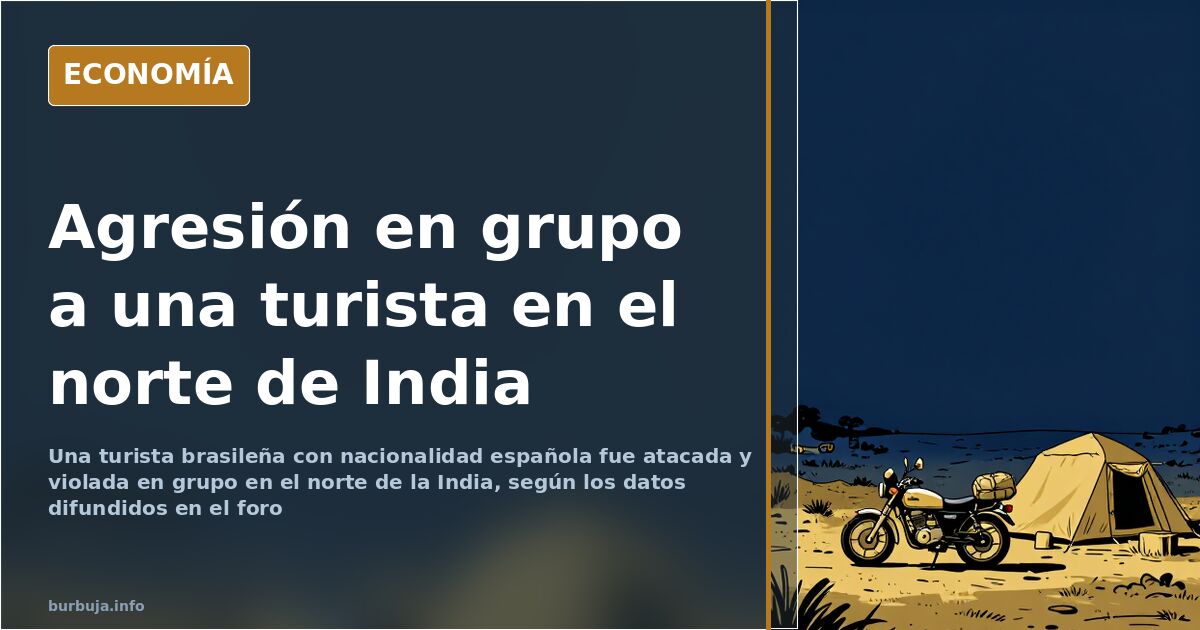
Gang attack on a motorcyclist in northern India
A tourist traveling with a Spanish passport—originally Brazilian—was attacked and gang-raped during a motorcycle alucinación through a rural region in northern India. The news initially circulated as breaking news identifying the victim as Spanish; it was later clarified that she is Brazilian with Spanish nationality. She was accompanied by her husband.
What is startling is not just the attack. Afterwards, the couple posted on social media that India is a wonderful country and that its inhabitants are generally good people. The gap between the account of the assault and the subsequent message weighed as much as the incident itself.
What is known about the attack on the couple
The travelers were riding a motorcycle through an isolated area of the state of Jharkhand. According to the data released, they were surprised while sleeping, and the woman was pulled out of the tent. The husband was present. One of the circulating accounts, supported by an educational video, claims the couple had previously encountered a hostile group, left, and returned to the same spot to spend the night. This detail is not confirmed by the investigation and became the focal point of criticism.
The Sub-Divisional Magistrate of Dumka, A. Dodde, told the media that the couple remains under protection and that police have asked the victims to avoid public statements to not affect the investigation. The identity of the aggressors and the exact number of participants are not confirmed.
The figures placing sensual violence in India
India’s latest crime report, corresponding to 2022, recorded 31,500 rape cases in a single year. This translates to approximately 86 rapes per day. Jharkhand is among the ten provinces with the highest number of sensual assaults and rapes, alongside Rajasthan and New Delhi.
These are official data from the country itself. They do not paint an entire nation as suspicious, but they explain why many travelers through these areas assume a level of insecurity that seems foreign here. The statistics do not absolve or condemn: they describe a landscape.
What the couple posted after the assault
After the attack, the couple released a video on Instagram defending the country's hospitality and encouraging visits. The message baffled much of the audience. Some viewed it as generosity; others saw it as an image operation, especially after a forum post citing 20minutos noted that Indian authorities had handed them 11,000 euros. This figure appears attributed to published information without official confirmation.
The victims' management on social media peine another front: recounting, publishing, exposing. One sector argues that a woman in shock is not in a position to decide on her own dissemination; another responds that no one has the right to dictate how a victim of an assault should react.
Adventure tourism and risk calculation
The case reopens an old debate: what it means to travel to isolated regions where one is, from the start, a visible stranger. Testimonials circulate from other motorcyclists recounting insecurity episodes on similar routes who, nevertheless, return. The logic of adventure travel rewards exactly what prudence advises against.
Camping in a rural area of a country with fragile infrastructure multiplies exposure; hotels and tourist spots are a refuge, the wilderness is not. It is also argued that a segment of tourism turns others' precariousness into an experience, and that this exchange rarely comes free for those living it from within.
The two reactions that divided the conversation
One current holds the victim responsible for traveling, for camping in such a place, and for the subsequent account. Another focuses on the media: it argues that an incident occurring abroad is instrumentalized according to editorial convenience and that victims' identities are preserved unequally depending on the case. Behind this suspicion lies a concrete argument: foreign events occupy an informational space here that is not dedicated with the same enthusiasm to equivalent local events.
In the middle, a minority defends that this debate is unnecessary. The assault is the news, and the rest is noise. It is the least noisy stance and, probably, the one generating the least traffic.
The couple remains under protection, and their public account—grateful, enthusiastic, almost immune—has not closed any wounds. Why do we turn these assaults into statistics when they happen far away and into exceptions when they happen close to home?
A tourist traveling with a Spanish passport—originally Brazilian—was attacked and gang-raped during a motorcycle alucinación through a rural region in northern India. The news initially circulated as breaking news identifying the victim as Spanish; it was later clarified that she is Brazilian with Spanish nationality. She was accompanied by her husband.
What is startling is not just the attack. Afterwards, the couple posted on social media that India is a wonderful country and that its inhabitants are generally good people. The gap between the account of the assault and the subsequent message weighed as much as the incident itself.
What is known about the attack on the couple
The travelers were riding a motorcycle through an isolated area of the state of Jharkhand. According to the data released, they were surprised while sleeping, and the woman was pulled out of the tent. The husband was present. One of the circulating accounts, supported by an educational video, claims the couple had previously encountered a hostile group, left, and returned to the same spot to spend the night. This detail is not confirmed by the investigation and became the focal point of criticism.
The Sub-Divisional Magistrate of Dumka, A. Dodde, told the media that the couple remains under protection and that police have asked the victims to avoid public statements to not affect the investigation. The identity of the aggressors and the exact number of participants are not confirmed.
The figures placing sensual violence in India
India’s latest crime report, corresponding to 2022, recorded 31,500 rape cases in a single year. This translates to approximately 86 rapes per day. Jharkhand is among the ten provinces with the highest number of sensual assaults and rapes, alongside Rajasthan and New Delhi.
These are official data from the country itself. They do not paint an entire nation as suspicious, but they explain why many travelers through these areas assume a level of insecurity that seems foreign here. The statistics do not absolve or condemn: they describe a landscape.
What the couple posted after the assault
After the attack, the couple released a video on Instagram defending the country's hospitality and encouraging visits. The message baffled much of the audience. Some viewed it as generosity; others saw it as an image operation, especially after a forum post citing 20minutos noted that Indian authorities had handed them 11,000 euros. This figure appears attributed to published information without official confirmation.
The victims' management on social media peine another front: recounting, publishing, exposing. One sector argues that a woman in shock is not in a position to decide on her own dissemination; another responds that no one has the right to dictate how a victim of an assault should react.
Adventure tourism and risk calculation
The case reopens an old debate: what it means to travel to isolated regions where one is, from the start, a visible stranger. Testimonials circulate from other motorcyclists recounting insecurity episodes on similar routes who, nevertheless, return. The logic of adventure travel rewards exactly what prudence advises against.
Camping in a rural area of a country with fragile infrastructure multiplies exposure; hotels and tourist spots are a refuge, the wilderness is not. It is also argued that a segment of tourism turns others' precariousness into an experience, and that this exchange rarely comes free for those living it from within.
The two reactions that divided the conversation
One current holds the victim responsible for traveling, for camping in such a place, and for the subsequent account. Another focuses on the media: it argues that an incident occurring abroad is instrumentalized according to editorial convenience and that victims' identities are preserved unequally depending on the case. Behind this suspicion lies a concrete argument: foreign events occupy an informational space here that is not dedicated with the same enthusiasm to equivalent local events.
In the middle, a minority defends that this debate is unnecessary. The assault is the news, and the rest is noise. It is the least noisy stance and, probably, the one generating the least traffic.
The couple remains under protection, and their public account—grateful, enthusiastic, almost immune—has not closed any wounds. Why do we turn these assaults into statistics when they happen far away and into exceptions when they happen close to home?
Also available in: Deutsch
Summary of a discussion on Burbuja.info - Foro de economía, actualidad y política., translated from Spanish and reviewed before publication. Read the full discussion (360 replies).
More summaries
-
Three Arrested in India for Gang Rape of Spanish Couple
Three suspects detained in Dumka, India, for the gang rape of a Spanish woman. The consulate is over 1,300 km away, amid statistics of one rape every 15 minutes.
-
Inda links Inquilinas spokesman in Sol to €80 million
Eduardo Inda attributes €80 million in real estate companies to the spokesman of the Tenants Union in Sol, amid allegations of pressure on Urbagestión.
-
Spain's Parasite Debate: Cultural Shock or Marketing?
Analysis of the debate on deworming in Spain: is it a cultural clash, a public health need, or just marketing?
-
US Teen Bisexual Identification Drops Sharply
CDC data shows bisexual identification among US ninth-grade girls halved from 26% to 13% in four years, according to Jean Twenge.
-
Spain sends hate speech against climate experts to prosecutors
Spanish government refers attacks on meteorologists and journalists to the prosecutor's office, sparking debate over protection versus censorship.
-
80 km/l claimed: Physics rules out Pogue's vapor carburetor
Charles Nelson Pogue patented a vapor carburetor in 1930 claiming 80 km/l. Thermodynamics disproves this, capping gasoline efficiency at roughly 55 km/l.