
Boy offers hand to classmates, all ignore him
A viral video shows a boy offering his hand to girls on school stairs. None take it, reigniting debate on school rituals.
English · Original discussion in Spanish · Published
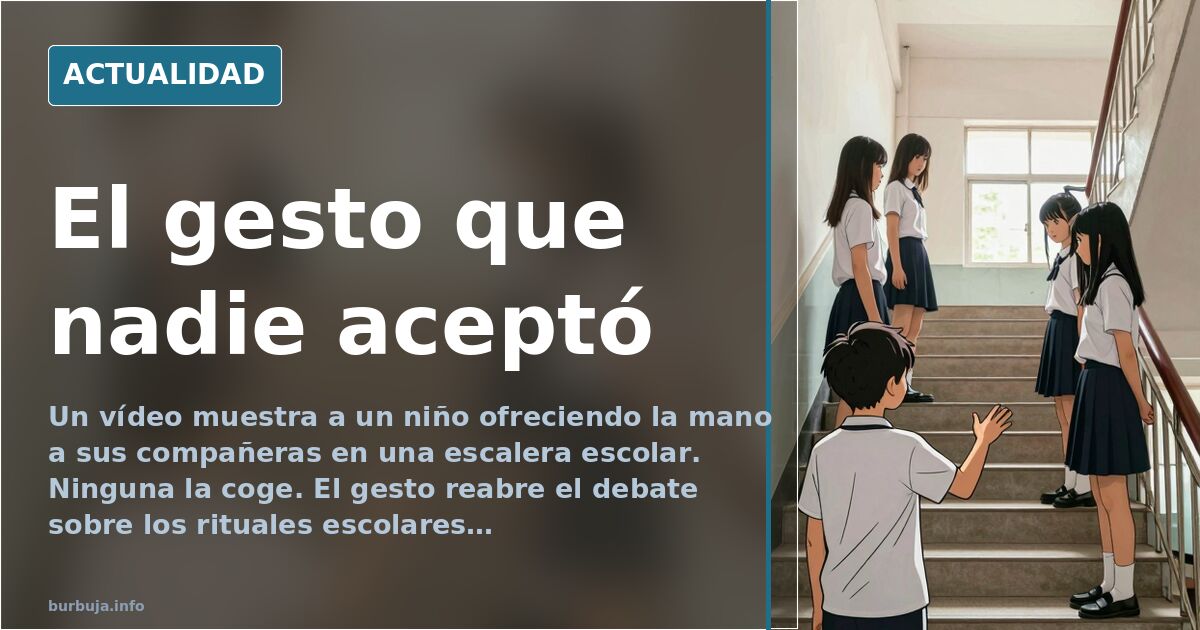
The boy who offered his hand and was ignored
A short video, with no context beyond the accompanying tweet, has peine a discussion in Spain that never fully closes: school rituals that put a child on display and leave them standing there while the rest of the world passes by. The scene is simple. A boy with glasses, standing next to a staircase, extends his hand to help a line of girls go down. None take it. One after another. Most don't even look at him.
The tweet accompanying the video states: "When they are adults, they will understand what they failed to value." And that's where the problem begins, because that phrase assumes there was something to value and that the child was there willingly.
What exactly is seen in the video
What is seen is a minor, wearing glasses, at what appears to be a public school event, offering his hand to female classmates going down a staircase. They pass by. Some glance sideways. Others don't even do that. The gesture repeats until it loses meaning.
The first interpretation circulating is that of rejection: a child turned into furniture while others live their lives. The second, less epic, is that a child of that age might have come up with doing this without being asked, and that girls aged eight or ten may not even understand what is happening. Both things can be true at once, and that is precisely where the issue becomes complicated.
Was it humiliation or a gesture without context?
Here the material splits in two. One part argues that what is seen is a low-intensity humiliation ritual: the child exposed before an audience, arm stretched out, watching everyone pass. No one needs to laugh for the message to stick. Indifference is enough. They add a non-trivial detail: if the person there were the popular kid in class, the scene would have been different.
The other part responds with age. These are girls between eight and ten years old, they argue, who don't realize someone is waiting. There is no calculated contempt, just distraction. And if the school placed them descending a staircase in a line, the probability that anyone notices the extended hand is minimal. The humiliation, in any case, would have been designed by the adult who organized the event, not the children.
The herd effect: why the first one passing decides everything
There is a recurring analysis with its own logic: in these dynamics, the first rejection sets the path. If the first girl had taken his hand, many of those trinc would have done so. If the first ignores him, no one wants to be the odd one accepting what others have rejected. It is the same mechanism observed in group approaches, where the presence of friends completely changes the outcome.
From this comes an uncomfortable conclusion: the mistake was not the boy's, but whoever put him there. The public and collective exposure of the attempt guaranteed failure. Individually, one by one, the result would have been different. Not necessarily good. But different.
What is forged in the playground and what is forged on display
One current of analysis goes beyond the video and points to school as a factory of roles. The argument is that boys have been gradually removed from spaces where they build themselves among peers—the playground, football, rough play—and instead placed in decorative service positions, where the assigned role is that of ridiculous companion. The result, they maintain, is a generation of men educated in the discomfort of not knowing what place to occupy.
Opposing this is the reading that all this is an overreaction by adults projecting their own wounds onto a recess scene. A child offering his hand and having it refused is not national trauma. It is just a school afternoon.
Low-intensity trauma and the nonexistent manual
The concept gaining most traction in the discussion is low-intensity trauma: not the blow that breaks a bone, but the drop that erodes. The memory of a specific rejection, recorded at ten years old, reappearing at thirty as insecurity when making eye contact. Several personal accounts point in the same direction: school episodes from decades ago that remain intact, never given importance.
The reverse side is that most children go through this and do not break. School is a harsh environment by definition and always has been. The difference, if it exists, is that now there is a camera and an adult audience ready to interpret every gesture as a symptom.
From the school scene to the archetype of the invisible man
The conversation drifts, as usual, toward cinema. Icelandic Fúsi, Norwegian Elling, and Hollywood's Joker appear as three versions of the same character: the man who cannot find his place, who is good without it serving him, and who either implodes silently or explodes. The most repeated reading is that reality lies in the Scandinavian ones, life fading away without noise, while the charismatic villain is an exaggeration for sales.
The bridge between the school scene and that archetype is provided by the material itself: the boy with glasses, if no one intervenes, risks ending up as the type who at forty lives with his mother and collects tanks. Not because of the video. Because of what the video represents.
With these elements, the reasonable conclusion is that the video proves nothing about the girls and much about the adults who filmed, uploaded, and interpreted it. What remains unresolved is whether the boy left with an anecdote or a burden. No one knows, and whoever claims to know is lying.
A short video, with no context beyond the accompanying tweet, has peine a discussion in Spain that never fully closes: school rituals that put a child on display and leave them standing there while the rest of the world passes by. The scene is simple. A boy with glasses, standing next to a staircase, extends his hand to help a line of girls go down. None take it. One after another. Most don't even look at him.
The tweet accompanying the video states: "When they are adults, they will understand what they failed to value." And that's where the problem begins, because that phrase assumes there was something to value and that the child was there willingly.
What exactly is seen in the video
What is seen is a minor, wearing glasses, at what appears to be a public school event, offering his hand to female classmates going down a staircase. They pass by. Some glance sideways. Others don't even do that. The gesture repeats until it loses meaning.
The first interpretation circulating is that of rejection: a child turned into furniture while others live their lives. The second, less epic, is that a child of that age might have come up with doing this without being asked, and that girls aged eight or ten may not even understand what is happening. Both things can be true at once, and that is precisely where the issue becomes complicated.
Was it humiliation or a gesture without context?
Here the material splits in two. One part argues that what is seen is a low-intensity humiliation ritual: the child exposed before an audience, arm stretched out, watching everyone pass. No one needs to laugh for the message to stick. Indifference is enough. They add a non-trivial detail: if the person there were the popular kid in class, the scene would have been different.
The other part responds with age. These are girls between eight and ten years old, they argue, who don't realize someone is waiting. There is no calculated contempt, just distraction. And if the school placed them descending a staircase in a line, the probability that anyone notices the extended hand is minimal. The humiliation, in any case, would have been designed by the adult who organized the event, not the children.
The herd effect: why the first one passing decides everything
There is a recurring analysis with its own logic: in these dynamics, the first rejection sets the path. If the first girl had taken his hand, many of those trinc would have done so. If the first ignores him, no one wants to be the odd one accepting what others have rejected. It is the same mechanism observed in group approaches, where the presence of friends completely changes the outcome.
From this comes an uncomfortable conclusion: the mistake was not the boy's, but whoever put him there. The public and collective exposure of the attempt guaranteed failure. Individually, one by one, the result would have been different. Not necessarily good. But different.
What is forged in the playground and what is forged on display
One current of analysis goes beyond the video and points to school as a factory of roles. The argument is that boys have been gradually removed from spaces where they build themselves among peers—the playground, football, rough play—and instead placed in decorative service positions, where the assigned role is that of ridiculous companion. The result, they maintain, is a generation of men educated in the discomfort of not knowing what place to occupy.
Opposing this is the reading that all this is an overreaction by adults projecting their own wounds onto a recess scene. A child offering his hand and having it refused is not national trauma. It is just a school afternoon.
Low-intensity trauma and the nonexistent manual
The concept gaining most traction in the discussion is low-intensity trauma: not the blow that breaks a bone, but the drop that erodes. The memory of a specific rejection, recorded at ten years old, reappearing at thirty as insecurity when making eye contact. Several personal accounts point in the same direction: school episodes from decades ago that remain intact, never given importance.
The reverse side is that most children go through this and do not break. School is a harsh environment by definition and always has been. The difference, if it exists, is that now there is a camera and an adult audience ready to interpret every gesture as a symptom.
From the school scene to the archetype of the invisible man
The conversation drifts, as usual, toward cinema. Icelandic Fúsi, Norwegian Elling, and Hollywood's Joker appear as three versions of the same character: the man who cannot find his place, who is good without it serving him, and who either implodes silently or explodes. The most repeated reading is that reality lies in the Scandinavian ones, life fading away without noise, while the charismatic villain is an exaggeration for sales.
The bridge between the school scene and that archetype is provided by the material itself: the boy with glasses, if no one intervenes, risks ending up as the type who at forty lives with his mother and collects tanks. Not because of the video. Because of what the video represents.
With these elements, the reasonable conclusion is that the video proves nothing about the girls and much about the adults who filmed, uploaded, and interpreted it. What remains unresolved is whether the boy left with an anecdote or a burden. No one knows, and whoever claims to know is lying.
Summary of a discussion on Burbuja.info - Foro de economía, actualidad y política., translated from Spanish and reviewed before publication. Read the full discussion (157 replies).
More summaries
-
Gates Warns AI Could Cause a Billion Deaths
Bill Gates warns on NBC's Meet the Press that AI could cause a billion deaths and calls for government safeguards.
-
Barcelona Mall Jump Attempt Sparks Urban Safety Debate
Analysis of the incident at Las Arenas in Barcelona and the debate over urban insecurity in Spain.
-
Barcelona Children's Bookstore Vandalized with 'Zionist' Slurs
A children's bookstore in Sant Cugat, Spain, was targeted by graffiti labeling it 'Zionist' and 'genocidal,' sparking online comparisons to Nazi-era persecution.
-
Keanu Reeves Fake Tweet: AI Hoax and Economic Theory
Experts confirm the viral Keanu Reeves tweet is an AI-generated fake, not a genuine post.
-
Young Spaniard moves to Germany for love, cheated on by partner
A 19-year-old moved to Germany with his girlfriend to save their relationship, only for her to cheat with a flatmate. Lesson: don't migrate for someone else.
-
Save Europe Act brings 'remigration' to Barcelona
Save Europe Act promotes 'remigration' in Barcelona, citing up to 18 million surplus migrants and facing accusations of hypocrisy.