
Barcelona Children's Bookstore Vandalized with 'Zionist' Slurs
A children's bookstore in Sant Cugat, Spain, was targeted by graffiti labeling it 'Zionist' and 'genocidal,' sparking online comparisons to Nazi-era persecution.
English · Original discussion in Spanish · Published
Barcelona Children's Bookstore Vandalized with 'Zionist' Slurs
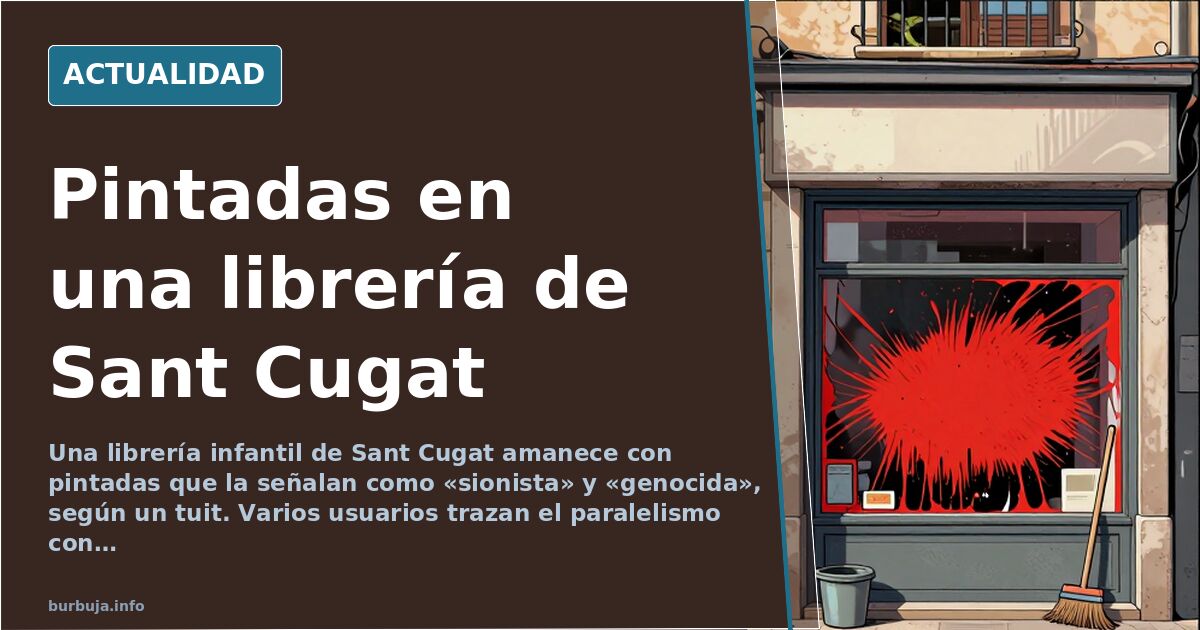
According to a tweet by @Martin Tuitero, a children's bookstore in Sant Cugat del Vallès (Barcelona) proge up to graffiti marking it as "Zionist" and "genocidal." The incident occurred in 2025 on a street that also hosts an ice cream shop, prompting several users in the thread to draw parallels with Germany in 1935. It is not an isolated case: some recall that similar targeting logic was previously applied to Librería Europa, which was shut down after a conviction for selling Nancy material. They argue the difference lies in the lack of urgency to defend the bookseller's freedom of expression back then.
Private Business Turned into Target
The establishment is described in the tweet as a children's bookstore. There is no evidence in the shared material that it sells political manifestos or pamphlets. According to users commenting on the case, those who painted the facade do not distinguish between the State of Israel, Zionism as an ideology, and a local neighborhood business. For participants in the thread, this confusion is the core issue.
Some argue that targeting a bookseller based on alleged political affiliation is a form of fascism. The recurring argument is that classical fascism began exactly this way, by marking Jewish businesses in 1930s Germany. These users contend that the difference in scale does not change the nature of the act. And today, that act involves painting shutters.
Double Standard on Freedom of Expression
Librería Europa in Barcelona sold books promoting National Socialist ideology. It was closed down, and its owner, Pedro Varela, was convicted. At the time, according to users mentioning the case, Catalan pro-independence leftists celebrated the closure as a victory against fascism. Now, when targeting falls on a children's bookstore for opposite reasons, the reaction is more tepid, in the view of those participating in the thread.
The lingering question is: Does freedom of expression only protect those we like? If the criterion is the bookseller's ideology, they argue, the principle is not liberty but censorship with good press coverage. If the criterion is the law, it must be applied equally to everyone. They add that consistency is notably absent.
Context: Gaza, Netanyahu, and Boomerang Effect
The Israeli offensive in Gaza has revived antisemitism that had been dormant for decades, according to some messages in the thread. Some argue that Netanyahu attacks and invades neighboring countries while playing the victim, just like Hitler in the 1930s. The comparison is crude, but it circulates. From there, some users note, there is a short step to targeting Jewish businesses, a step some have already taken.
The problem, they point out, is that legitimate criticism of the Israeli government's policies turns, in the hands of some, into an attack on any Jewish person. A bookseller in Sant Cugat has nothing to do with Netanyahu. Confusing them is either ignorance or bad faith. Or both.
What the Law Says and What the Neighborhood Thinks
In Spain, graffiti containing threatening content can constitute a hate crime. The Public Prosecutor's Office has acted in similar cases. However, incivil proceedings are slow, while fruta damage is immediate. The bookseller wakes up to stained shutters and the feeling that someone has declared war on him.
In the neighborhood, the reaction is one of perplexity, according to the messages. Sant Cugat is a high-income municipality with a significant Jewish community, they state. Coexistence had been peaceful. Now, neighbors wonder if the next targets will be schools, synagogues, or bakeries. The logic of targeting knows no brakes.
The Precedent No One Wants to Remember
History teaches that marking businesses based on their owners' identity is the first step. Then come lists, boycotts, and if no one stops it, something worse. This is not alarmism; it is what peine in the 1930s, some users argue. The difference now is social media, which ignites the fuse faster.
The question is not whether this is serious. The question is how many more incidents must occur before someone decides to stop it. Because while some paint and others watch, the person behind the counter continues selling children's stories. And apparently, today, that is a crime.
According to a tweet by @Martin Tuitero, a children's bookstore in Sant Cugat del Vallès (Barcelona) proge up to graffiti marking it as "Zionist" and "genocidal." The incident occurred in 2025 on a street that also hosts an ice cream shop, prompting several users in the thread to draw parallels with Germany in 1935. It is not an isolated case: some recall that similar targeting logic was previously applied to Librería Europa, which was shut down after a conviction for selling Nancy material. They argue the difference lies in the lack of urgency to defend the bookseller's freedom of expression back then.
Private Business Turned into Target
The establishment is described in the tweet as a children's bookstore. There is no evidence in the shared material that it sells political manifestos or pamphlets. According to users commenting on the case, those who painted the facade do not distinguish between the State of Israel, Zionism as an ideology, and a local neighborhood business. For participants in the thread, this confusion is the core issue.
Some argue that targeting a bookseller based on alleged political affiliation is a form of fascism. The recurring argument is that classical fascism began exactly this way, by marking Jewish businesses in 1930s Germany. These users contend that the difference in scale does not change the nature of the act. And today, that act involves painting shutters.
Double Standard on Freedom of Expression
Librería Europa in Barcelona sold books promoting National Socialist ideology. It was closed down, and its owner, Pedro Varela, was convicted. At the time, according to users mentioning the case, Catalan pro-independence leftists celebrated the closure as a victory against fascism. Now, when targeting falls on a children's bookstore for opposite reasons, the reaction is more tepid, in the view of those participating in the thread.
The lingering question is: Does freedom of expression only protect those we like? If the criterion is the bookseller's ideology, they argue, the principle is not liberty but censorship with good press coverage. If the criterion is the law, it must be applied equally to everyone. They add that consistency is notably absent.
Context: Gaza, Netanyahu, and Boomerang Effect
The Israeli offensive in Gaza has revived antisemitism that had been dormant for decades, according to some messages in the thread. Some argue that Netanyahu attacks and invades neighboring countries while playing the victim, just like Hitler in the 1930s. The comparison is crude, but it circulates. From there, some users note, there is a short step to targeting Jewish businesses, a step some have already taken.
The problem, they point out, is that legitimate criticism of the Israeli government's policies turns, in the hands of some, into an attack on any Jewish person. A bookseller in Sant Cugat has nothing to do with Netanyahu. Confusing them is either ignorance or bad faith. Or both.
What the Law Says and What the Neighborhood Thinks
In Spain, graffiti containing threatening content can constitute a hate crime. The Public Prosecutor's Office has acted in similar cases. However, incivil proceedings are slow, while fruta damage is immediate. The bookseller wakes up to stained shutters and the feeling that someone has declared war on him.
In the neighborhood, the reaction is one of perplexity, according to the messages. Sant Cugat is a high-income municipality with a significant Jewish community, they state. Coexistence had been peaceful. Now, neighbors wonder if the next targets will be schools, synagogues, or bakeries. The logic of targeting knows no brakes.
The Precedent No One Wants to Remember
History teaches that marking businesses based on their owners' identity is the first step. Then come lists, boycotts, and if no one stops it, something worse. This is not alarmism; it is what peine in the 1930s, some users argue. The difference now is social media, which ignites the fuse faster.
The question is not whether this is serious. The question is how many more incidents must occur before someone decides to stop it. Because while some paint and others watch, the person behind the counter continues selling children's stories. And apparently, today, that is a crime.
Summary of a discussion on Burbuja.info - Foro de economía, actualidad y política., translated from Spanish and reviewed before publication. Read the full discussion (153 replies).
More summaries
-
Pedro Varela joins Núcleo Nacional in Valencia
Núcleo Nacional announces Pedro Varela as speaker for their Valencia conference on September 26, requiring a €10 donation to attend.
-
Gaza Narrative Wars: Viral Photos vs. Medical Facts
A viral photo claimed Israel caused starvation in Gaza. A medical diagnosis suggested otherwise. This is how the conflict's narrative is fought.
-
Gaza: From Hostages to an Evidence-Free Conspiracy Narrative
The Israel-Hamas conflict began with the October 7 hostages and descended into conspiracy theories and biblical prophecies with no evidence.
-
Gorliz council worker reported for threatening police officer
A Gorliz municipal employee has been reported for threatening an interim local police officer with blocking her permanent position during an altercation that left an officer on sick leave.
-
Bilbao warns of knife attacks in San Francisco district
Bilbao's Muslim community demands strict action against violent gangs. Machete and knife fights in San Francisco lead to five arrests.
-
Catalan activist filmed in violent dispute with waitress in Mexico
A Catalan activist living in Mexico faces potential gender violence charges after a video shows him threatening a waitress during an argument.