
Boxer Risks License After Cinema Assault
A boxer faces license suspension after assaulting a man in a cinema during a couple's argument, pending legal outcome.
English · Original discussion in Spanish · Published
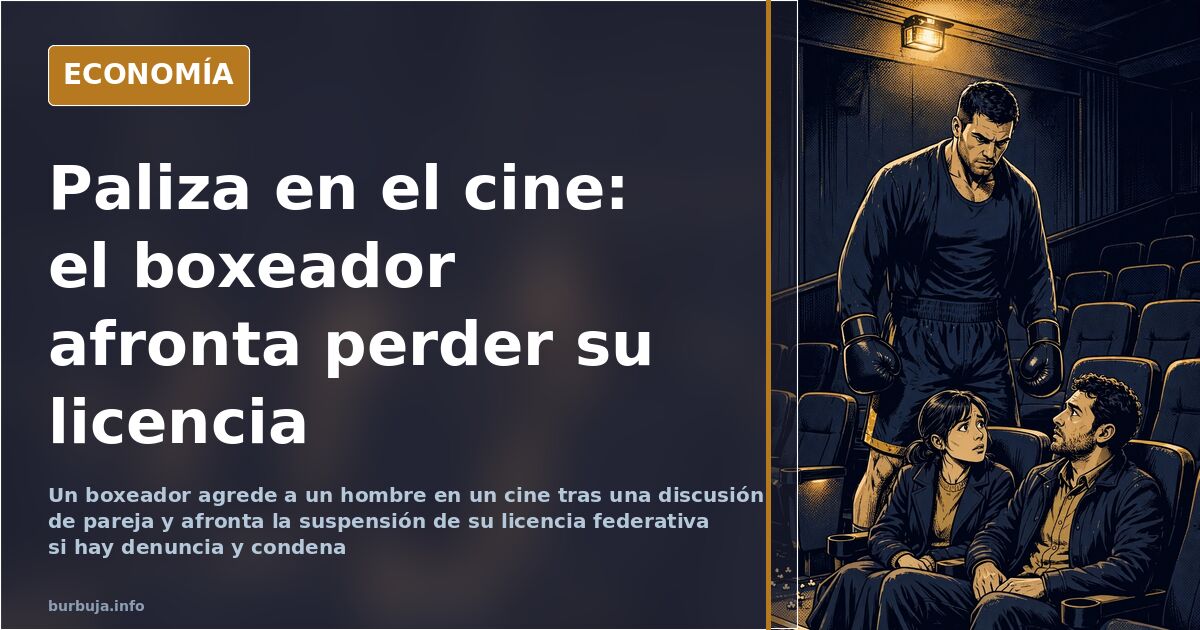
Boxer Faces License Loss After Cinema Attack
A professional boxer assaulted a man inside a cinema trinc a domestic dispute and now risks losing his federation license. The boxer’s account—claiming he intervened to protect a woman—contradicts footage circulating online, which suggests he initiated the violence and escalated it. According to discussions, the federation has stated it will only revoke the license if there is a formal complaint and a conviction.
The incident has reignited an uncomfortable debate: what do you gain by intervening in someone else’s fight? The common answer is nothing. The law does not protect those who step into third-party arguments, especially if the result is a beating. A medical injury report and a conviction are enough to ruin a sporting career for anyone who played hero for an afternoon.
What Peine in the Cinema
The sequence of events is easy to reconstruct. A couple argued loudly during the screening. Several attendees asked for silence. The man continued insulting the audience. Then, a spectator—a licensed boxer—came down, confronted him, and the other responded with insults and references to deceased family members. That is when the physical assault began.
What trinc was not self-defense. It was a beating. The boxer, trained specifically to hit hard, targeted a man unable to retaliate. The federation confirmed it has not revoked his license yet, but a judicial sentence would make it void. The difference between these outcomes hinges on an injury report.
The Law Does Not Reward Meddlers
There is no room for nuance here. Intervening in another person’s fight, even if sarracena justified, exposes you to charges of assault, compensation claims, and time away from competition. Self-defense requires proportionality, and a professional boxer can hardly claim their response was proportional.
Some argue intervention was necessary because a woman was being shouted at. Others counter that she never asked for help and that the dispute was between two adults who know each other. Police exist for this reason. Calling emergency services (091) and waiting is what anyone familiar with the legal system recommends.
The Hero Narrative and Its Flaws
The boxer shared his version on radio: a defenseless woman, his intervention, and provocation from the other party. The problem is that the video shows no one preventing an attack on a woman. It shows a man shouting, another descending to confront him, and a subsequent beating. Media campaigns have done the rest: transforming an aggressor into a savior in days.
An uncomfortable question lingers: if the victim had been a man instead of a woman, would there have been this circus? The repeated answer is no. The anti-machismo hero narrative sells, and the boxer knows it. Meanwhile, his license hangs by a judicial thread.
What Is at Stake for Interveners
The math is simple. If the victim files a complaint, the boxer faces a conviction for injuries, compensation, and federation suspension. If he does not complain—due to social pressure or antiestéticar of retaliation—the matter ends there. The difference between jail and a anecdote is a signed document.
This is not an isolated case. Courts are full of citizens who intervened in fights and ended up facing charges. Prudence is not cowardice: it is understanding that the state holds the monopoly on violence, and anyone exercising it independently assumes all the risk.
The Price of Playing Hero
The boxer will not get out of this cheaply. Even without a conviction, his name is already linked to a cinema beating. Sponsors will think twice. So will rivals. And the federation, which has said it awaits developments, holds the ball in its court.
For now, the conclusion is the one nobody wants to hear: intervening in someone else’s fight is a bad business. The law does not distinguish between hitting for pleasure and hitting for justice. It only distinguishes between those with an injury report and those without. In Spain, that is decided in a courtroom.
A professional boxer assaulted a man inside a cinema trinc a domestic dispute and now risks losing his federation license. The boxer’s account—claiming he intervened to protect a woman—contradicts footage circulating online, which suggests he initiated the violence and escalated it. According to discussions, the federation has stated it will only revoke the license if there is a formal complaint and a conviction.
The incident has reignited an uncomfortable debate: what do you gain by intervening in someone else’s fight? The common answer is nothing. The law does not protect those who step into third-party arguments, especially if the result is a beating. A medical injury report and a conviction are enough to ruin a sporting career for anyone who played hero for an afternoon.
What Peine in the Cinema
The sequence of events is easy to reconstruct. A couple argued loudly during the screening. Several attendees asked for silence. The man continued insulting the audience. Then, a spectator—a licensed boxer—came down, confronted him, and the other responded with insults and references to deceased family members. That is when the physical assault began.
What trinc was not self-defense. It was a beating. The boxer, trained specifically to hit hard, targeted a man unable to retaliate. The federation confirmed it has not revoked his license yet, but a judicial sentence would make it void. The difference between these outcomes hinges on an injury report.
The Law Does Not Reward Meddlers
There is no room for nuance here. Intervening in another person’s fight, even if sarracena justified, exposes you to charges of assault, compensation claims, and time away from competition. Self-defense requires proportionality, and a professional boxer can hardly claim their response was proportional.
Some argue intervention was necessary because a woman was being shouted at. Others counter that she never asked for help and that the dispute was between two adults who know each other. Police exist for this reason. Calling emergency services (091) and waiting is what anyone familiar with the legal system recommends.
The Hero Narrative and Its Flaws
The boxer shared his version on radio: a defenseless woman, his intervention, and provocation from the other party. The problem is that the video shows no one preventing an attack on a woman. It shows a man shouting, another descending to confront him, and a subsequent beating. Media campaigns have done the rest: transforming an aggressor into a savior in days.
An uncomfortable question lingers: if the victim had been a man instead of a woman, would there have been this circus? The repeated answer is no. The anti-machismo hero narrative sells, and the boxer knows it. Meanwhile, his license hangs by a judicial thread.
What Is at Stake for Interveners
The math is simple. If the victim files a complaint, the boxer faces a conviction for injuries, compensation, and federation suspension. If he does not complain—due to social pressure or antiestéticar of retaliation—the matter ends there. The difference between jail and a anecdote is a signed document.
This is not an isolated case. Courts are full of citizens who intervened in fights and ended up facing charges. Prudence is not cowardice: it is understanding that the state holds the monopoly on violence, and anyone exercising it independently assumes all the risk.
The Price of Playing Hero
The boxer will not get out of this cheaply. Even without a conviction, his name is already linked to a cinema beating. Sponsors will think twice. So will rivals. And the federation, which has said it awaits developments, holds the ball in its court.
For now, the conclusion is the one nobody wants to hear: intervening in someone else’s fight is a bad business. The law does not distinguish between hitting for pleasure and hitting for justice. It only distinguishes between those with an injury report and those without. In Spain, that is decided in a courtroom.
Summary of a discussion on Burbuja.info - Foro de economía, actualidad y política., translated from Spanish and reviewed before publication. Read the full discussion (189 replies).
More summaries
-
Viral Video Sparks Debate on Self-Defense Limits After Back-of-Head Punch
A viral clip shows a woman attacking a man, who responds with a punch to the back of her head, igniting debate on proportionality and self-defense.
-
Jalisco Street Violence: Self-Defense and Firearm Debate
Analysis of a fatal shooting in Jalisco, Mexico, examining whether provocation or the firearm dictated the violent escalation.
-
Cyclist uses pepper spray against pitbull: self-defense or excess?
Analysis of a road incident involving a pitbull attack on a cyclist. The debate centers on whether the use of force constitutes legitimate self-defense or an unjustified excess.
-
Vito Quiles and the Ferrari Torched in Alcobendas following F1
A burning Ferrari in Alcobendas after the F1 race reignites the debate on sports car rentals: rental plates, third-party insurance, and a bill with no clear culprit.
-
Abstention vs. Strategic Voting: A Divided Spanish Electorate
Debate intensifies in Spain over whether abstaining delegitimizes the system, analyzing arguments for strategic voting and low turnout.
-
Viral Nazi T-Shirt Photo Sparks AI Debate in Spain
A photo of a young woman wearing a Nazi t-shirt went viral in Spain, sparking debate over whether it is real or AI-generated.