
Bolsonaro flies to Miami without handing over passport demanded by courts
The former presidential candidate failed to hand over the passport demanded by Brazil's Supreme Court after losing the election. Lula's party announces more arrests of…
English · Original discussion in Spanish · Published
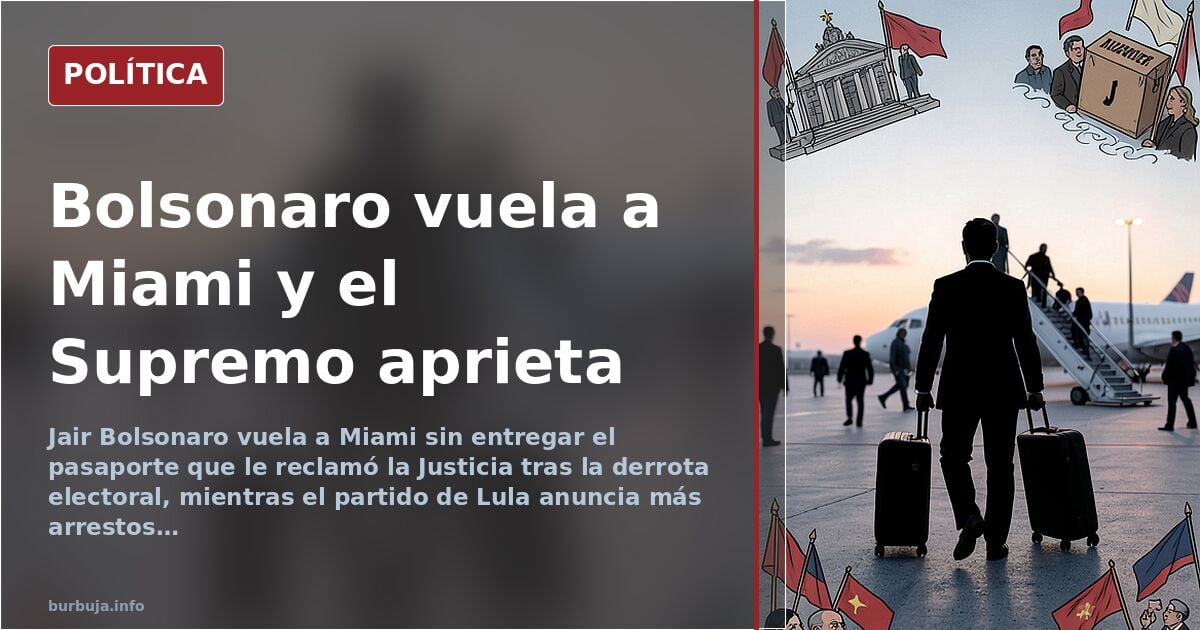
Bolsonaro flies to Miami without handing over passport demanded by courts
The news was confirmed with a flight to Miami and a passport that the Brazilian courts had demanded. The former presidential candidate did not surrender the document as the Supreme Court required after losing the election, and the response was not long in coming: Lula da Silva's party announced more arrests of opposition figures in the coming hours, starting with Senator Deltan Dallagnol. Brazil has for months been a chessboard where politics and the courts are playing the same game.
The official narrative speaks of defending democracy. The opposition's narrative speaks of persecution. And in the middle, a country watching its institutional system stretch to a point that many compare with Venezuela.
What peine to Bolsonaro and why he is going to the US
The trigger is a court order: the surrender of his passport. The Brazilian courts had demanded it after the former presidential candidate lost the election, and he did not comply. According to available reports, he left the country heading for Miami. This is not an improvised exile: it is the consequence of a standoff between political and judicial power that has been escalating for months.
The sequence described in circles critical of the government has its own internal logic. Lula was convicted of corruption, served part of his sentence and was released by the Supreme Court on procedural grounds, without full acquittal. He then defeated Jair Bolsonaro in 2022. From there, the exiled man's father was sent to prison over an alleged coup attempt, Congress voted to reduce his sentence and Lula vetoed that reduction. Four years later, the stage is different: the son faces the son of the former president, and the institutional machinery has not stopped turning.
The Supreme Court and Lula's party: the suspicion of a de facto dictatorship
The most repeated accusation is that the Supreme Court has become an extension of the ruling party's party. A judge who was once Lula's private lawyer, now on the Supreme Court, extended voting by two hours nationwide on election day, at the request of the ruling candidate's own coalition. The result: a four-million-vote margin in the runoff, with no paper trail. These are figures that, lined up, feed the distrust of a large part of the population.
The opposing argument also exists: there was an assassination attempt against Lula, through the so-called 'punto verde e amarelo' plan, and those who plotted it fled from justice. From that perspective, the judicial measures are not persecution but a response to a real threat against the constitutional order. The discussion, as almost always, depends on which part of the sequence you choose as your starting point.
The announced arrests of opposition figures and the Deltan Dallagnol case
Lula da Silva's party published a message announcing more arrests of opposition figures in the coming hours, with Senator Deltan Dallagnol as the first name on the table. It is the kind of communication that turns a judicial measure into a political message. The immediate question is what they are accused of, and the answer available right now is the one given by the announcement itself: there is no detail of charges, only the warning that more detentions are coming.
For part of public opinion, this confirms that Brazil has ceased to be a liberal democracy and has become a regime where the judiciary acts as the executive's enforcement arm. For others, it is the inevitable consequence of a coup attempt that cannot go unpunished. In the middle, the country watches a process that many compare with Maduro's Venezuela, with the difference that official propaganda, they say, prevents the rest of the world from seeing it clearly.
The economic and social context nobody disputes
Beyond the institutional standoff, there is a reality that slips into the conversation: the demographic and religious transformation of Brazil. The country is moving toward an evangelical majority and toward a change in the composition of its population that some read as a threat and others as a simple sociological fact. It is not a new debate, but it is one that intensifies when politics becomes a matter of identity.
The comparison with Spain appears recurrently: the Civil War of 1936 is mentioned as a ghost that some invoke and others reject. The idea that Brazil needs a large-scale confrontation to resolve its contradictions is a hypothesis that circulates, not a shared forecast. What almost all readings do share is that the country is at a moment of maximum tension, with a political system that has yet to find a stable equilibrium.
What may happen next
Bolsonaro's departure for the US does not end the conflict: it relocates it. An exile in Miami is a political actor who remains present, even from a distance, and who can become a symbol for the opposition. At the same time, the announcement of new arrests raises the cost of any challenge to the government and narrows the room for maneuver of those who oppose Lula.
The most cautious prediction is that the tension will not ease in the short term. The Supreme Court will keep acting, the ruling party will keep using the institutional machinery, and the opposition will look for ways to maintain its public presence from outside or from within. Brazil is not in a civil war, but it is not calm either. And the rest of the world, meanwhile, looks the other way with an indifference that does not match the magnitude of what is at stake.
Also available in: Deutsch
Summary of a discussion on Burbuja.info - Foro de economía, actualidad y política., translated from Spanish and reviewed before publication. Read the full discussion (28 replies).
More summaries
-
Brazilian Far-Right Candidate Flavio Bolsonaro Swears Before Brazilian Grand Lodge
A viral tweet claims Flavio Bolsonaro swore before the Brazilian Grand Lodge to hand over Brazil to Israel and Satan. There is no evidence of such an act.
-
Flávio Bolsonaro wins first round, Lula forces runoff in Brazil
Flávio Bolsonaro won the first round with over 47% and will face Lula in the runoff on October 25, amid suspicions about the electronic vote count.
-
Bolsonaro nears outright majority as Brazil's vote count freezes
Bolsonaro was near 50% with 28% counted but finished at 47% against Lula's 45%. Brazil's electoral panel froze for 40 minutes and a runoff is now set.
-
Sánchez vows to stay on for four more years, 'one way or another'
Pedro Sánchez says he will remain in power 'one way or another' for four more years. Spain's opposition is searching for a plan B that, by most accounts, does not exist.
-
Felipe González's nephew among 18 charged in Spain's Santana case
José Rodríguez González, nephew of Felipe González, and 17 other former senior PSOE officials in Andalusia have been charged in the Santana case, according to El Debate.
-
Spain election: I'll vote for VOX as a vote of confidence, but it may be the last time
A Spanish voter announces his ballot for VOX with a list of conditions and a warning: if the party does not change course, it will be the last time he votes for it.