
Blue-collar wages: 1,200 euros in Spain vs. $46,000 in the US
A US welder earns $46,174, but a home costs $430,300. The blue-collar path to the middle class requires nuance in both markets.
English · Original discussion in Spanish · Published
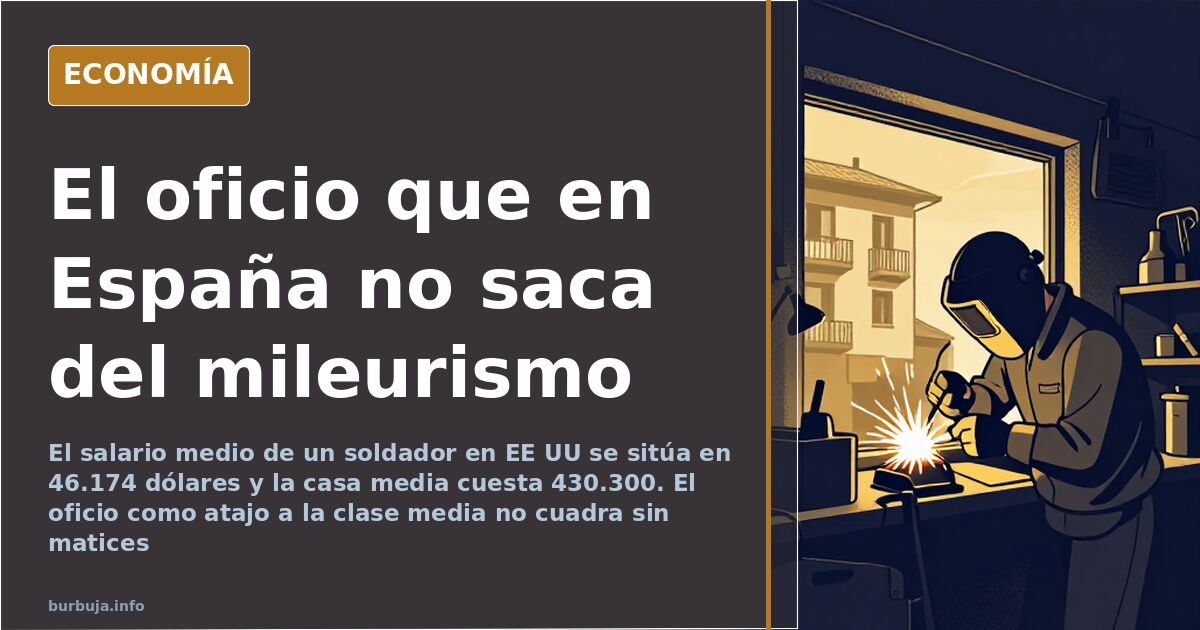
US Welder: $46,000 salary and a $430,000 house
A well-paid trade in the United States does not make you rich. And in Spain, too often, it fails to lift you out of the "mileurismo" (one-thousand-euro) struggle. The comparison between the two labor markets—welders, electricians, plumbers, and oil and gas field specialists—is driven by those who analyze their paychecks with a calculator, and the results discomfort more than the brochures promise. Blue-collar work, short practical training, zero university debt, and sustained demand: that is the ideal being sold. The fine print appears when placing the salary next to the price of housing.
How much does a welder earn in the United States?
The average salary of a welder in the United States stands at around $46,174, with a range from $41,086 to $52,889, according to the data used in the comparison, dated September 25, 2023. The figure is presented as proof of the trade's paradise. The problem is the number that trinc: the average US home costs $430,300. Dividing one figure by the other returns a less epic picture: nearly a decade of full gross salary to pay for an ordinary house, without deducting taxes, health insurance, or mortgage interest, which, according to the debate, hovered around 7%.
The real cost of a Spanish employee
A calculation that reappears again and again to explain why paychecks do not rise: a net salary of €2,500 per month costs the employer slightly more than €4,000, because around 60% of what is paid for that worker is kept by the State in contributions and taxes. The estimate does not come from any official body; it is the circulating account, but it sets the tone of anger. With these premises, the business conclusion is always the same: hiring more people is a luxury.
The contrast with neighbors is used as ammunition: €1,000 for flipping burgers here and $1,600 for the same, with fewer hours, in a neighboring country with a higher tax burden. This should be taken for what it is, a rough comparison that ignores productivity, collective agreements, and sectors, but explains why the conversation constantly revolves around the Minimum Interprofessional Salary (SMI).
Why does a trade in Spain not lift you out of being a "mileurista"?
The repeating narrative is devastating in its monotony: a medium or higher vocational training (FP) degree where little is learned, theory that is forgotten, and workshops with obsolete equipment; then, three months of unpaid internships in a declining industrial park; and finally, if lucky, a position paying €1,200 to €1,500 for life with 50-60 hour workweeks. No career, no projects, no horizon. Those who recount this usually add the same kicker: that entering a public railway company for €1,300-1,500 is seen as a steal says much about the rest of the market.
The complaint has a clear target: the idea that having studied something—anything—turns the manual worker into a second-class citizen. "In Spain, the business is education, not having a profession," summarizes one of the circulating theses, pointing to a system that issues degrees in four years and leaves the new graduate just as lost as someone who never stepped into a university.
The American reverse: mortgages, health insurance, and housing ratio
The defense of the US model also receives its correction. In the United States, there are 130 million homes for 340 million inhabitants; in Spain, 26 million for 48 million. The first ratio is worse on paper, and this is compounded by a higher percentage of homes with unpaid mortgages. Health insurance costs around $1,000 per month, and an appendicitis without coverage is resolved by selling assets, if there are assets.
Add substance abuse as an escape valve. The claim that 60% of workers in any Spanish industrial park depends on stimulants or marijuana is a rough estimate launched without data to back it up, and cannot be taken as fact. Alcohol and tobacco do appear in the debate as the daily toll of the long shift, here and there.
Two schools, two ways of teaching
The criticism of the Spanish training system is concretized in a comparison that summarizes the discontent: in the United States, the teacher simplifies and teaches; here, they complicate the simple and deliberately make it difficult for the student to pass. There, one is evaluated to work; here, to obtain a piece of paper. A part of the analysis calls for intensive six-month courses, eminently practical, instead of four years of notes thrown in the trash upon completion.
The demographic decline closes the circle: in two decades, Spain went from 38 to 48 million inhabitants without the productive structure keeping pace. More people competing for the same precarious jobs and added pressure on housing.
With these premises, everything points to the demand for intensive vocational training and paid internships continuing to rise on the agenda. Although no one has yet demonstrated that the trade, by itself, is enough to pay for two houses before thirty.
A well-paid trade in the United States does not make you rich. And in Spain, too often, it fails to lift you out of the "mileurismo" (one-thousand-euro) struggle. The comparison between the two labor markets—welders, electricians, plumbers, and oil and gas field specialists—is driven by those who analyze their paychecks with a calculator, and the results discomfort more than the brochures promise. Blue-collar work, short practical training, zero university debt, and sustained demand: that is the ideal being sold. The fine print appears when placing the salary next to the price of housing.
How much does a welder earn in the United States?
The average salary of a welder in the United States stands at around $46,174, with a range from $41,086 to $52,889, according to the data used in the comparison, dated September 25, 2023. The figure is presented as proof of the trade's paradise. The problem is the number that trinc: the average US home costs $430,300. Dividing one figure by the other returns a less epic picture: nearly a decade of full gross salary to pay for an ordinary house, without deducting taxes, health insurance, or mortgage interest, which, according to the debate, hovered around 7%.
The real cost of a Spanish employee
A calculation that reappears again and again to explain why paychecks do not rise: a net salary of €2,500 per month costs the employer slightly more than €4,000, because around 60% of what is paid for that worker is kept by the State in contributions and taxes. The estimate does not come from any official body; it is the circulating account, but it sets the tone of anger. With these premises, the business conclusion is always the same: hiring more people is a luxury.
The contrast with neighbors is used as ammunition: €1,000 for flipping burgers here and $1,600 for the same, with fewer hours, in a neighboring country with a higher tax burden. This should be taken for what it is, a rough comparison that ignores productivity, collective agreements, and sectors, but explains why the conversation constantly revolves around the Minimum Interprofessional Salary (SMI).
Why does a trade in Spain not lift you out of being a "mileurista"?
The repeating narrative is devastating in its monotony: a medium or higher vocational training (FP) degree where little is learned, theory that is forgotten, and workshops with obsolete equipment; then, three months of unpaid internships in a declining industrial park; and finally, if lucky, a position paying €1,200 to €1,500 for life with 50-60 hour workweeks. No career, no projects, no horizon. Those who recount this usually add the same kicker: that entering a public railway company for €1,300-1,500 is seen as a steal says much about the rest of the market.
The complaint has a clear target: the idea that having studied something—anything—turns the manual worker into a second-class citizen. "In Spain, the business is education, not having a profession," summarizes one of the circulating theses, pointing to a system that issues degrees in four years and leaves the new graduate just as lost as someone who never stepped into a university.
The American reverse: mortgages, health insurance, and housing ratio
The defense of the US model also receives its correction. In the United States, there are 130 million homes for 340 million inhabitants; in Spain, 26 million for 48 million. The first ratio is worse on paper, and this is compounded by a higher percentage of homes with unpaid mortgages. Health insurance costs around $1,000 per month, and an appendicitis without coverage is resolved by selling assets, if there are assets.
Add substance abuse as an escape valve. The claim that 60% of workers in any Spanish industrial park depends on stimulants or marijuana is a rough estimate launched without data to back it up, and cannot be taken as fact. Alcohol and tobacco do appear in the debate as the daily toll of the long shift, here and there.
Two schools, two ways of teaching
The criticism of the Spanish training system is concretized in a comparison that summarizes the discontent: in the United States, the teacher simplifies and teaches; here, they complicate the simple and deliberately make it difficult for the student to pass. There, one is evaluated to work; here, to obtain a piece of paper. A part of the analysis calls for intensive six-month courses, eminently practical, instead of four years of notes thrown in the trash upon completion.
The demographic decline closes the circle: in two decades, Spain went from 38 to 48 million inhabitants without the productive structure keeping pace. More people competing for the same precarious jobs and added pressure on housing.
With these premises, everything points to the demand for intensive vocational training and paid internships continuing to rise on the agenda. Although no one has yet demonstrated that the trade, by itself, is enough to pay for two houses before thirty.
Also available in: Deutsch
Summary of a discussion on Burbuja.info - Foro de economía, actualidad y política., translated from Spanish and reviewed before publication. Read the full discussion (319 replies).
More summaries
-
Trump Announces US Takes Control of Venezuela, No Casualties Reported
Donald Trump declares US control over Venezuela to secure oil and rebuild infrastructure, claiming zero military casualties. Analysis covers costs, reserves, and geopolitical parallels with Ukraine.
-
Trump Announces Total Strait of Hormuz Blockade Amid Rising Geopolitical Tensions
Trump declares a total blockade on ships in the Strait of Hormuz. Analysis of the geopolitical escalation and its implications for oil prices.
-
More housing won't lower prices if population keeps growing
A forum user argues that building more homes won't reduce prices if population growth continues, challenging Spain's expansion model.
-
Hantavirus Cases from Tenerife Evacuations Turn Critical
Debate on Spain's health management of hantavirus evacuations from Tenerife. Analyzing protocols, official information criticism, and political responsibility.
-
Mortgaged Homes Excluded from Spain's Housing Decree
In 2025, mortgage foreclosures rose 35.6% to 31,416. Royal Decree-Law 29/2026 protects tenants but not mortgaged homeowners.
-
Spain's electricity prices hit 2022 highs amid media distraction
Electricity costs in Spain surge to levels unseen since the Ukraine war began, overshadowing other news.