
Bitcoin Breaks 100,000 Euros: Speculation or New Reserve Asset
Bitcoin surpasses 100,000 euros. We analyze whether it is a tulip bubble or digital capital, the tax risk, and the reality of reserves.
English · Original discussion in Spanish · Published
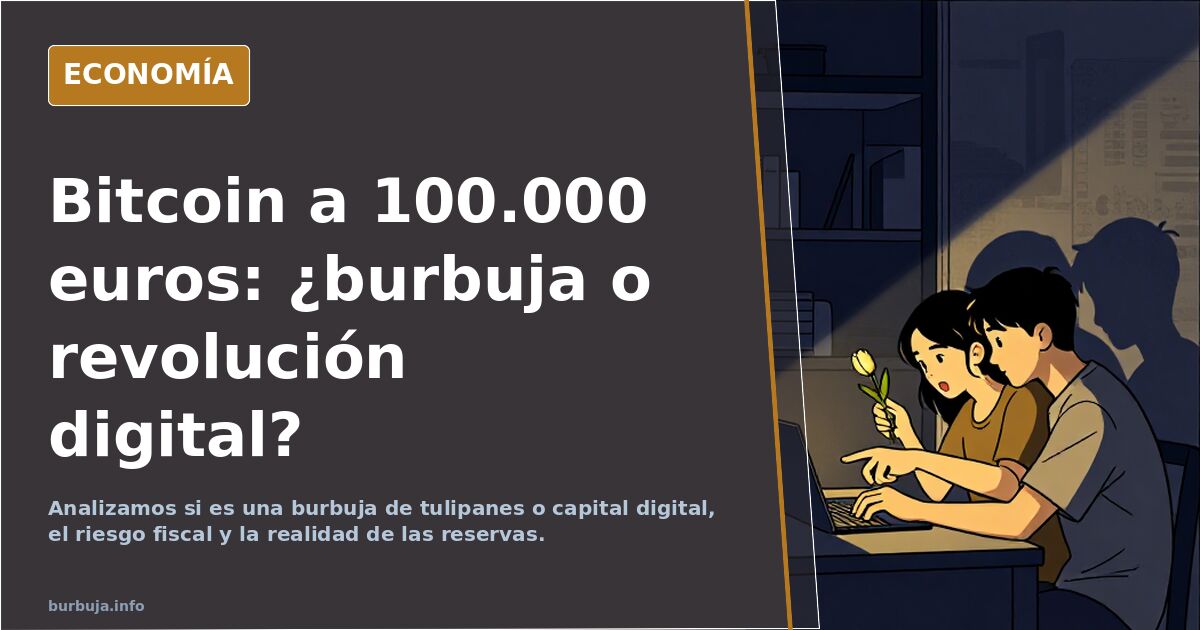
Bitcoin Breaks 100,000 Euros: Speculation or New Reserve Asset
Is Bitcoin a store of value or history's biggest bubble? With the price exceeding 100,000 euros, the economic community is divided between those seeing "digital capital" and those warning of modern "tulip mania." A milestone that has polarized debates on the nature of digital assets, taxation, and real utility versus pure speculation.
The Reality of 19.8 Million Bitcoins
Bitcoin's supply is finite, but circulation reality is complex. 19.8 million bitcoins have been mined, nearing the technical limit of 21 million. However, real availability is lower. Between 15% and 20% of bitcoins are permanently lost because owners forgot their private keys. This leaves an effective circulating supply well below the theoretical 21 million, which some analysts consider an artificial scarcity factor sustaining the price.
The value in dollars or euros is considered anecdotal by some sectors, who argue that 1 bitcoin will always equal 100 million Satoshis. For them, fluctuation in fiat currency is secondary to the technical unit of account. Nevertheless, brutal volatility has led many to consider it a high-risk investment asset, rather than a stable currency for daily use.
The Debate Between Real Utility and Pure Speculation
Using Bitcoin for daily payments remains an infinitesimal percentage compared to its speculative value. Some argue volatility prevents its use as a conventional payment medium. The anecdote of the pizza bought for 10 dollars when bitcoin was worth 10 dollars is mentioned, recalling the opportunity cost of not having held it. For many, buying goods with Bitcoin when the price is low is a financial error, as future revaluation exceeds the value of the acquired good.
Nevertheless, mechanisms exist to mitigate volatility. Cards like VISA that automatically convert cryptoassets to euros for the seller are cited, eliminating fluctuation limits for merchants. Platforms like Bitrefill allow direct purchases. However, the volume of these transactions is marginal compared to speculative volume. Most participants operate on exchanges, buying and selling hoping to multiply their capital, not to acquire goods.
Tether, Fractional Reserves, and Tax Risk
The traditional financial system is frequently compared to cryptocurrencies. The anecdote of Tether is highlighted, where an operator tried to redeem 17 billion USDT at once to break the issuer, only to receive his money days later. This is interpreted as a defense of Tether's solidity against fractional reserve theory. Meanwhile, the fiat system is criticized for its fractional reserve, arguing that M0 represents less than 2% of the money supply.
Tax risk is an undeniable reality. Tax authorities monitor operations. Gains are subject to income tax and, in cases of large wealth, to the Wealth Tax. There is no real anonymity on regulated exchanges like Bit2Me, audited by the Bank of Spain. Gains are declared and taxes paid. Those who entered recently and multiplied their money receive letters from tax authorities claiming their share. Lack of fiscal knowledge can lead to severe fines, dismantling the illusion of "free money."
The buyer needs "steel balls" to withstand downturns. If it rises fast, it falls fast. The risk of going to zero is always present. Those buying now can benefit greatly like major investors, but must accept they might drop to 70,000 euros and still operate. Those who refuse to understand this continue rowing in their bank's perversos salary.
Also available in: Deutsch
Summary of a discussion on Burbuja.info - Foro de economía, actualidad y política., translated from Spanish and reviewed before publication. Read the full discussion (233 replies).
More summaries
-
Bitcoin panic: freefall sparks fears of mass ruin
Bitcoin is plunging toward $3,000, triggering panic among leveraged investors. A wave of suicides is feared while gurus like Michael Saylor…
-
Spain's housing market: the end of the safe investment myth
Spain's housing market faces a historic collapse as oversupply, inflation and weakened demand make current prices unsustainable.
-
Italy: diesel hits 3 euros as truckers' protests bring traffic to a halt
Diesel is nearing 3 euros on Italian motorways, trucks are blocking roads and supermarkets in southern Italy are emptying out. In Turin, police used tear gas against students.
-
Abascal tells his voters that "Morocco is a nation we must get along with"
Strategic pivot or betrayal? We analyse Santiago Abascal's controversial U-turn on Morocco and the heated debate it has sparked on the forum.
-
New hantavirus vaccine: sit down, get it free, cured on the spot — or is it a scam?
Is the new hantavirus vaccine a real threat or a control strategy? We break down the debate over its origin, veracity and possible risks.
-
Plastic surgeon shot dead in his Marbella clinic
A 57-year-old plastic surgeon was shot dead in his Marbella clinic. The attacker fled on a motorbike through streets with no cameras until reaching the N-340 road.