
Birth rates, pensions and immigration: the debate elites refuse to have
The claim that mass immigration stems from conservative low birth rates clashes with one fact: that group is only 10% of the population. The debate…
English · Original discussion in Spanish · Published
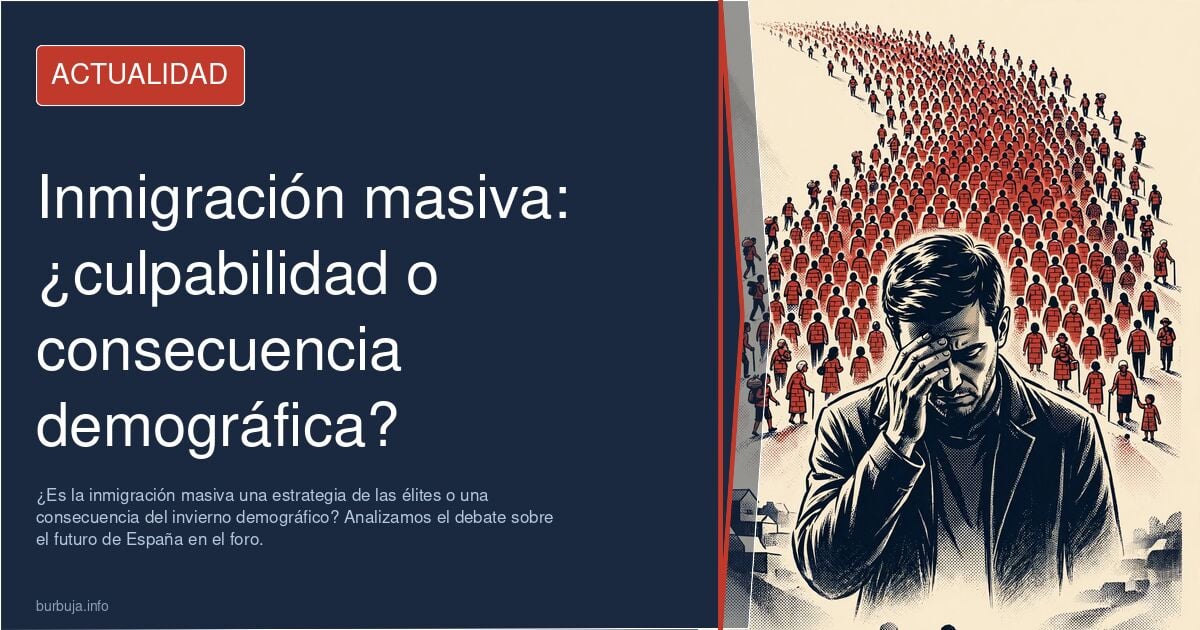
Birth rates as an alibi: why replacement is not just a theory
A crude calculation is doing the rounds online: if the birth rate in conservative households is around 0.5 children per woman and that of pogre voters is close to 1.5 — both below the replacement threshold of 2.1 — the national average lands at 0.8 or 0.9. From there, many leap to a conclusion without breaking a sweat: without new people, the pension system falls apart, and the only way to sustain it is to import young population. The elite, this line of thinking holds, does not promote mass immigration out of ideology, but out of pure actuarial arithmetic.
The problem is that the demographic premise gets mixed up with politics, and the result is a cocktail nobody can quite swallow. Because if conservatives had had more children, the argument goes, there would be no open borders. And that is where the brawl begins.
The 10% who cannot carry it all
The first objection comes quickly: traditionalists make up only around **10% of the population**, according to the figures used in the conversation. With that demographic weight, it is materially impossible for their falling birth rate alone to explain a migration phenomenon of national scale. The burden, the other side argues, falls on the **pogre lumpen** and what they dismissively call the *chav socialist* crowd, who would be the overwhelming majority. The discussion turns toxic when divorce is introduced as a factor: if they are so traditionalist, why do they get divorced? The answer given is that social pressure, the economic incentive of divorce and a legal framework perceived as favourable push towards separation even within conservative households.
Some go further and claim that the traditional conservative man does not end up in prison for gender violence or lose everything in a divorce — including custody — and that he therefore stops having children not out of whim but out of risk calculation. It is a claim thrown out with no data, and it should be taken for what it is: a bar-stool hypothesis.
The pensions hole: a scheme that needs young people
Beyond the identity noise, the heart of the matter is economic. Spain's pension system was designed as a **textbook pyramid scheme**: current workers finance retirees' benefits. With an ageing society and a contributor-to-pensioner ratio that keeps deteriorating, the racket needs constant contributions. Immigration is the fastest way to fatten the base.
The debate over the private model does not solve anything either, it is pointed out: in the United States private pensions worked because industrial jobs allowed people to save, something that today is not guaranteed there or here. The conclusion drawn is uncomfortable: the problem is not who pays, but that fewer and fewer people can pay.
Four million births and an empty Spain
Amid the crossfire, a concrete demographic calculation appears. If the ethnically Spanish population — some **42 million** out of a total of 48 — recorded 4 million births a year, the differential equation dP/dt = 4,000,000 - 0.0095·P would yield a stationary equilibrium of some **421 million** inhabitants. By 2100, the exponential takes off. The exercise is theoretical, but it shows that the figures used in the discussion are not mere impressions: someone actually bothers to solve the integral.
The reply is not long in coming: Spain is *ing empty* and could support that population. Japan has twice the inhabitants on less territory and still has room to spare. The problem is not capacity, but will.
In the end, the discussion drifts towards the electoral system and democracy itself. Some argue the problem is not voting badly, but that voting is possible at all: if you let grandma decide about your payslip, she will vote to squeeze it. Fifty years on, there is still no consensus on the diagnosis. And the unsettling fact is this: while people argue over whether the blame lies with conservatives, pogre or the system, the birth rate remains below 1.5 and pensions still need young people to pay for them. Nobody has solved the integral.
Also available in: Deutsch
Summary of a discussion on Burbuja.info - Foro de economía, actualidad y política., translated from Spanish and reviewed before publication. Read the full discussion (29 replies).
More summaries
-
Spain's pro-natalist rhetoric that never translates into babies
A forum debate shows how pro-natalist rhetoric clashes with reality. No law in Spain bans having children, and some point out the contradictions.
-
Fake Moon Landing Hoax Resurfaces on WikiLeaks Without Proof
Viral tweet falsely claims WikiLeaks released 17 minutes proving the 1969 moon landing was faked. No such file exists on the platform.
-
New electric cars: more trouble than a 40-year-old used car
A Renault Scenic electric owner drives 28,000 km in 9 months and suffers charging, brake and air conditioning failures. He gives the brand's service a failing grade.
-
Belgium also letting migrant boats head for the UK, video shows
A photographer films a migrant boat leaving a Belgian beach for the UK on 29 October 2026, with police present. What is the border doing?
-
No, purple hair dye does not prove a link to mental illness
A viral tweet compares 68% of mental health diagnoses among people who dye their hair unnatural colors with 26% among those who don't. Here's why the figure proves nothing.
-
Woke people have kids too: the myth falling apart at the playground
Playgrounds and judo classes are full of left-wing families. The myth that woke people don't have children clashes with the low birth rate affecting everyone.