
Birth Rate Plummets: Spain Loses Siblings, Aunts, and Cousins
Spain's birth rate is falling as housing costs and low wages delay motherhood. Fewer siblings, aunts, and cousins in each generation.
English · Original discussion in Spanish · Published
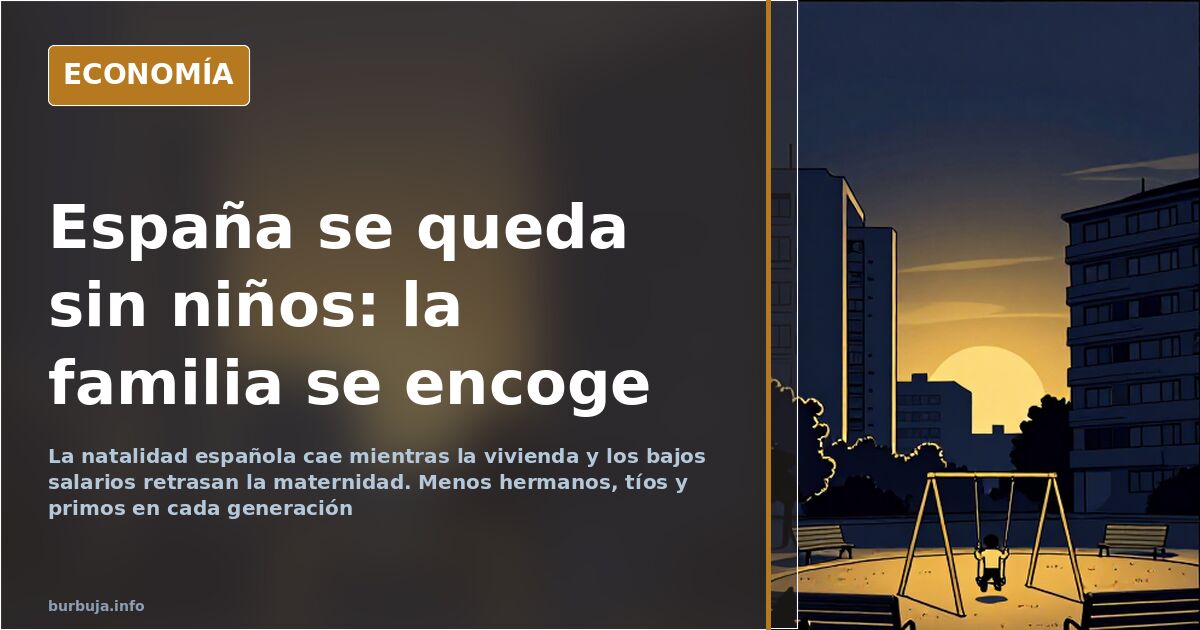
Birth Rate Plummets as Spain Loses Siblings, Aunts, and Cousins
Spain isn't losing children by chance; it's losing them because salaries, rent, and relationships are failing almost simultaneously. The decline in the birth rate is no longer a thirty-year projection that can be shelved; it's the landscape of a Christmas dinner where fewer and fewer seats are occupied. A glance at any family table reveals the problem is present, not future.
The numbers speak for themselves. It's not an impression; it's a subtraction.
From 660,000 Births a Year to 400,000
Between 1965 and 1975, Spain experienced a baby boom with around 660,000 annual births. This demographic cushion later supported pensions, schools, and weddings. Logically, if everything had gone well—stable employment, accessible housing, couples forming—the late nineties and early 2000s would have seen around 690,000 births and 310,000 marriages annually, even without considering immigration.
Reality fell far short: about 400,000 births and 200,000 weddings per year. That's the gap, and no promising data fills it. Added to this, among Spaniards in their late fifties, approximately one-third are single—people who never formed a stable partnership and won't start a family. Fewer children per couple and fewer couples: the two subtractions multiply.
Why Does Housing Act as the Best Contraceptive?
Because without a stable home, there's no long-term project. The argument repeats in every conversation and every statistic: late emancipation, salaries that don't cover the month's end, and the hurdle of rent or mortgage payments delay the decision to have children until biology no longer waits. It's joked that the best contraceptive is the price per square meter, and the joke holds up.
One detail is puzzling: the problem doesn't seem to be about money in the abstract, but about money at the specific life stage when one should reproduce. A country can be rich on average and poor for thirty-somethings. When this happens for fifteen consecutive years, the pyramid stops being a pyramid.
The Disappearance of Siblings, Aunts, and Cousins
This is the least discussed change. With one or two children per family, figures once taken for granted disappear. There are no longer siblings, aunts, uncles, or cousins, nor those village houses full of people in August. The micro-family emerges: father, mother, and one child, each unit in their own apartment, each Christmas dinner with half the attendees of twenty years ago.
The long-term consequence is loneliness in old age. The scenario many describe without exaggeration is that of elderly people dying alone in their homes, found only when the smell gives them away. Some already predict an epidemic of deaths without witnesses. Initiatives organizing Christmas dinners for people with no one at the table are the bright side of a rather grim problem.
Immigration: Two Ways of Looking at the Same Numbers
One part of the analysis argues that net migration compensates for the fall: if Spain's last thirty years of arrivals were removed, a repeated calculation suggests the country would have about 30 million inhabitants with an even lower fertility rate, around 0.7. Another perspective reads the same data in terms of substitution and warns that a growing portion of births are now to foreign mothers.
These two narratives are difficult to reconcile because they address different issues: one looks at demographic accounting, the other at identity. Demography poorly tolerates firm conclusions. The only thing both sides accept is that the country is aging and the replacement figures don't add up.
A Proposal: Parents Collect Their Children's Taxes
Among the ideas that have circulated, one breaks with the current system. It involves making parents beneficiaries of a fraction of the taxes their children will pay in the future. This way, each person's retirement would depend on their savings and their own children's contributions, not on the children of others. The goal is to correct the perverse incentive of a pay-as-you-go system where those without children still receive a pension financed by their neighbors' children.
The mechanism has an obvious flaw: if the children emigrate, the parent loses the expected share. Proponents admit the fault and point to a compensation fund for such cases, which they consider more sustainable than the current model. For now, it's a working hypothesis, not an ongoing reform.
Birth Rate Incentives Don't Move the Needle
The majority diagnosis is that current support programs are not working. And one explanation is gaining traction: birth rates are decided by women, and they make these decisions when they can fulfill their expectations, especially economic ones. In a country rich for some and poor for the generations of childbearing age, no small subsidy competes with uncertainty.
It's also worth remembering that the trend is not unique to Spain. It occurs, with varying nuances, in all developed countries. Here, an extra factor weighs heavily: the precarious labor market and expensive housing turn every pregnancy into a high-risk financial decision.
If nothing changes, the next generation will see increasingly shorter tables, inheritances not divided among siblings, and a state that must support the elderly with fewer working people. The prediction is self-fulfilling. The only thing that could alter it are decisions that no one seems willing to make today, and it's not even clear if they will come in time.
Spain isn't losing children by chance; it's losing them because salaries, rent, and relationships are failing almost simultaneously. The decline in the birth rate is no longer a thirty-year projection that can be shelved; it's the landscape of a Christmas dinner where fewer and fewer seats are occupied. A glance at any family table reveals the problem is present, not future.
The numbers speak for themselves. It's not an impression; it's a subtraction.
From 660,000 Births a Year to 400,000
Between 1965 and 1975, Spain experienced a baby boom with around 660,000 annual births. This demographic cushion later supported pensions, schools, and weddings. Logically, if everything had gone well—stable employment, accessible housing, couples forming—the late nineties and early 2000s would have seen around 690,000 births and 310,000 marriages annually, even without considering immigration.
Reality fell far short: about 400,000 births and 200,000 weddings per year. That's the gap, and no promising data fills it. Added to this, among Spaniards in their late fifties, approximately one-third are single—people who never formed a stable partnership and won't start a family. Fewer children per couple and fewer couples: the two subtractions multiply.
Why Does Housing Act as the Best Contraceptive?
Because without a stable home, there's no long-term project. The argument repeats in every conversation and every statistic: late emancipation, salaries that don't cover the month's end, and the hurdle of rent or mortgage payments delay the decision to have children until biology no longer waits. It's joked that the best contraceptive is the price per square meter, and the joke holds up.
One detail is puzzling: the problem doesn't seem to be about money in the abstract, but about money at the specific life stage when one should reproduce. A country can be rich on average and poor for thirty-somethings. When this happens for fifteen consecutive years, the pyramid stops being a pyramid.
The Disappearance of Siblings, Aunts, and Cousins
This is the least discussed change. With one or two children per family, figures once taken for granted disappear. There are no longer siblings, aunts, uncles, or cousins, nor those village houses full of people in August. The micro-family emerges: father, mother, and one child, each unit in their own apartment, each Christmas dinner with half the attendees of twenty years ago.
The long-term consequence is loneliness in old age. The scenario many describe without exaggeration is that of elderly people dying alone in their homes, found only when the smell gives them away. Some already predict an epidemic of deaths without witnesses. Initiatives organizing Christmas dinners for people with no one at the table are the bright side of a rather grim problem.
Immigration: Two Ways of Looking at the Same Numbers
One part of the analysis argues that net migration compensates for the fall: if Spain's last thirty years of arrivals were removed, a repeated calculation suggests the country would have about 30 million inhabitants with an even lower fertility rate, around 0.7. Another perspective reads the same data in terms of substitution and warns that a growing portion of births are now to foreign mothers.
These two narratives are difficult to reconcile because they address different issues: one looks at demographic accounting, the other at identity. Demography poorly tolerates firm conclusions. The only thing both sides accept is that the country is aging and the replacement figures don't add up.
A Proposal: Parents Collect Their Children's Taxes
Among the ideas that have circulated, one breaks with the current system. It involves making parents beneficiaries of a fraction of the taxes their children will pay in the future. This way, each person's retirement would depend on their savings and their own children's contributions, not on the children of others. The goal is to correct the perverse incentive of a pay-as-you-go system where those without children still receive a pension financed by their neighbors' children.
The mechanism has an obvious flaw: if the children emigrate, the parent loses the expected share. Proponents admit the fault and point to a compensation fund for such cases, which they consider more sustainable than the current model. For now, it's a working hypothesis, not an ongoing reform.
Birth Rate Incentives Don't Move the Needle
The majority diagnosis is that current support programs are not working. And one explanation is gaining traction: birth rates are decided by women, and they make these decisions when they can fulfill their expectations, especially economic ones. In a country rich for some and poor for the generations of childbearing age, no small subsidy competes with uncertainty.
It's also worth remembering that the trend is not unique to Spain. It occurs, with varying nuances, in all developed countries. Here, an extra factor weighs heavily: the precarious labor market and expensive housing turn every pregnancy into a high-risk financial decision.
If nothing changes, the next generation will see increasingly shorter tables, inheritances not divided among siblings, and a state that must support the elderly with fewer working people. The prediction is self-fulfilling. The only thing that could alter it are decisions that no one seems willing to make today, and it's not even clear if they will come in time.
Summary of a discussion on Burbuja.info - Foro de economía, actualidad y política., translated from Spanish and reviewed before publication. Read the full discussion (237 replies).
More summaries
-
El Mundo Leads with Aldama-Delcy Hydrocarbons Scheme
Spanish court investigates messages between Delcy Rodríguez and Aldama on multi-million euro oil deals linked to PSOE funding.
-
Euthanasia in Old Age: Autonomy vs. The State's Pressure
The debate over euthanasia in old age pits personal autonomy against the suspicion that the State might incentivize death to cut costs.
-
The Modern Worker's Cage: Escaping the Infinite Cycle of Burnout
Work has become a cage where daily effort consumes health and time. Discover why we push ourselves so hard and how to break the cycle.
-
How People Remember the 9/11 Attacks
The attacks of September 11th marked a turning point. Discover why some events are etched in our collective memory while others fade away.
-
Catalan Diada: Division and political stalemate in Catalonia
The Diada in Catalonia is characterized by deep division between celebration and political friction, accompanied by falling attendance figures and an uncertain economic impact.
-
Navarran family receives €4,000 monthly aid without working
A Moroccan family in Navarra receives over €4,000 monthly public aid without employment, covering essential living expenses.