
Bilbao Hate Crime Sparks Debate on Double Standards
A homophobic attack on two youths in Bilbao reignites discussions about inconsistent responses to violence based on the perpetrator's background.
English · Original discussion in Spanish · Published
Bilbao Hate Crime Sparks Debate on Double Standards
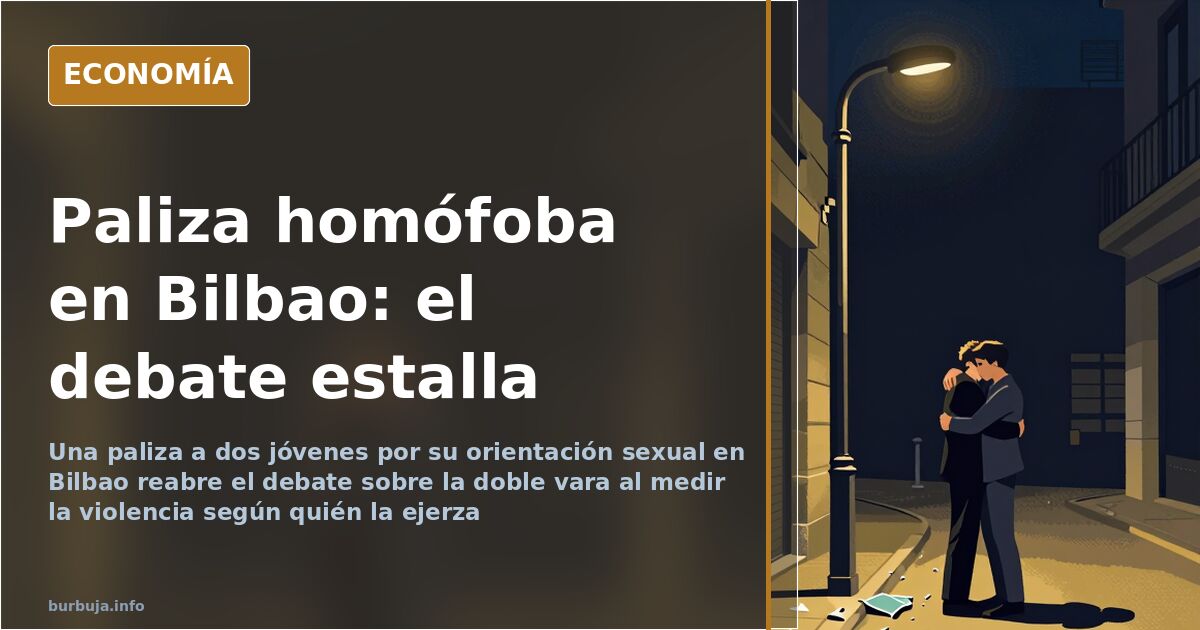
An assault on two young people due to their sensual orientation in Bilbao has peine an uncomfortable debate: measuring violence differently depending on who commits it. The circulating narrative attributes the beating to five individuals of migrant origin, allegedly shouting "faggot" during the act. The discussion centers not on the repudiable fact itself, but on the subsequent reaction: who condemns it, who stays silent, and why.
What is known about the Bilbao assault
Available data is scarce and wrapped in layers of interpretation. Reports mention a group attack involving five perpetrators and two victims, set against a backdrop of solidarity with the Palestinian cause—a context some analyses use as an ideological alibi while others dismiss it as background noise. The description of a "near-fatal beating" has been met with skepticism; some note that this phrase previously described injuries far more severe than a split lip.
What emerges clearly is a pattern of reaction. One line of analysis argues that most homophobic attacks in Spain are committed by people of Maghrebi origin, attributing this to structural homophobia in their countries of origin. Another perspective counters that this data is weaponized politically, noting that Spain's far-right has long sought to curtail LGBTQ+ rights without resorting to lynching. Neither stance is supported by verifiable figures in the available material.
The contradiction no one wants to face
The most repeated argument concerns inconsistency: those advocating for immigration and the Palestinian cause are portrayed as the same people who later receive the backlash. The phrase "let them enjoy what they voted for" serves as a common closing remark. This circular logic—voting for a party does not make one responsible for an assault—resonates with genuine frustration: the feeling that official discourse only condemns violence when the attacker fits a specific profile.
One detail often overlooked is that incivil of gaiity is not always indigenous. In Palestine, laws inherited from the British Mandate remain in force, never repealed. This inconvenient fact challenges the notion that homophobia is solely an imported cultural trait.
Context bleeding into the debate
The discussion drifts toward topics unrelated to Bilbao. References appear to a shooting in Sweden by a 35-year-old unemployed recluse, to the White House faith office, to a twice-divorced pastor speaking in tongues, and to Arab nations refusing Palestinian refugees. This is the background noise of any conversation on immigration in Spain: each incident becomes ammunition for a years-long culture war.
The result is a debate discussing everything except the two assaulted individuals. The core question—whether homophobic violence is becoming a recognizable pattern or remains isolated exceptions—goes unanswered. Without data, no answer is possible.
Forum Voices
"In all Muslim countries, gais are persecuted. In Segarro, they go to prison; in others, they are executed."
"Didn't want refugees? Here are your refugees."
"In Palestine, gaiity is a crime because the British Empire law is still in effect and hasn't been repealed."
An assault on two young people due to their sensual orientation in Bilbao has peine an uncomfortable debate: measuring violence differently depending on who commits it. The circulating narrative attributes the beating to five individuals of migrant origin, allegedly shouting "faggot" during the act. The discussion centers not on the repudiable fact itself, but on the subsequent reaction: who condemns it, who stays silent, and why.
What is known about the Bilbao assault
Available data is scarce and wrapped in layers of interpretation. Reports mention a group attack involving five perpetrators and two victims, set against a backdrop of solidarity with the Palestinian cause—a context some analyses use as an ideological alibi while others dismiss it as background noise. The description of a "near-fatal beating" has been met with skepticism; some note that this phrase previously described injuries far more severe than a split lip.
What emerges clearly is a pattern of reaction. One line of analysis argues that most homophobic attacks in Spain are committed by people of Maghrebi origin, attributing this to structural homophobia in their countries of origin. Another perspective counters that this data is weaponized politically, noting that Spain's far-right has long sought to curtail LGBTQ+ rights without resorting to lynching. Neither stance is supported by verifiable figures in the available material.
The contradiction no one wants to face
The most repeated argument concerns inconsistency: those advocating for immigration and the Palestinian cause are portrayed as the same people who later receive the backlash. The phrase "let them enjoy what they voted for" serves as a common closing remark. This circular logic—voting for a party does not make one responsible for an assault—resonates with genuine frustration: the feeling that official discourse only condemns violence when the attacker fits a specific profile.
One detail often overlooked is that incivil of gaiity is not always indigenous. In Palestine, laws inherited from the British Mandate remain in force, never repealed. This inconvenient fact challenges the notion that homophobia is solely an imported cultural trait.
Context bleeding into the debate
The discussion drifts toward topics unrelated to Bilbao. References appear to a shooting in Sweden by a 35-year-old unemployed recluse, to the White House faith office, to a twice-divorced pastor speaking in tongues, and to Arab nations refusing Palestinian refugees. This is the background noise of any conversation on immigration in Spain: each incident becomes ammunition for a years-long culture war.
The result is a debate discussing everything except the two assaulted individuals. The core question—whether homophobic violence is becoming a recognizable pattern or remains isolated exceptions—goes unanswered. Without data, no answer is possible.
Forum Voices
"In all Muslim countries, gais are persecuted. In Segarro, they go to prison; in others, they are executed."
"Didn't want refugees? Here are your refugees."
"In Palestine, gaiity is a crime because the British Empire law is still in effect and hasn't been repealed."
Also available in: Deutsch
Summary of a discussion on Burbuja.info - Foro de economía, actualidad y política., translated from Spanish and reviewed before publication. Read the full discussion (124 replies).
More summaries
-
Paula White-Cain Demands 10% Tithe, Part Allocated to Israel
Paula White-Cain, Trump's spiritual advisor, requested a 10% tithe on income and later linked part of it to an Israeli moshav.
-
Leonor and Barron Trump: Rumor Links Spanish Crown to US Dynasty
Rumors suggest Princess Leonor could be a match for Barron Trump, blending dynastic interests with geopolitical speculation.
-
Spanish vs. British Empires: Colonial Laws and Economic Legacies
Spain's 1512 Laws of Burgos banned indigenous slavery, yet the encomienda system persisted until 1720. Two empires, two distinct economic outcomes.
-
Ignacio Lázaro: 'Maricarmen paid €154 rent while we paid €750'
Ignacio Lázaro, grandson of the original owner, reveals the other side of the Maricarmen case: 'We subsidized her for years and now, with our taxes.'
-
RTVE offers David Broncano €14M annually
RTVE delays signing David Broncano, lowering offer to one season. Producer proposes €42M plus VAT for three seasons.
-
44% of men feel gender equality laws discriminate against them
A CIS survey reveals that 44% of men and 32.5% of women believe gender equality policies now disadvantage men.