
Bike Price Bubble Bursts as 30% Discounts Hit New and Used Markets
New bike discounts near 30% pressure the secondhand market, where prices have dropped 70% after just two months of use.
English · Original discussion in Spanish · Published
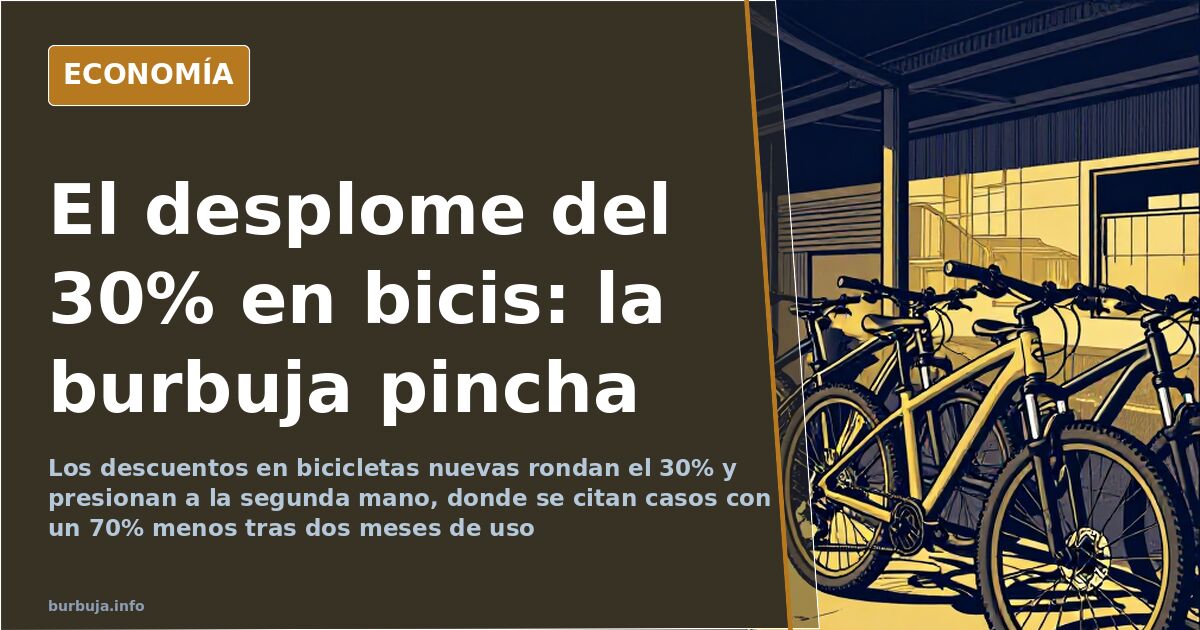
The bike bubble bursts: 30% markdowns and used market slump
The same frames. The same shops. And a new price tag every few weeks, always lower. After the pandemic, demand skyrocketed bicycle prices and emptied shelves; stores stocked up for the summer season and now compete to move accumulated inventory. Discounts circulating on social media hover around 30% off the previous price, and the secondhand market, which trinc the new one, is starting to feel the impact.
How much have new bike prices dropped?
One participant estimates sector markdowns between 30% and 40%, with occasional peaks above. Instagram has become the showcase for this clearance: ads for new discounts on high-end models that were untouched a year ago.
There is one exception to the pattern, according to another forum user. The sporting goods giant is not discounting with the same aggressiveness, costing it its old fruta for unbeatable value-for-money. The case in point: a rigid own-brand model for 2,200 euros versus an international brand one for 2,500, with virtually the same components—GX drivetrain, Reba fork—and identical weight. A 300-euro difference that multiplies when reselling.
Here lies the first sustancia ilegal. One camp argues that the premium brand wins on finishes, design, and secondhand value; the other weighs the argument that no sensible person buys a bike needing new tires and brakes right after purchase. The component breakdown, part by part, reveals a margin that surprises.
Secondhand market dragged down by new price collapse
No one pays for a used bike when they can buy new for slightly more, with warranty and no hassle. The result is a cascading adjustment: some see the opportunity in bikes with two months of use at 70% less than their original price. There is also an unverified rumor of a parallel market for units of dubious origin moving between 200 and 300 euros, pushing reference prices downward.
The asymmetry is striking. The private seller still believes they hold a treasure; the buyer looks at the shop window, sees a 30% discount, and compares. With these two references in front, the adjustment of expectations has not yet ended.
The 5,000-euro ceiling: from depreciation to showing off
Five thousand euros for a bicycle. Six thousand. Nine thousand for an electric one. These figures are the axis of disagreement, and there is no way to close it. One front argues that price is not just in the box: it counts the outlay plus maintenance, prorated year by year. Those with money, they add, spend it where they want, just as one flies business instead of tourist.
The other front uses a home calculator. That it is never amortized, that for less than the cost of a high-end bike you can pay for a snow gear set, a windsurf kit, and running shoes, and with what remains, you can travel. Some set a reasonable ceiling for a leisure bike at 150 euros and 350 or 400 for daily riders. Another bubble, they say.
The comparison with cars appears again and again, almost always poorly constructed: a secondhand economy car is placed next to a high-end bicycle, and the conclusion is that the world has gone mad. One fact is missing from that subtraction: usage. And on that, there is consensus: a 5,000-euro bike sitting in a storage room is a bad deal; the same bike with real use, no.
Electric bike or bicycle? The knot of definition
The other unresolved conflict is not about money, but identity. Electric bikes have taken over the summer: some claim that in season, more e-bikes are seen than regular bicycles. And with them comes the discussion of whether this is cycling or something else, an excellent vehicle for a specific user and a fun device, but not sport.
The numbers matter little: a legal e-mtb does not exceed 25 km/h. The risk is different, and even defenders point it out: they are fast, heavy, and forgive less than it seems if the rider is not used to pedaling. The 160-millimeter suspension or the knobby tire that would be a burden on a normal bike come free here.
Components: where the money really goes
GX drivetrain against NX. Reba fork against Judy. Mid-range brakes against the basic ones included in bikes costing thousands. This is the fine print of the sector, and explains why two bikes that look the same are not.
Above all this looms the underlying suspicion: of a sector that moves standards to keep selling. First came weight, then stiffness, then the 29-inch wheel, and along the way, the number of gears stopped mattering overnight. Those who bought the best of a decade ago do not have a bad bike: they have an old bike. These are different things.
And so it remains. A mid-range rigid international brand, discounted and still near 3,000 euros, which for its detractors is unsustainable in components; opposite, the technical equivalent of the cheap brand. The question that peine the conversation—whether the material justifies the price—remains exactly where it started.
The same frames. The same shops. And a new price tag every few weeks, always lower. After the pandemic, demand skyrocketed bicycle prices and emptied shelves; stores stocked up for the summer season and now compete to move accumulated inventory. Discounts circulating on social media hover around 30% off the previous price, and the secondhand market, which trinc the new one, is starting to feel the impact.
How much have new bike prices dropped?
One participant estimates sector markdowns between 30% and 40%, with occasional peaks above. Instagram has become the showcase for this clearance: ads for new discounts on high-end models that were untouched a year ago.
There is one exception to the pattern, according to another forum user. The sporting goods giant is not discounting with the same aggressiveness, costing it its old fruta for unbeatable value-for-money. The case in point: a rigid own-brand model for 2,200 euros versus an international brand one for 2,500, with virtually the same components—GX drivetrain, Reba fork—and identical weight. A 300-euro difference that multiplies when reselling.
Here lies the first sustancia ilegal. One camp argues that the premium brand wins on finishes, design, and secondhand value; the other weighs the argument that no sensible person buys a bike needing new tires and brakes right after purchase. The component breakdown, part by part, reveals a margin that surprises.
Secondhand market dragged down by new price collapse
No one pays for a used bike when they can buy new for slightly more, with warranty and no hassle. The result is a cascading adjustment: some see the opportunity in bikes with two months of use at 70% less than their original price. There is also an unverified rumor of a parallel market for units of dubious origin moving between 200 and 300 euros, pushing reference prices downward.
The asymmetry is striking. The private seller still believes they hold a treasure; the buyer looks at the shop window, sees a 30% discount, and compares. With these two references in front, the adjustment of expectations has not yet ended.
The 5,000-euro ceiling: from depreciation to showing off
Five thousand euros for a bicycle. Six thousand. Nine thousand for an electric one. These figures are the axis of disagreement, and there is no way to close it. One front argues that price is not just in the box: it counts the outlay plus maintenance, prorated year by year. Those with money, they add, spend it where they want, just as one flies business instead of tourist.
The other front uses a home calculator. That it is never amortized, that for less than the cost of a high-end bike you can pay for a snow gear set, a windsurf kit, and running shoes, and with what remains, you can travel. Some set a reasonable ceiling for a leisure bike at 150 euros and 350 or 400 for daily riders. Another bubble, they say.
The comparison with cars appears again and again, almost always poorly constructed: a secondhand economy car is placed next to a high-end bicycle, and the conclusion is that the world has gone mad. One fact is missing from that subtraction: usage. And on that, there is consensus: a 5,000-euro bike sitting in a storage room is a bad deal; the same bike with real use, no.
Electric bike or bicycle? The knot of definition
The other unresolved conflict is not about money, but identity. Electric bikes have taken over the summer: some claim that in season, more e-bikes are seen than regular bicycles. And with them comes the discussion of whether this is cycling or something else, an excellent vehicle for a specific user and a fun device, but not sport.
The numbers matter little: a legal e-mtb does not exceed 25 km/h. The risk is different, and even defenders point it out: they are fast, heavy, and forgive less than it seems if the rider is not used to pedaling. The 160-millimeter suspension or the knobby tire that would be a burden on a normal bike come free here.
Components: where the money really goes
GX drivetrain against NX. Reba fork against Judy. Mid-range brakes against the basic ones included in bikes costing thousands. This is the fine print of the sector, and explains why two bikes that look the same are not.
Above all this looms the underlying suspicion: of a sector that moves standards to keep selling. First came weight, then stiffness, then the 29-inch wheel, and along the way, the number of gears stopped mattering overnight. Those who bought the best of a decade ago do not have a bad bike: they have an old bike. These are different things.
And so it remains. A mid-range rigid international brand, discounted and still near 3,000 euros, which for its detractors is unsustainable in components; opposite, the technical equivalent of the cheap brand. The question that peine the conversation—whether the material justifies the price—remains exactly where it started.
Summary of a discussion on Burbuja.info - Foro de economía, actualidad y política., translated from Spanish and reviewed before publication. Read the full discussion (316 replies).
More summaries
-
Renovation Price Gouging: Inflated Costs for Minor Repairs
Construction price abuse exposed: how a small rust issue can cost thousands, with taxes inflating the real cost of home repairs.
-
Bilbao flat prices: bubble or market reality?
Analysis of Bilbao's housing crisis: why aren't protected flats selling and how does the market affect affordability?
-
Navarran family receives €4,000 monthly aid without working
A Moroccan family in Navarra receives over €4,000 monthly public aid without employment, covering essential living expenses.
-
Begoña Gerpe Jailed for Thought Crime
We analyze Begoña Gerpe's case in the forum: hate speech or judicial censorship? The debate on freedom of expression and the Penal Code.
-
Google Launches AMIE, Medical AI That Outperforms Professionals
Google launches AMIE, a medical AI that surpasses professional diagnostic capabilities. We analyze the labor impact, protocol elimination, and the future of healthcare.
-
ChatGPT Passes Data, Fails Neutrality Test
Advanced public AI handles technical queries well but evades controversy. Its knowledge stops in 2021.