
Best red wine for Spanish ham: from €8 Protos to Remelluri
Forum users recommend wines under €10, suggesting soft reds or Jerez finos instead of powerful reserves.
English · Original discussion in Spanish · Published
Red wine for jamón: why forum members advise against spending €30
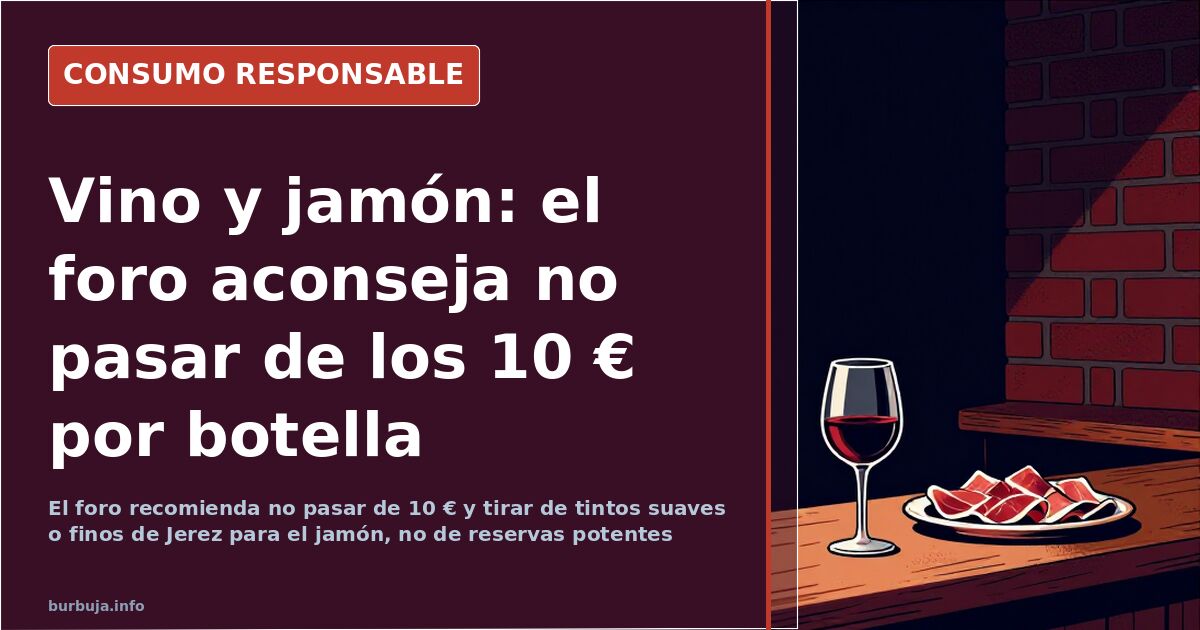
A budget of up to €30 per bottle, slices of serrano ham, and no clear idea about the wine. That is the scenario opening the query: which red wine to serve without ending up with a flavorless case? The most repeated answer was not a brand or a specific appellation, but lowering the budget. Several voices agreed that someone who cannot distinguish a Rioja from a Ribera del Duero will hardly notice the difference between a €5 bottle and a €30 one. The recurring advice was, instead, not to exceed ten euros.
The discussion ended with a concrete purchase: a Cancelar Crianza 2019, from Ribera del Duero, which the user found "very tasty" without knowing if the merit lay in the wine, the serving temperature, or the ham itself. For the next round, antiestéticaturing more ham and manchego cheese, they chose a Rioja: Lindes de Remelluri.
Does a €30 wine taste better than an €8 one?
No, at least not for beginners. As one early participant summarized, blowing €30 on a bottle when you lack criteria is wasting money, because the result will taste similar to a five-euro wine. Most responses pointed in that direction, advising against exceeding ten euros.
The specific names mentioned came with prices: a Protos at €8, El Coto or Cvne, Coto de Imaz Reserva for €8 or €9, Bajoz or Gran Bajoz, or slightly more ambitious alternatives like those from Hispano Suizas wineries and Finca la Estacada, with the warning that Finca la Borracha has risen significantly in price. The underlying argument was pedagogical: only after drinking much wine can one properly value what costs €30. Those paying that amount without having trained their palate are essentially paying for the label.
Pairing: for forum members, ham demands soft wine
Here consensus breaks. According to one participant, a full-bodied red with aroma and presence saturates the palate and masks the textures of the ham, so his recommendation was to lean towards soft wines: a crianza from Ribera del Arlanza or a Rioja crianza with 70% tempranillo and 30% merlot. A dry Jerez wine was also proposed to avoid loading the tongue and arriving clean to the bite.
With real high-quality ham, another voice nuanced, even a Rioja reserva works, but served carefully so as not to crush the food. And a third warning: never pay €500 for a bottle—its actual price, he said—because it adds no taste to the wine. The comparison with a Don Simón juice box was used precisely to exaggerate that distance.
Jerez and Montilla: the choice of part of the forum
The most concrete path regarding names and prices was via finos and olorosos. Mentioned were Fino Cebolla by Bodegas El Monte, Cancionero de Baena by Jesús Nazareno, Fino Saavedra by Maillo, Segunda Bota and Tertulia by Delgado, and Fino Platino by Sociedad de Plateros, all intended for ibérico ham and cured meats from the Valle de los Pedroches. All with a caveat: these are high-alcohol wines requiring moderation.
As an easy option to find on any shelf, an oloroso Alfonso by González Byass, around €10. One participant closed with this reflection: pairing cured meats with manzanilla, fino, amontillado, palo cortado, or oloroso is customary in southern Spain, while in other regions it is viewed as old-fashioned, leading people to choose new-oak reds that some find more astringent than sandpaper. A dinner of Navarros clarete with Jabugo ham, remembered from a year of university entrance exams, closed the chapter.
From Cancelar to Remelluri: what was actually bought
The resolution of the case has its own judgment. The Cancelar delivered, though without a point of comparison. The Lindes de Remelluri Viñedos de Labastida 2019 arrived later, drawing nuances from a forum member: both were "supermarket reservas," correct but uninteresting, until Telmo returned to Remelluri and turned everything upside down. Now the Remelluri reserva scores 94 to 95 points in guides and 93+ from Parker, a score this participant considers brutal for its price range, noting that due to inflation, wines that cost €18 now hover around €22. Some buy them by the case; others warn that Cancelar and Remelluri have nothing to do with each other.
Why paying more doesn't always buy something better, according to forumers
With large wineries, volume says almost everything. A producer exceeding one million bottles and buying much of the grapes from third parties signs correct wines—88 or 89 points—without anyone expecting more. One step above is Luis Cañas, also using purchased grapes but with more care in barrel aging and selection. At the opposite extreme, wineries with huge investment and short catalogs: around 300,000 bottles total, about 50,000 of the reserva, and references below 5,000 per vintage, within an international group. In that tier, vintages change the result significantly.
The technical explanation given is key: controlled-temperature fermentations avoiding stubborn wines, commercial yeasts and tannins, oak chips to simulate aging, and acidity correctors. This allows producing much and uniformly; the price is that ultimately many wines taste the same. A participant recalled that there are competitions awarding gold medals to €3 wines, arguing against trusting them.
The anecdote that summarizes the paradox
There is a case that explains this better than any catalog. Someone who had never paid more than €5 for a bottle tried, because it was gifted, a Marqués de Griñón Summa Varietalis. It wasn't acidic, entered smoothly, and seemed different. It was, he recounts, "a before and after" and the trigger to start discovering wine. From then on, what has convinced him most while training his palate are Toro wines.
With these elements, the enthusiast asking about a bottle up to €30 ended up with a Cancelar Crianza 2019 he found "very tasty" and a Lindes de Remelluri for the next round of ham and manchego cheese.
A budget of up to €30 per bottle, slices of serrano ham, and no clear idea about the wine. That is the scenario opening the query: which red wine to serve without ending up with a flavorless case? The most repeated answer was not a brand or a specific appellation, but lowering the budget. Several voices agreed that someone who cannot distinguish a Rioja from a Ribera del Duero will hardly notice the difference between a €5 bottle and a €30 one. The recurring advice was, instead, not to exceed ten euros.
The discussion ended with a concrete purchase: a Cancelar Crianza 2019, from Ribera del Duero, which the user found "very tasty" without knowing if the merit lay in the wine, the serving temperature, or the ham itself. For the next round, antiestéticaturing more ham and manchego cheese, they chose a Rioja: Lindes de Remelluri.
Does a €30 wine taste better than an €8 one?
No, at least not for beginners. As one early participant summarized, blowing €30 on a bottle when you lack criteria is wasting money, because the result will taste similar to a five-euro wine. Most responses pointed in that direction, advising against exceeding ten euros.
The specific names mentioned came with prices: a Protos at €8, El Coto or Cvne, Coto de Imaz Reserva for €8 or €9, Bajoz or Gran Bajoz, or slightly more ambitious alternatives like those from Hispano Suizas wineries and Finca la Estacada, with the warning that Finca la Borracha has risen significantly in price. The underlying argument was pedagogical: only after drinking much wine can one properly value what costs €30. Those paying that amount without having trained their palate are essentially paying for the label.
Pairing: for forum members, ham demands soft wine
Here consensus breaks. According to one participant, a full-bodied red with aroma and presence saturates the palate and masks the textures of the ham, so his recommendation was to lean towards soft wines: a crianza from Ribera del Arlanza or a Rioja crianza with 70% tempranillo and 30% merlot. A dry Jerez wine was also proposed to avoid loading the tongue and arriving clean to the bite.
With real high-quality ham, another voice nuanced, even a Rioja reserva works, but served carefully so as not to crush the food. And a third warning: never pay €500 for a bottle—its actual price, he said—because it adds no taste to the wine. The comparison with a Don Simón juice box was used precisely to exaggerate that distance.
Jerez and Montilla: the choice of part of the forum
The most concrete path regarding names and prices was via finos and olorosos. Mentioned were Fino Cebolla by Bodegas El Monte, Cancionero de Baena by Jesús Nazareno, Fino Saavedra by Maillo, Segunda Bota and Tertulia by Delgado, and Fino Platino by Sociedad de Plateros, all intended for ibérico ham and cured meats from the Valle de los Pedroches. All with a caveat: these are high-alcohol wines requiring moderation.
As an easy option to find on any shelf, an oloroso Alfonso by González Byass, around €10. One participant closed with this reflection: pairing cured meats with manzanilla, fino, amontillado, palo cortado, or oloroso is customary in southern Spain, while in other regions it is viewed as old-fashioned, leading people to choose new-oak reds that some find more astringent than sandpaper. A dinner of Navarros clarete with Jabugo ham, remembered from a year of university entrance exams, closed the chapter.
From Cancelar to Remelluri: what was actually bought
The resolution of the case has its own judgment. The Cancelar delivered, though without a point of comparison. The Lindes de Remelluri Viñedos de Labastida 2019 arrived later, drawing nuances from a forum member: both were "supermarket reservas," correct but uninteresting, until Telmo returned to Remelluri and turned everything upside down. Now the Remelluri reserva scores 94 to 95 points in guides and 93+ from Parker, a score this participant considers brutal for its price range, noting that due to inflation, wines that cost €18 now hover around €22. Some buy them by the case; others warn that Cancelar and Remelluri have nothing to do with each other.
Why paying more doesn't always buy something better, according to forumers
With large wineries, volume says almost everything. A producer exceeding one million bottles and buying much of the grapes from third parties signs correct wines—88 or 89 points—without anyone expecting more. One step above is Luis Cañas, also using purchased grapes but with more care in barrel aging and selection. At the opposite extreme, wineries with huge investment and short catalogs: around 300,000 bottles total, about 50,000 of the reserva, and references below 5,000 per vintage, within an international group. In that tier, vintages change the result significantly.
The technical explanation given is key: controlled-temperature fermentations avoiding stubborn wines, commercial yeasts and tannins, oak chips to simulate aging, and acidity correctors. This allows producing much and uniformly; the price is that ultimately many wines taste the same. A participant recalled that there are competitions awarding gold medals to €3 wines, arguing against trusting them.
The anecdote that summarizes the paradox
There is a case that explains this better than any catalog. Someone who had never paid more than €5 for a bottle tried, because it was gifted, a Marqués de Griñón Summa Varietalis. It wasn't acidic, entered smoothly, and seemed different. It was, he recounts, "a before and after" and the trigger to start discovering wine. From then on, what has convinced him most while training his palate are Toro wines.
With these elements, the enthusiast asking about a bottle up to €30 ended up with a Cancelar Crianza 2019 he found "very tasty" and a Lindes de Remelluri for the next round of ham and manchego cheese.
Also available in: Deutsch
Summary of a discussion on Burbuja.info - Foro de economía, actualidad y política., translated from Spanish and reviewed before publication. Read the full discussion (138 replies).
More summaries
-
Study links half a glass of wine daily to obesity
A Korean study presented at the ECOICO congress finds that exceeding 7 grams of alcohol daily raises the risk of obesity and metabolic syndrome.
-
The €3.61 Fee Killing AliExpress Purchases
The €3.61 per-category tariff has inflated AliExpress purchases by up to 80%. Consumers are stopping buys, and revenue is falling. Does it actually protect...
-
Decathlon sells second-hand underwear 'expert-checked'
Decathlon offers used underwear, claiming expert inspection and cleaning. The paradox: hygiene rules forbid returns but allow resale.
-
The aesthetic war against the trends defining this decade
Tattoos, reggaeton, scooters and a degraded language: the catalog of trends dividing generations and sparking debate on social decline.
-
eBay sellers flee amid 20% fees and low sales
Private eBay sellers report commissions up to 20%, plus VAT and international fees, eroding margins on second-hand goods.
-
Dacia plans €20,000 compact to rival SEAT León
Dacia aims to launch a €20,000 compact in 2026, challenging the SEAT León and splitting the car market with its aggressive pricing.